

Overview
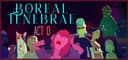
Prairie towns rarely die in one blow. They thin out, they shutter, and eventually somebody proposes a party big enough to turn things around. Boreal Tenebrae Act 0: Sundowning opens on that act of civic desperation. Tamarack Narrows, a fading northern prairie town, is staging a centennial celebration to save itself. Over one night, the festivities collapse into disaster after a mysterious visitor arrives promising salvation. The story follows Sarah Walker, her sister Bree, and residents including Nicole and Sam as the night comes apart.
The game comes from Snot Bubbles Productions, and its label needs some explaining: it is a standalone prequel to Boreal Tenebrae Act I. “Act 0” sounds like homework for existing fans, but the game is built so newcomers can start here. That makes it the logical front door to the series.
It sits where two crowded indie scenes meet:
- Analog horror: the format of degraded tapes, broadcast glitches and footage that looks wrong.
- The PSX revival: low-poly 3D and wobbly textures borrowed from late-1990s consoles.
Sundowning folds both into a narrative adventure with fixed-camera exploration, interactive dialogue, puzzles and some combat, including boss fights. Its themes are bigger than its price: community, class struggle and cosmic intrusion, all under a crimson aurora. Content warnings cover disturbing imagery, violence and substance references.
The pricing is aggressive. The game is a paid release for Steam and Nintendo Switch, dated July 30, 2026 and priced at $5.99. It is single-player and English-only.
Early Steam feedback points in one direction: the PSX-style visuals, especially the orange skies, the tense small-town atmosphere and the mysterious writing draw comparisons to Lynch and Lovecraft. The same feedback points fans of Oxenfree and NORCO toward it, while complaints cluster on the gameplay side. That split, strong storytelling held back by shaky mechanics, matches what the design suggests.
Key features
- Fixed-camera exploration: Set camera angles frame each scene, from liquor stores to church basements, in the style of late-1990s survival horror.
- Analog media built into play: CRT distortion, VHS noise and infrared footage are part of how the game plays, layered over PSX-style models and lo-fi video textures.
- Dialogue, puzzles and combat: Interactive conversations carry the story. Puzzles and fights, including boss encounters, supply the obstacles.
- One night, one town: The whole story covers a single night in Tamarack Narrows, built around two sisters and the community around them.
- GUIDEWIRE soundtrack: A score that swings between nostalgic warmth and unsettling dissonance.
- Standalone prequel: No knowledge of Boreal Tenebrae Act I required.
Analysis
Story and Structure
Setting everything on one night is a smart limit for a game at this price. It forces the story to escalate: the town starts in celebration and ends in crisis, so every location has to push that slide forward. There is little room for filler when the clock only runs until dawn.
The premise is also more pointed than most horror setups. A town throwing a centennial to save itself is really fighting for its economic survival, and a stranger promising salvation fits neatly into that desperation. Add the stated themes of class struggle and community, and the setup reads as a parable about what struggling places will accept from outsiders when the alternative is disappearing. The cosmic-horror layer, with its crimson aurora and “intrusion,” gives that social anxiety a supernatural shape.
Steam users compare the writing to Lynch and Lovecraft, and on paper the pairing fits:
- Lynch for small-town surrealism
- Lovecraft for the intrusion from outside
We read those comparisons as hints about tone, not proof of equal craft.
The cast is built sensibly. Centering the story on two sisters, Sarah and Bree, gives a town-wide catastrophe a personal stake. Residents like Nicole and Sam widen the view to the community the themes are about.
The Analog Effects
The most interesting design choice is making CRT distortion, VHS noise and infrared footage part of the play. This turns the look into a layer of information. When the image degrades, flickers or switches to infrared, the player’s ability to read the scene becomes part of the tension. That ties the late-1990s aesthetic to the experience instead of leaving it as wallpaper.
It also carries risk. A visual style built on degradation and puzzles built on spotting details pull in opposite directions. Steam users single out one required puzzle as confusing because of hidden elements. Whatever the exact cause, a mandatory obstacle that depends on noticing something obscured is a poor fit for an audience that came for the story. In a game deliberately this murky, puzzles on the main path need to be clearer, not less clear.
Sound
Steam users single out the sound design, and the soundtrack description explains the appeal. GUIDEWIRE’s score moves between nostalgic warmth and unsettling dissonance, which mirrors the story: a hometown celebration that sours into catastrophe. In horror built on dread rather than jump scares, audio does much of the work, and this is where Sundowning appears strongest.
Combat and Bosses
Combat is the weak link, and the design explains why. Fixed cameras give framed, cinematic shots for exploration and dread. They have always been awkward for fighting, because the player can’t control the angle threats approach from.
Steam users call the combat clunky and flag one boss that takes too long to defeat. In a story-first game, a drawn-out boss hurts pacing as much as mechanics. It parks the narrative while the player grinds through a fight.
Including combat at all is defensible. Horror with no threat to the player risks becoming a walking tour, and boss fights mark the night’s escalation. The idea holds up. By player accounts, the execution does not.
Timing and Missable Progress
The most serious complaint is also the quietest. Steam users describe strict timing around item exchanges, with a missed exchange able to force a replay. In a short adventure a replay costs little time, but the principle is wrong for the genre. A story game where one missed exchange can force a restart punishes the lingering over dialogue and scenery that it otherwise encourages. Clearer signposting or a safety net would cost little and spare players the restart.
Length and Polish
Length is short enough that a replay costs little time, but friction can inflate the time spent stuck. An opaque puzzle, a long boss fight and a possible forced replay can each add real time. At $5.99, the price is low, but the open question is how much of the experience is story and how much is time spent stuck.
Visuals & performance
The art direction commits fully to its references. PSX-style models and lo-fi video textures make Tamarack Narrows look recovered from an old tape rather than freshly rendered.
Steam users keep coming back to the orange skies, and that choice makes sense. A saturated, wrong-colored sky is a cheap and powerful signal that something is off, and it reads clearly even through low-poly geometry.
The locations help too. Liquor stores and church basements are the ordinary interiors of small-town life, and low-fidelity rendering makes them uncanny without any monster on screen.
The trade-off is readability. Fixed camera shots give the developer full control over composition, which suits horror. Layering CRT distortion and VHS noise on top means important details compete with deliberate visual clutter. That is worth keeping in mind given the hidden-element puzzle complaint.
On performance, PSX-era geometry and low-resolution textures are light on hardware by design. Full-screen distortion and video-texture effects are the likelier cost, but a game of this scope should not be demanding on either platform.
Platform nuances
Boreal Tenebrae Act 0: Sundowning is a paid release for Steam and Nintendo Switch, dated July 30, 2026 and priced at $5.99. The publisher is Snot Bubbles Productions.
- Steam: The original release and the only version with early player feedback to draw on. Fixed-camera adventures descend from console design built around a gamepad, so the format suits controller play.
- Nintendo Switch: The same single-player, English-only package. Handheld mode is a natural home for a deliberately low-resolution look. The dense CRT and VHS effects, and any puzzle that relies on spotting obscured details, may be harder to read on a small screen.
- Shared ground: Both versions carry the same content warnings.
We’d point PC players to Steam, and players who want a one-sitting horror story on the couch or in bed to Switch.
Final verdict
The atmosphere and premise are the strongest parts. A town throwing a party to avoid its own funeral, then welcoming a savior it should fear, has real thematic bite. Its analog effects shape how scenes are read, not just how they look, and its sound design earns the most consistent praise in early player feedback.
What drags it down is the gameplay around that story:
- clunky combat that fights against the fixed camera
- a boss that outstays its welcome
- a puzzle that hides what it needs the player to find
- timing strict enough to force a restart
Each of these is fixable, and none fully undermines the experience. Together they mark the gap between a strong debut chapter and a great one.
At $5.99, the price is low, but the mechanics make this hard to recommend for most people. We recommend it to anyone who plays horror for dread, place and story, with the warning that the game’s mechanics are rougher than its atmosphere.
Reviewed by the Rankeno RPG & Adventure Desk. Scores are out of 10; the overall score is the desk’s editorial judgement, informed by the four sub-scores above. How we review