
Overview
Jonathan Blow’s Braid, developed by Number None, Inc., shattered preconceived notions of what an indie game could be. It was a philosophical treatise disguised as a puzzle box, leveraging a singular, innovative mechanic—time manipulation—to weave a narrative of regret and consequence. Now, with the Anniversary Edition, the acclaimed title returns, not as a simple up-scaling exercise, but as a deliberate and expansive revitalization. This is the same game that earned its place in the canon of interactive storytelling, yet it arrives with a visual and auditory fidelity that aligns with contemporary expectations, alongside a trove of new content. This edition is positioned not just to reintroduce Braid to an audience accustomed to cutting-edge graphics and intricate game design, but to solidify its legacy as a foundational work in the independent games movement. It’s an archival piece, a model of design, and a thoroughly enjoyable experience all rolled into one, demonstrating how a singular vision, executed with precision, can resonate for years. The market positioning for this release is clear: it’s for those who missed the original, those who adored it and seek its definitive form, and for scholars of game design eager to examine its genesis.
Key features
- Refined Time-Manipulation Mechanics: The core gameplay loop remains untouched, centered on Tim’s ability to rewind time, pause, and exploit localized time effects. This foundational mechanic, which allows for intricate puzzle solving and safe passage through hazardous environments, is as fresh and challenging as it was at launch.
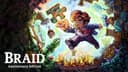
- Fully Repainted High-Resolution Graphics: Original artist David Hellman has carefully re-rendered every visual element. This is a complete artistic overhaul, boasting striking hand-drawn fidelity, improved animations, and richly detailed environments that breathe new life into each world.
- Extensive Developer Commentary: A wealth of insightful commentary from Jonathan Blow and his creative team is embedded directly within new in-game levels. These aren’t mere audio tracks; they’re interactive design documents, offering rare insight into the game’s development, philosophy, and the intricate thought processes behind its puzzles.
- Expanded Content & Instant Visual Toggle: The Anniversary Edition introduces a substantial set of new levels, significantly extending the puzzle-solving challenge. Players also have the ability to toggle between the original and enhanced visuals on the fly, a subtle yet powerful feature that underscores the transformation while preserving the historical context.
Analysis
Braid has always existed in a class of its own, and the Anniversary Edition only cements that status. The game is a model of iterative puzzle design. Each world introduces a new facet of Tim’s time-bending powers, forcing players to unlearn conventional platformer logic and embrace temporal paradoxes as solutions. The strength lies not in sheer difficulty, but in how the game patiently teaches its own rules, building layers of complexity without resorting to hand-holding. A puzzle that seems insurmountable often yields to a moment of epiphany, a sudden understanding of how time itself can be manipulated to create opportunities or undo mistakes.
The narrative, often described as allegorical and open to interpretation, avoids explicit exposition in favor of environmental cues and subtle text fragments. This deliberate ambiguity, which some critics initially found “pretentious,” is precisely what lends Braid its enduring allure. It’s a story about regret, consequence, and the futility of rewriting the past, wrapped in the guise of a princess-rescue quest. The Anniversary Edition‘s expanded developer commentary is, arguably, its most significant addition for aficionados. This isn’t superficial developer diaries; it’s a deep dive into the theoretical underpinnings of game design, level construction, and the philosophical considerations that shaped every pixel and mechanic. It transforms the game into a living textbook, invaluable for anyone interested in the craft.
The user experience flow is remarkably fluid. The ability to instantly rewind any mistake eliminates frustration, converting failure into a learning opportunity. This design choice is fundamental; it encourages experimentation, allowing players to poke and prod at the temporal fabric without penalty. The game’s pacing is deliberate, rarely rushed, allowing ample time for contemplation before demanding execution. This contemplative rhythm, combined with the often-challenging nature of the puzzles, creates a distinct engagement loop: observe, hypothesize, test, rewind, refine, succeed. The added levels offer a substantial expansion of this loop, ensuring that even seasoned Braid veterans will find fresh mental hurdles to overcome. The strength of Braid always lay in its unique blend of cerebral challenge and emotional resonance, and this new edition amplifies both, providing an experience that is at once intellectually demanding and deeply affecting.
Gameplay Loop
The core gameplay loop in Braid is elegantly simple yet endlessly complex: encounter a puzzle, identify the time mechanic at play, formulate a solution, execute, and if (more often than not, when) failure occurs, instantly rewind to try again. This constant cycle of trial-and-error, mitigated by the forgiving rewind feature, transforms potential frustration into persistent engagement. The game expertly introduces new time-bending rules in each world—from objects immune to time reversal to parallel realities—and then layers these mechanics, demanding increasingly abstract and creative solutions. Success isn’t about reflexes; it’s about lateral thinking and a profound understanding of cause and effect within a temporal distortion field. The new levels in this edition ensure that this loop, honed to a fine edge, continues to challenge even those who have mastered the original.
Depth of Commentary
The developer commentary works as an interactive pedagogical tool integrated into new, bespoke levels. Blow and his team dissect design decisions, philosophical influences, and the myriad challenges faced during development. This level of transparency is rare and invaluable, offering a granular look into the creative process of a landmark title. It shifts Braid from being merely a game to a historical document, a living artifact of its own creation, providing context that deepens appreciation for its intricate design.
Visuals & performance
The visual overhaul in Braid: Anniversary Edition is genuinely impressive. David Hellman’s fully repainted high-resolution graphics give the game’s distinct art style the polish of a genuine gallery piece. The soft, painterly look is now crisper, more vibrant, and replete with subtle animations and environmental details that were previously impossible. Every background is a work of art, enhancing the melancholic beauty of Tim’s journey. This is an artistic reimagining that deepens the game’s emotional impact. The UI remains minimalistic, allowing the art to take center stage, and the instant toggle between original and enhanced visuals is a smart touch, offering a direct, powerful comparison that highlights the care invested in this edition. As a 2D puzzle game of modest technical scope, Braid is light on hardware demands, and the Switch build is designed to run smoothly whether docked or in handheld mode. The revamped audio experience—new sound effects and remixed soundtrack variants—adds a layer of immersion, with the haunting score given renewed clarity.
Platform nuances
On Nintendo Switch, Braid: Anniversary Edition is well suited to the hardware, particularly in its portable form. The game’s contemplative nature and puzzle-focused gameplay translate naturally to handheld play, making it an ideal companion for commutes or relaxed sessions. While Braid was never heavily reliant on precision platforming, the Switch’s controllers offer reliable input. The game primarily uses traditional button inputs, and while touch controls aren’t explicitly highlighted as a primary interaction method (unlike some mobile ports), the Switch’s versatility means players can choose their preferred mode. The high-resolution assets are designed to hold up on the smaller screen. The visual toggle feature is particularly effective here, allowing players to quickly appreciate the scale of the upgrade no matter how they play.
Final verdict
Jonathan Blow’s Braid: Anniversary Edition is a model of respectful modernization. It takes a game that was already essential and makes it newly accessible without compromising what made it matter. The visual and auditory enhancements are integral components that deepen an already profound experience. The developer commentary, in particular, transcends mere bonus content, becoming a vital companion to the game itself. While Braid‘s unique brand of puzzle-solving and its often-abstract narrative may not ensnare every player, for those who embrace its challenges and contemplate its depths, this Anniversary Edition is a richly rewarding return. It is a careful, faithful preservation—powerfully amplified for a new generation, and easy to recommend despite its reservations.
Reviewed by the Rankeno Puzzle & Casual Desk. Scores are out of 10; the overall score is the desk’s editorial judgement, informed by the four sub-scores above. How we review