
Overview
Start with the part that should have been impossible. In 2019, Nintendo — a company that treats The Legend of Zelda the way the Vatican treats relics — licensed Link, Zelda, Hyrule, and the entire Baranowsky-bait back catalogue of Koji Kondo compositions to Brace Yourself Games, a small studio best known for a game about a girl who explodes if she stops dancing. Then it published the result itself, exclusively on Switch. There is no other example of this in modern Nintendo history. Not one. Whatever else you think of Cadence of Hyrule, it is a genuine anomaly in a corporate culture built on saying no.
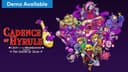
The premise is a graft, and a clean one. Crypt of the NecroDancer (2015) built its reputation on a single idea executed with monastic discipline: you move on the beat, enemies move on the beat, and combat becomes a positioning puzzle solved in real time at a fixed tempo. Cadence of Hyrule transplants that engine into a top-down Hyrule that looks and moves like a lost SNES cartridge, then hands you Link, Zelda, or Cadence herself — with Impa, Sheik, Yves, and Aria arriving later — and turns them loose on a procedurally generated overworld studded with dungeons, instruments to recover, and a lute-wielding antagonist named Octavo who has stolen the plot along with the sacred instruments.
Positioning-wise, this is a budget-priced side dish that eats several full-price main courses alive. It arrived between Breath of the Wild and its sequel, and it never pretended to compete with either. What it offers instead is density: a brisk first run that rewards the second, third, and fourth runs with new characters whose abilities genuinely reconfigure the fight — not palette swaps with different stat lines. Critics rated it broadly highly, though with a wider spread than its reputation suggests. That spread is instructive, and it’s worth unpacking.
Key features
- Beat-locked combat: Every action — step, strike, dodge, bomb, boomerang — resolves on the beat of the track. Enemies telegraph their patterns musically, so a Darknut isn’t a health bar, it’s a two-beat rhythm you have to read and step around.
- Danny Baranowsky’s remixed soundtrack: A generous set of reworked Zelda themes in the base game, plus more via the Season Pass. This is the load-bearing wall of the entire design, not set dressing.
- Procedurally generated Hyrule: A shuffled overworld with fixed landmarks — Death Mountain, Lost Woods, Lake Hylia — connecting randomized dungeon layouts, so map knowledge never fully calcifies.
- Seven playable characters: Link plays defensively with a shield, Zelda leans on Nayru’s Love and Din’s Fire, Cadence and Aria import NecroDancer’s brutal must-move-every-beat contract. Aria is effectively a hard mode with a sprite.
- Fixed-beat mode: Removes rhythm timing entirely. Enemies move only when you move, converting the game into a turn-based tactics roguelite. It is the single best accessibility decision in the package.
- Local two-player co-op, Dungeon Beat mode, and Symphony of the Mask — a full Skull Kid-led campaign bundled into the Season Pass.
Analysis
The Gameplay Loop
The clever trick here is that Zelda’s enemy design was already rhythmic and nobody noticed. Keese flutter in erratic bursts. Stalfos hop in fixed cadences. Zols split. Wizzrobes teleport, fire, and vanish on a schedule. Brace Yourself Games didn’t force Zelda’s bestiary onto a metronome so much as it revealed the metronome that was always there. Once you internalize that a Moblin moves every other beat and a Darknut must be flanked because it only blocks forward, encounters stop being reflex tests and become short-form spatial puzzles you solve at tempo.
That’s the crucial distinction from most rhythm games. You are not hitting prompts. There are no falling notes, no arrows scrolling toward a judgment line. The beat is a clock, and the game is asking you to plan two or three moves ahead while that clock runs. Miss a beat and you don’t fail a note — you simply don’t act, which usually means something hits you and your damage multiplier collapses. That chain multiplier is the loop’s engine: consecutive on-beat kills stack a bonus that fattens your rupee income, so playing greedily and playing accurately are the same thing. Elegant.
Death is where the design shows real restraint. This is roguelite-adjacent, not roguelike-punitive. Dying costs you your loose currency and dumps you back at a checkpoint, but map progress, unlocked items, and permanent upgrades stay put. The result is a difficulty curve that punishes sloppiness without weaponizing your time: a death costs loose change, not an evening.
Where the Design Strains
Two real complaints, and neither is fatal.
The first is the procedural generation tax. Zelda dungeons are, historically, authored objects — the Water Temple is memorable because a human being sat down and made it cruel on purpose. Randomized layouts can’t do that. What you get instead are competent, readable, forgettable rooms. The overworld fares better because the landmarks are fixed and only the connective tissue shuffles, but nobody is going to be drawing Cadence of Hyrule dungeon maps from memory in fifteen years. The trade is replayability, and it’s a fair trade at this price. It’s still a trade.
The second is the onboarding cliff. Without a musical background, the first hour is rough — not because the timing window is tight (it’s generous) but because playing on the beat while also thinking tactically is a dual-task problem that has to be trained. Several critics flagged this, and they’re right. What saves it is fixed-beat mode, which deserves a forceful defense: it is not a lesser version. It’s a legitimate second game hiding inside the first, and dismissing it as “easy mode” misreads what it does. It also, quietly, makes the game playable by people with motor or auditory impairments who would otherwise be locked out entirely. More studios should steal this.
Systems and Texture
Classic Zelda gear returns and — this is the impressive part — most of it survives the translation intact. Bombs are placed on a beat and detonate on a beat, which turns them into timed traps rather than panic buttons. The hookshot doubles as traversal and a positioning tool for yanking yourself out of a bad tile. Boomerangs stun on the return. Layered on top are NecroDancer’s shovels, spell scrolls, and weapon classes with distinct attack geometry — spears hit two tiles forward, broadswords sweep an arc, rapiers dash. Weapon choice isn’t a damage number, it’s a change to which tiles are lethal, and against which enemy patterns.
Co-op is local-only and shares the beat, which makes it either delightful or a partnership-strainer depending on the second player’s sense of rhythm. It’s a good-faith inclusion, not a headline feature.
Visuals & performance
The art direction is a 16-bit revival done with taste rather than nostalgia-brain. Sprite work sits squarely in A Link to the Past territory, but with a wider color depth, modern lighting passes, and animation with more frames than any SNES cartridge could have afforded. Enemies read instantly at a glance, which matters enormously when you have only a moment to identify what’s in front of you. That’s not aesthetics — that’s legibility as a combat mechanic, and the sprite work is doing serious functional labor.
The UI is appropriately spare: hearts, rupees, diamonds, an item wheel, and a beat indicator at the bottom of the screen that pulses toward the center. That indicator is the one piece of interface design worth contesting. It’s fine, but it competes for attention with the action, and the game plays better when you trust your ears rather than your eyes — something the HUD doesn’t communicate.
Technically, there’s little to worry about, which is the correct outcome for this design. A 2D game of this scope is light on hardware, and the beat-driven structure leaves little room for performance drama to matter even if it appeared.
Platform nuances
Switch exclusivity here is more consequential than usual, and one detail deserves a warning label.
Do not play this over Bluetooth audio. The Switch’s Bluetooth stack — added in 2021, well after launch — carries enough latency to shift the perceived beat by a noticeable margin, and in a game where the input window is defined by what you hear, that’s not a nuisance, it’s a broken game. Use the 3.5mm jack, the handheld speakers, or wired headphones through the dock. This is the single most important piece of practical advice in this review.
Controller choice matters too. Movement is four-directional and digital, so analog sticks are workable but imprecise under pressure. The Pro Controller’s unified d-pad is meaningfully better than the left Joy-Con’s four discrete buttons, which make accidental diagonal inputs easy at speed. Face buttons work as a directional input too and are the preferred setup for a lot of high-level NecroDancer players — the game supports it, and experimentation pays off.
Handheld play is where this game is built to live. Runs are short, the checkpointing is forgiving, and the pixel art is crisp on the Switch panel; OLED screens flatter it further. Docked, the sprite scaling is clean but the game gains nothing from the bigger screen. This is a commute game, a couch game, a twenty-minutes-before-bed game.
Final verdict
Cadence of Hyrule is the rare licensed crossover where the licensor’s most valuable asset came back improved. Brace Yourself Games understood something structural about Zelda — that its combat has always been about reading patterns and controlling space — and found a way to make that legible by attaching it to music. The result is a game that teaches you to hear Hyrule.
It has limits. It’s short. The procedural generation buys replayability at the cost of the handcrafted spite that makes the best Zelda dungeons stick. And the rhythm requirement will lose some players in the first hour, though fixed-beat mode catches most of them on the way down.
None of that changes the core assessment. We rate it a clear recommendation with real reservations: at this price it is more inventive than most full-price releases, and it’s backed by a soundtrack that justifies the purchase on its own. Buy the base game. If the hooks land — and they will land within two hours or not at all — the Season Pass and Symphony of the Mask are worth the upgrade. Nintendo took a swing at something outside its own walls. It connected.
Reviewed by the Rankeno Puzzle & Casual Desk. Scores are out of 10; the overall score is the desk’s editorial judgement, informed by the four sub-scores above. How we review