
Bottom Line: Knuckle Cracker's liquid-enemy strategy hybrid remains one of the most original ideas in the genre, and the jump to 3D terrain makes it more tactile than ever. The campaign is merely good; the ecosystem around it is effectively bottomless.
The Loop
The rhythm of a Creeper World 4 mission is unlike anything else in strategy gaming, and it's worth spelling out because it explains both the game's cult following and its niche ceiling. You land. You survey the terrain — where are the emitters, where will the fluid pool, which ridgeline buys you time. You sprawl a lattice of collectors across safe ground to generate energy, string relays toward the front, and plant weapons at the waterline. Then you hold.
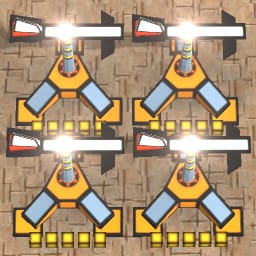
What follows is a slow-motion territorial war against a substance. Mortars lob shells into deep pools to knock the level down. Cannons chew at the shallow leading edge. Every meter of ground you dry out is a meter you can build on, which extends your energy network, which powers more weapons, which dries out more ground. It's a positive-feedback loop with teeth, because the Creeper never stops coming, and a single breached wall can cascade into your entire forward network dissolving in seconds. The panic of watching blue fluid pour through a gap you didn't reinforce — while your energy grid browns out because you built one collector too few — is this series' signature emotion, and the 3D presentation amplifies it considerably.
The genius of the design is that the enemy is perfectly honest. There's no hidden AI, no rubber-banding, no scripted gotcha (well, few — the campaign occasionally indulges). The fluid does what fluid does. When you lose, the replay is legible: you can point at the exact saddle in the terrain you failed to respect. That honesty is what makes the game compulsive rather than frustrating. Losses feel like engineering failures, not dice rolls.
Where It Thins Out
The story campaign is the weakest pillar. It's a competent onboarding ramp — each mission introduces a unit or a wrinkle, the pacing is sensible — but the narrative wrapper is forgettable sci-fi boilerplate, and experienced players will finish it wanting more resistance. Knuckle Cracker knows this, which is presumably why the campaign is really a tutorial for the actual game: the community library and mission generator. That's where the difficulty curve extends into the stratosphere, and where the in-game sharing system — browse, one-click download, play — does quietly excellent work. No Workshop tab-juggling, no external tools.
The map editor deserves specific praise. Scripting support means the community hasn't just made harder maps; it has made different games — tower-defense variants, puzzle modes, scenarios with custom units the base game never shipped. A decade-plus of Knuckle Cracker cultivating this community shows. This is the rare indie title where "community content" isn't a euphemism for a trickle of reskins.
The honest criticism: the moment-to-moment loop, for all its tension, can settle into solved-problem territory on standard maps. Once you internalize the doctrine — mortars on pools, cannons on edges, never outrun your grid — mid-difficulty missions become execution rather than thought. The game's answer is its endless supply of maps designed specifically to break your doctrine, but you have to go looking for them.