Overview
ustwo games has spent a decade building a reputation as the studio that makes you feel something in under ten hours. Monument Valley did it with impossible architecture. Alba: A Wildlife Adventure did it with a camera and a Mediterranean island. Desta: The Memories Between is the studio’s strangest bet yet: a turn-based tactics roguelite where the combat is dodgeball and the ammunition is unresolved conversation.
You play as Desta, a non-binary person returning to their hometown after their father’s death. The waking hours are quiet and heavy. The sleeping hours are where the game lives — surreal dreamscapes where Desta’s anxieties manifest as tactical dodgeball matches against dream-versions of friends, family, and old wounds. Hit someone with the ball and you’re hitting them with the words left unsaid. Defeat them and they might join your team. It’s a metaphor so on-the-nose it shouldn’t work. It works.
Originally a Netflix Games mobile exclusive, that version was delisted in late 2024 — meaning the Dream Team Edition on Steam and Nintendo Switch (released April 25, 2023, at $3.39) is now the only way to play, and arguably the definitive one. It bundles Challenge Mode, Nightmare Mode, additional characters, and the full Mansur Brown soundtrack. At 6–10 hours with full voice acting, it’s positioned as a premium narrative-tactics hybrid in a market that has plenty of tactics games and plenty of grief games, but almost nothing that fuses the two this directly.
Key features
- Physics-based tactical dodgeball: Positioning, throwing, catching, and bank-shot bounces off walls and obstacles replace the standard attack-and-cover grammar of turn-based tactics. Trick shots aren’t flourish — they’re the core skill expression.
- Recruitable dream-team roster: Defeated opponents can join you, each with a distinct ability — teleports, curved throws, extra actions — turning team composition into the run-to-run strategic layer.
- A narrative that earns its metaphor: Full voice acting and a story about grief, identity, and repairing relationships, told through conversations you literally fight to have.
- Dream Team Edition extras: Challenge Mode and Nightmare Mode add post-story teeth the original mobile release lacked, alongside extra characters and the complete soundtrack.
Analysis
The Gameplay Loop
The dodgeball conceit is smarter than it sounds. Traditional tactics games ask you to manage cover, range bands, and action economy. Desta keeps the action economy but replaces hit-percentage dice rolls with deterministic physics. A throw either has a clean line or it doesn’t — and if it doesn’t, you can manufacture one by bouncing the ball off a wall, a pillar, or the arena’s furniture. This does something quietly radical: it removes the XCOM-style “95% miss” resentment entirely. When a shot fails in Desta, it’s because the geometry was misread, not because the RNG betrayed you.
Catching is the other half of the system, and it’s where the design gets tense. An incoming throw can be caught if a teammate is positioned right, which flips possession and momentum in a single move. The best turns in Desta are little Rube Goldberg sequences — teleport a teammate into a catch lane, intercept, bounce a curved throw around an obstacle, knock out two opponents. When it clicks, it’s closer to a puzzle game wearing tactics clothing, which is very much ustwo’s home turf.
The roster system feeds this well. Recruited characters aren’t stat variations; they’re rule changes. One character bends throws. One teleports. One grants extra actions. Because arenas are small — usually a handful of units per side — a single ability reshapes the whole possibility space. Drafting a team mid-run is the closest the game gets to real build-craft.
Where the Structure Strains
The roguelite wrapper is the honest criticism, and it deserves stating plainly: Desta didn’t need to be a roguelite. Runs are procedurally structured, and failure sends you back with meta-knowledge and some progression. But the narrative — the actual reason this game exists — is linear and authored. The two impulses fight each other. Replaying early encounters to re-reach a story beat already understood dilutes exactly the emotional momentum the writing works so hard to build. The design invites repetition and sharp difficulty spikes that force re-runs at precisely the wrong narrative moments, and that friction is the game’s central problem.
The counterargument — that repetition mirrors how grief loops, how you rehearse the same conversation in your head night after night — is thematically elegant. It half-holds. But theme doesn’t fully excuse friction, and a more forgiving default difficulty (or a story mode) would have cost the game nothing.
The Writing
What can’t be argued with is the script. Desta’s non-binary identity is written as a fact of the character, not a plot device. The conversations with the dream-versions of Desta’s mother, estranged friends, and late father are specific in the way good fiction is specific: awkward pauses, deflections, the sentence you rewrite four times before saying. The voice cast sells all of it. In a genre where narrative is usually connective tissue between battles, Desta inverts the ratio, and it’s the right call.
Visuals & performance
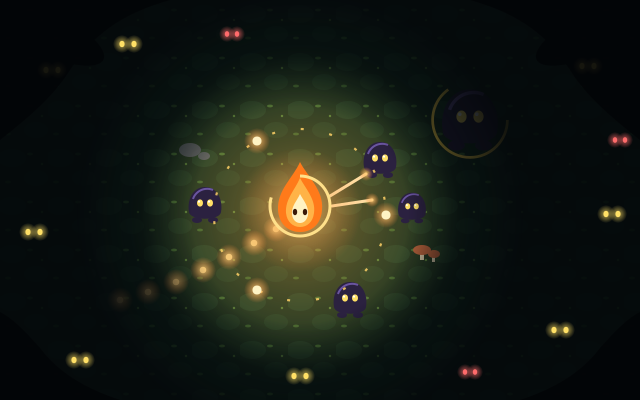
This is a gorgeous game. The dreamworld aesthetic — saturated gradients, floating geometry, arenas that look like memories half-dissolved — is unmistakably ustwo, carrying Monument Valley’s DNA into 3D character work. Mansur Brown’s soundtrack deserves specific mention: warm, jazz-inflected guitar work that gives the dream sequences a melancholy pulse most tactics games wouldn’t dare attempt. The UI is clean and readable, with throw trajectories and bounce previews telegraphed clearly — critical, given that geometry is the combat system. And as a 2D-styled game of modest scope, it’s light on hardware by design.
Platform nuances
The game’s mobile origins show, and on these platforms that’s mostly a compliment with an asterisk. On Switch, Desta is at home: short session structure, aim-and-flick controls that map naturally to a handheld, and an art style that flatters the smaller screen. This is the version we’d recommend to most people. On Steam, mouse-driven trajectory aiming is precise and comfortable, but the touch-first interface occasionally betrays itself — big friendly buttons, menu flows built for thumbs. It never impedes play; it just reminds you where the game grew up. With the Netflix mobile version delisted, these two storefronts are the only doors in, and both are solid.
Final verdict
Desta: The Memories Between is a game with one flaw and it’s structural: a roguelite chassis bolted onto a story that wanted to be told straight through. Everything else — the physics-driven dodgeball tactics, the aching script, the art, the music — ranges from good to exceptional. ustwo took a real risk fusing cosy narrative design with a genre built on failure, and the seams show. The ambition is the point, and few studios would even attempt to make a tactics game about the conversations you never got to have. But the structural friction lands hard enough that we can’t recommend it to most people — it’s a mixed recommendation for players who know the repetition won’t ruin the story for them. Now that it’s escaped Netflix exclusivity at a low price, the Dream Team Edition is the version this game always deserved. Switch, headphones, and patience with the re-runs.
Reviewed by the Rankeno Strategy & Sim Desk. Scores are out of 10; the overall score is the desk’s editorial judgement, informed by the four sub-scores above. How we review