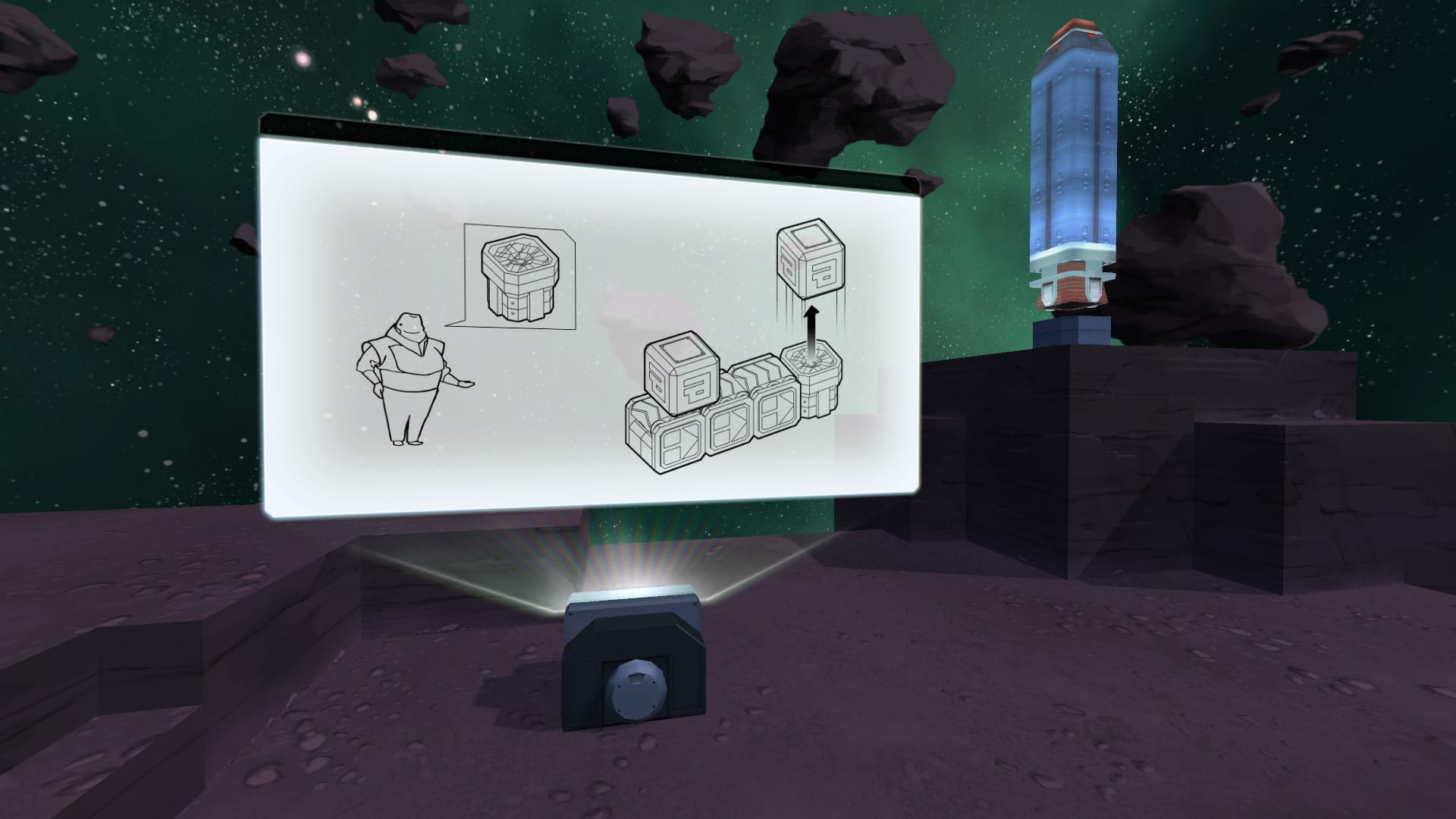



Bottom Line: A grueling, brilliant masterclass in spatial engineering that turns industrial labor into a high-stakes puzzle of cosmic proportions. It is less a game and more a digital apprenticeship in mechanical efficiency.
The Architecture of Automation
The brilliance of Infinifactory lies in its refusal to hold your hand. You are dropped into a sandbox with a set of outputs and a pile of inputs. How you bridge that gap is entirely up to you. This is where the game transitions from a "puzzle" to a "design" exercise. In a linear puzzle game, there is one key. In Infinifactory, you are building the lock, the key, and the door itself.
The gameplay loop is a cycle of frantic iteration. You might start by laying down a simple line of conveyor belts to see where the raw blocks land. Then, you realize you need to rotate a block 90 degrees before it hits the welder. You add a pusher. Then you realize the timing is off—the pusher is firing too late. You add a sensor and a logic gate. Suddenly, you aren't just placing blocks; you are programming with physical objects. The satisfaction of watching a 20-step assembly line finally hum into life, moving with the rhythmic precision of a Swiss watch, is unrivaled in the genre.
The Optimization Trap
Zachtronics understands the psychology of the engineer. Finishing a level isn't enough; finishing it well is the real game. The histograms that appear at the end of each level are the ultimate motivators (or ego-shredders). You might have solved a puzzle in 400 cycles, only to see a massive spike in the global data at 150 cycles.
This forces a fundamental shift in how you play. You go back. You rip out the sprawling, messy "brute-force" solution and try to condense it. You look for ways to weld blocks in parallel rather than series. You find ways to use the environment as a natural funnel. This is where the game’s difficulty curve—often cited as a cliff—becomes a feature. It isn't just about getting harder; it’s about demanding more elegance. The friction of the later levels, which can feel like actual vocational labor, is exactly what makes the breakthrough feel so earned.
The Narrative of Despair
Most automation games are optimistic—about progress, about conquest, about growth. Infinifactory is intentionally bleak. The audio logs you find are the last testaments of people who were also "good with their hands." They talk about their lives, their regrets, and their eventual disposal. This narrative layer adds a surprising amount of weight to the mechanics. You aren't just building a missile; you're building a missile for a master who will kill you when you're no longer useful. It’s dark humor at its best, providing a necessary counterpoint to the dry, logical grind of the factory floor.