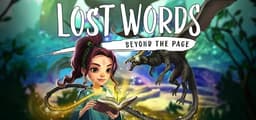
Lost Words: Beyond the Page
game
•Updated Sep 2026Steam

Lost Words: Beyond the Page

Rhianna Pratchett's script and David Housden's score make Lost Words one of the most emotionally honest short games about loss. The word-based puzzles are clever at first, but they never get hard enough to be more than a way to turn the pages.

Platforms
Steam · Nintendo Switch
Developer
Sketchbook Developments, Fourth State, Sketchbook Games

More Steam / PC app reviews

Quick summary

Lost Words: Beyond the Page (Steam) — scored 8.1: Rhianna Pratchett's script and David Housden's score make Lost Words one of the most emotionally honest short games about loss. The word-based puzzl...

Pros

  • Rhianna Pratchett's writing handles grief with rare honesty and restraint
  • Walkable diary pages tie mechanics and meaning together
  • David Housden's score and the watercolour art are standout production values

Cons

  • Puzzles almost never need more than the obvious answer
  • Estoria's spell system has a small vocabulary and never grows into anything deeper
  • Short 4–5 hour runtime and slow movement make the gaps feel padded

Scores

Score breakdown

How the overall score splits across the categories we review.

Design
8/10
Innovation
8.5/10
Value
7.5/10
Utility
7/10

Our strongest category here is Innovation (8.5/10); the weakest is Utility (7.0/10).

Verdict

Is Lost Words: Beyond the Page worth it?

Lost Words: Beyond the Page has one great idea, and the idea is that language itself is the space you move through. In the diary chapters it's close to perfect: reading and moving blend together, and the game's feelings come through in its layout. Estoria doesn't live up to that. It turns the idea into a plain lock-and-key loop that never tests you and rarely surprises you.

Still, criticizing it for being a weak puzzle game partly misses the point. It's an interactive story first, and as one it's excellent. Pratchett's script treats a child's grief seriously, Housden's score earns its emotional moments, and the watercolour art makes the whole thing feel handmade. It's not a mechanical masterpiece, but it's a moving one, and it's worth your evening.

Pros

  • Rhianna Pratchett's writing handles grief with rare honesty and restraint
  • Walkable diary pages tie mechanics and meaning together
  • David Housden's score and the watercolour art are standout production values

Cons

  • Puzzles almost never need more than the obvious answer
  • Estoria's spell system has a small vocabulary and never grows into anything deeper
  • Short 4–5 hour runtime and slow movement make the gaps feel padded
From Rankeno

Our verdict, on your site

A scored review out of 10 and a permanent review page on rankeno.com. Submit your app and see where it stands.

Get reviewed

Gallery

Screenshots

4 screenshots · tap to enlarge

What stands out

Key features

  1. Diary pages you can walk on: In the real-world chapters, Izzy's handwritten lines are the platforms. You pick up and rearrange words to open a path, so reading and moving become one action.
  2. Word spells in Estoria: In the fantasy chapters you collect words and cast them on the world. "Rise" lifts rocks, "break" shatters obstacles and "repair" rebuilds bridges.
  3. Two stories that mirror each other: Events in Izzy's diary reshape the fantasy she's writing, and the two halves echo each other more and more as the story goes on.
  4. Hand-painted watercolour art: 2D-styled worlds rendered in 3D, so every scene looks like an illustration from a storybook.
  5. Orchestral score by David Housden: Music by the BAFTA-nominated composer, plus a fully voiced cast.

Full review

Lost Words: Beyond the Page in depth

Bottom Line: Rhianna Pratchett's script and David Housden's score make Lost Words one of the most emotionally honest short games about loss. The word-based puzzles are clever at first, but they never get hard enough to be more than a way to turn the pages.

The Core Idea: Language as Level Design

The central idea is excellent, and it lands right away. In the diary chapters, the text isn't something laid over the level. The text is the level. You jump from one sentence to the next, and when a gap gets in your way you pull a word off the page and drop it where you need a foothold. Because walking a line means reading it, the game controls how fast you take in each sentence without cutscenes or locking your controls. A sad line takes longer to cross, and the pause in your movement matches the pause in the thought.

It's a good piece of design, and the game uses it best in the quiet moments. When Izzy's writing gets shaky, the platforms get shaky too. When she can't find the words, the path runs out. Very few games tie mechanics and meaning together this closely, and these pages are the best thing in the game.

Estoria: Where the Loop Thins Out

The fantasy chapters get less out of the idea. Estoria runs on a more familiar setup: move through a side-view world, find a glowing obstacle, pick the right word from Izzy's book, cast it. Rise, break, repair. The mapping is clear and clever the first time, and it expresses the game's thesis neatly. A child who can't fix her real world gets a world she can fix with words.

The trouble is that the vocabulary stays small and every puzzle has one obvious answer. You almost never have to think about which word to use, because the environment practically announces it. There's no combining words, no playing on their meanings, and no way to fail that teaches you anything. After a few hours the loop becomes: look at the glowing object, cast the matching verb, move on. Players have said the same thing, calling the puzzles easy and the platforming slow and short on mechanics.

That's the game's biggest missed opportunity. A system built on language is well suited to ambiguity, where a word could mean two things and the story could go either way. Lost Words keeps choosing the literal reading.

Movement and Pacing

Izzy moves deliberately, which suits the diary chapters and drags in Estoria, where there's more ground to cover and not much happening in between. It doesn't make the game feel clumsy, but it does make it feel padded. With a short runtime, any stretch that feels slow stands out.

The Writing Carries It

Pratchett's script is why you should play this. It avoids the easy route, where the grandmother is a saintly symbol and her illness is just a plot device. Izzy's diary reads like a real child who is precocious, a bit self-important about wanting to be a writer, and caught off guard by feelings she doesn't have words for yet. The fantasy story works as her coping mechanism, and the way it slowly warps as her real life gets harder is handled with restraint. The game never spells out what Estoria stands for. It trusts you to notice.

The voice acting supports that. The performances are warm without being sentimental, and the game gives its hardest scenes room instead of rushing to comfort you.

Onboarding and Difficulty

There's almost no friction at the start. The game teaches its mechanics through the story, and you can't really get stuck. For a narrative-first audience, including younger players and anyone working through grief of their own, that's a deliberate and fair choice. Anyone who comes looking for real puzzles will be done well before the game ends.

Your rating for Lost Words: Beyond the Page:
Was this helpful?

Alternatives

If not Lost Words: Beyond the Page, then what?

Best alternatives to Lost Words: Beyond the Page

FAQ

Common questions

Is Lost Words: Beyond the Page worth it in 2026?

Lost Words: Beyond the Page has one great idea, and the idea is that language itself is the space you move through. Our experts scored Lost Words: Beyond the Page 8.1 out of 10 — recommended.

Is Lost Words: Beyond the Page good?

With a score of 8.1 out of 10, Lost Words: Beyond the Page lands in our recommended band. Innovation is its strongest category at 8.5 out of 10. Utility is the weakest at 7.0.

What do users like most about Lost Words: Beyond the Page?

Rhianna Pratchett's writing handles grief with rare honesty and restraint. Walkable diary pages tie mechanics and meaning together.

What do users dislike most about Lost Words: Beyond the Page?

Puzzles almost never need more than the obvious answer. Estoria's spell system has a small vocabulary and never grows into anything deeper.

What platforms is Lost Words: Beyond the Page available on?

Lost Words: Beyond the Page is available on Steam, Nintendo Switch.

Who makes Lost Words: Beyond the Page?

Lost Words: Beyond the Page is made by Sketchbook Developments, Fourth State, Sketchbook Games.

What are good Lost Words: Beyond the Page alternatives?

The closest alternatives to Lost Words: Beyond the Page are Starseed Pilgrim, Wizard with a Gun, Oxenfree II: Lost Signals.

Is our Lost Words: Beyond the Page review up to date?

We last refreshed our Lost Words: Beyond the Page review in Sep 2026.

About this review

How we scored Lost Words: Beyond the Page

Lost Words: Beyond the Page was scored on Design, Innovation, Value and Utility — each from 1 to 10, with the same rubric as every other game in its category — for an overall 8.1. Research and drafting follow Rankeno's fixed editorial rules; the rubric, the checks before publishing and the decision to publish are ours. Published Sep 26, 2026.

Editorial disclaimer The reviews and scores on this site are based on our editorial team's independent analysis and personal opinions. While we strive for objectivity, gaming experiences can be subjective. We are not compensated by developers for these scores.

For developers

Get your app or game reviewed

A scored review on the same rubric as this one and a permanent review page on rankeno.com. Paid tiers buy a place in the queue — never a score.

Submit for review
Embed this score badge on your site

Embed this review badge

Paste this snippet on your site to show your Rankeno score. The link back to rankeno.com is a normal link — no redirect, no tracking.

From Rankeno

Finished reading? Get your own verdict.

Submit your app for a scored review out of 10, published as a review page on rankeno.com.

8.1Lost Words: Beyond the PageSteam