
Overview
Rhythm games are a genre built on cruelty. Miss the beat, break the chain, watch the run die. That unforgiving contract is the whole appeal for the people who love them, and the reason everyone else bounces off in ninety seconds. Mad Rat Dead, released by Nippon Ichi Software in 2020 for Switch and PlayStation 4, is a rare attempt to break that contract without gutting what makes the genre work — and for its opening stretch, it’s one of the more inventive things NIS has shipped.
The pitch is small. You’re a laboratory rat who dies on a dissection table and gets granted a single extra day by the Rat God, with a talking Heart riding along as narrator, cheerleader, and metronome. Every input — jump, dash, wall-kick, air-dash — only registers on the beat. Off-beat presses don’t just fail; they don’t exist. A life meter drains in time with the track, so the song is simultaneously the soundtrack, the timer, and the thing killing you. Stomp an enemy or grab cheese and you buy back seconds.
This is NIS operating well outside its comfort zone. The publisher is best known for Disgaea and a deep bench of grind-heavy strategy RPGs, and Mad Rat Dead’s closest genre relative is Crypt of the NecroDancer — but where NecroDancer is a roguelike wearing rhythm as a constraint, Mad Rat Dead is a momentum platformer, closer in feel to a 2D character-action game that happens to be quantized.
Market positioning was awkward from day one. It launched at a premium price for a short campaign, into a Switch eShop already saturated with cheaper indie rhythm titles. The critical split tells the story: reception was noticeably warmer on Switch than on PlayStation 4. Same game. Different hardware fit. That gap is not an accident, and it’s the most useful context for this review.
Key features
- Beat-Locked Movement: Every action is quantized to the track. Jump, dash, air-dash, wall-kick — the game reads your input on the beat or not at all. Movement is not scored by rhythm, it’s gated by it.
- The Song as a Health Bar: A life meter drains with the music. Kills and cheese pickups refill it. Time is literally the resource, and the theme — one borrowed day of life — is baked into the systems rather than bolted onto them.
- Beat Rewind: Scrub back to the previous beat at will. A mistimed dash into a spike pit becomes a rollback, not a restart. This is undo, in a rhythm game, and it’s the single most important design decision here.
- Diegetic Guide (Heart): Your talking heart is the tutorial voice, the plot device, and a visible on-screen pulse. The HUD and the narrator are the same character.
- Genre-Spanning Soundtrack: EDM, jazz, rock, chiptune, largely from Japanese composers, with each stage’s layout authored around its track’s structure. Not a playlist over a level — a level built out of a song.
- Boss Encounters: Cats, dogs, and humans, layering pattern recognition on top of the rhythm constraint.
- Extras: Stage editor, unlockable art and music, and score-chasing replays for perfect beat-matched runs.
Analysis
The Gameplay Loop
Strip away the presentation and Mad Rat Dead is a resource puzzle. Each beat is a token. You spend it on exactly one action, and every action commits you to a momentum vector you’ll be living with two or three beats from now. Direction comes from the stick, timing comes from the track, and the interaction between them is where the design is genuinely clever. A dash isn’t “move right” — it’s a decision about where your rat will be, and how fast, when the next window opens. Good players aren’t reacting to the level. They’re reading four beats ahead and pre-committing.
That’s a real skill, and the game is built to teach it. The design intent is that the beat stops feeling like a restriction and starts feeling like a grid — you’re not fighting the music, you’re building on it. When it clicks, Mad Rat Dead offers something almost nothing else in the genre does: platforming that feels composed. You’re not hitting notes. You’re improvising over a bar line.
Tying the life meter to the track is the best idea here. Standard platformers separate the timer from the health bar; here they’re the same number. Every beat you waste standing still is damage. Every enemy you stomp is a few more seconds of a life you weren’t supposed to have. The mechanic and the story are the same statement, which is the sort of thing design writers claim about games constantly and games actually earn about once a year.
The Rewind Is the Whole Game
The rewind deserves its own paragraph because it’s doing enormous, quiet work. Rhythm games have brutal onboarding friction — the ramp from “I hear the beat” to “my hands are on the beat” is where most players quit. Rewind removes the cost of being wrong. Blow a jump, tap back, try a different vector. It converts the genre’s core failure state from punishment into iteration, and it’s the reason a rhythm-locked platformer with this much mechanical depth is playable by people who would never touch Rhythm Heaven.
It also, unavoidably, undercuts the thing it’s protecting. Flow state is the payoff of a rhythm game — the stretch where you stop thinking and just ride the track. Every rewind is an interruption of exactly that. Lean on it and you’re not performing a song, you’re editing a take in an audio workstation, beat by beat. Two design goals in direct tension, and NIS never fully resolves it. The generous read is that the tension is the point: rewind to learn, then chase a clean run for score. The honest read is that most players will scrub their way through the campaign and never find the flow the game is built around.
Where It Stalls
The verb set is complete by the end of the first world. Jump, dash, air-dash, wall-kick, stomp. That’s it. Everything after that is the same grammar applied to new wallpaper. A great platformer front-loads its verbs and then spends the rest of its runtime complicating the context — new hazards that reframe what a dash means, environments that invalidate your habits. Mad Rat Dead mostly changes the backdrop and the BPM. Stages start blurring together well before the credits, and the campaign’s back half coasts on soundtrack variety to disguise level design that stopped developing.
The bosses are a harder problem. They’re built on pattern recognition, which means learning a telegraph and responding — reactive play. But everything the game has trained you to do is proactive: commit early, plan ahead, own the beat. The bosses take the instrument away and hand you a quiz. They spike in difficulty, they interrupt the pacing, and they were the loudest complaint in the critical consensus for good reason.
The story follows the same curve. The opening is legitimately great — a dead rat, a bored god, a heart with opinions. NIS’s writing has a mean, funny edge here that suits the premise. Then it stops going anywhere, and the last act limps to a finish the mechanics have already outpaced.
Visuals & performance
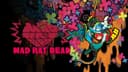
The art direction is the least compromised thing in the package. High-contrast, punk-adjacent, aggressively hand-drawn, with a colour language that shifts to match each track’s genre. Mad Rat himself is an ugly little creature rendered with real affection, and the cutscene animation punches well above what a mid-budget NIS release usually gets. It is specific in a way most rhythm games — which tend to default to neon-abstract — never bother to be.
The UI keeps the right things visible. The life meter is unmissable, Heart pulses as a visual beat reference, and the beat indicator sits where your eyes already are. When you fail, you should generally know why. That matters more than it sounds: a rhythm game with ambiguous feedback is a broken rhythm game.
Technically, the bar here is narrow and a 2D game of this scope is light on hardware, so the Switch build should have little trouble holding a steady frame rate — and in a beat-gated game frame pacing isn’t a nice-to-have, it’s the contract. A dropped frame is a dropped input window. Audio latency, not rendering, is the failure mode to worry about — and that’s a hardware conversation, not a software one.
Platform nuances
The warmer critical reception on Switch versus PS4 isn’t about ports. It’s about context. This is a short-burst, high-intensity, headphone-native game, and the Switch is the machine that lets you play it the way it wants to be played: handheld, wired headphones, brief sessions, sleep mode between stages. Same code, better fit.
Specific advice, because on this game the setup changes the experience:
- Use the 3.5mm jack. Switch Bluetooth audio introduces latency, and a beat-gated game has no tolerance for it. Wireless headphones are the wrong tool here.
- Recalibrate per configuration. Handheld and docked-to-TV are different latency environments — a display’s processing adds lag the game cannot see. Run calibration when you switch. Do not trust one setting across both.
- Play attached or wired. Detached Joy-Con add a small wireless input delay on top of everything else. Handheld mode or a wired Pro Controller is the low-latency path. The directional dash also wants a stick you trust — drifting Joy-Con will cost you runs.
- Sleep mode is doing real work. A short campaign in bite-sized stages is close to ideal commuter software, and the Switch’s instant resume suits the structure better than sitting down at a console ever did.
Final verdict
Mad Rat Dead is a short game with one ten-out-of-ten idea in it. Locking movement to the beat and making the song itself the thing draining your life is the kind of clean, thematically-loaded mechanic most studios never land, and NIS landed it in a mid-budget release nobody expected much from. The rewind makes it approachable without making it easy, which is a much harder trick than it looks.
What’s missing is ambition past the prototype. The game finds its idea, proves it, and then repeats it until the credits, with boss fights that pull against the grain of everything they’ve taught you. It should have either gone deeper on its verbs or gone shorter and cheaper. For most people, that’s a hard recommendation to make at full price. On Switch, on sale, in handheld with wired headphones, it’s a much easier case — provided you accept that the last stretch is coasting on a soundtrack that’s still, somehow, carrying it.
Not worth full price for most people. Worth remembering, though — the mechanic here deserves a sequel that knows what to build on top of it.
Reviewed by the Rankeno Puzzle & Casual Desk. Scores are out of 10; the overall score is the desk’s editorial judgement, informed by the four sub-scores above. How we review