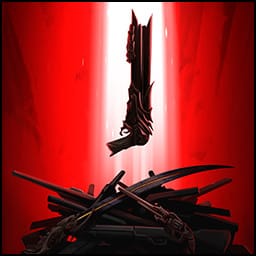
Bottom Line: Metal: Hellsinger fuses rhythm-game timing with Doom-style carnage so effectively that going back to a normal shooter feels flat afterward. The campaign is short and the enemy roster thin, but for four blistering hours, nothing else sounds like this.
The Loop
Here's what The Outsiders understood that most rhythm hybrids don't: the beat cannot be a tax; it has to be a reward. In lesser rhythm games, timing requirements feel like a metronome scolding you. Hellsinger inverts this. Off-beat shots still fire — they're just weak. On-beat shots crack like thunder, spike your multiplier, and pull another instrumental layer into the mix. The game never punishes you into frustration; it seduces you into precision.
The result is the most reliable flow state I've hit in a shooter in years. At 16x Fury, with White-Gluz screaming over the mix and your shotgun punctuating every downbeat, the distinction between playing a game and performing music genuinely dissolves. This is not marketing hyperbole. It's a measurable design outcome: your inputs and the audio engine are the same instrument.
The arsenal is small but purposeful. The skull companion Paz gives you an infinite-ammo beat-keeper — a brilliant onboarding tool, since you can always "practice the rhythm" without resource pressure. The dual pistols reward fast subdivisions; the shotgun demands patient, heavy downbeats; the blade turns melee into a percussion fill. Each weapon carries an Ultimate ability that charges through sustained rhythm, closing the loop between performance and power. Executions ("slaughters") restore health and sustain your streak, borrowing Doom's glory-kill economy and syncing it to the bar line.
Where It Runs Thin
Now the firm part of the critique. The campaign runs four to five hours, and the eight realms — while visually distinct — recycle a structural template almost immediately: arena, corridor, arena, boss. Worse, the enemy variety is genuinely inadequate. You'll see the full bestiary well before the halfway mark, and several bosses are literally the same encounter re-skinned with a larger health pool. In a game about musical escalation, the combat encounters themselves stop escalating conceptually around hour two.
The difficulty tuning also has a flat spot. On default settings, a competent FPS player will rarely die; the real game is the scoreboard, and the game undersells this. If you treat Hellsinger as a campaign to finish, you'll leave satisfied but slightly hungry. If you treat each track as a song to master — chasing perfect streaks on higher torments, climbing the leaderboards — the value proposition roughly triples. Leviathan mode helps, adding roguelike modifiers and upgrade decisions to the wave format, though it feels more like a well-made encore than a second act.
The Soundtrack as System
Two Feathers deserves specific credit. Writing original metal that must function at four intensity layers, loop indefinitely without fatigue, and stand alone as actual songs is a brutal brief, and they cleared it. Tracks like "Stygia" (Tankian) and "No Tomorrow" (Blythe) would survive on a playlist with no game attached. That matters because the entire design collapses if the music is mediocre. It isn't. This is the rare licensed-talent project where the talent shaped the product instead of decorating it.