

Bottom Line: Molek-Syntez is Zachtronics at its most skeletal and punishing, stripping away narrative fluff to deliver a pure, high-octane hit of spatial logic and optimization. It is a digital workbench for the intellectually masochistic.
The Geometry of Logic
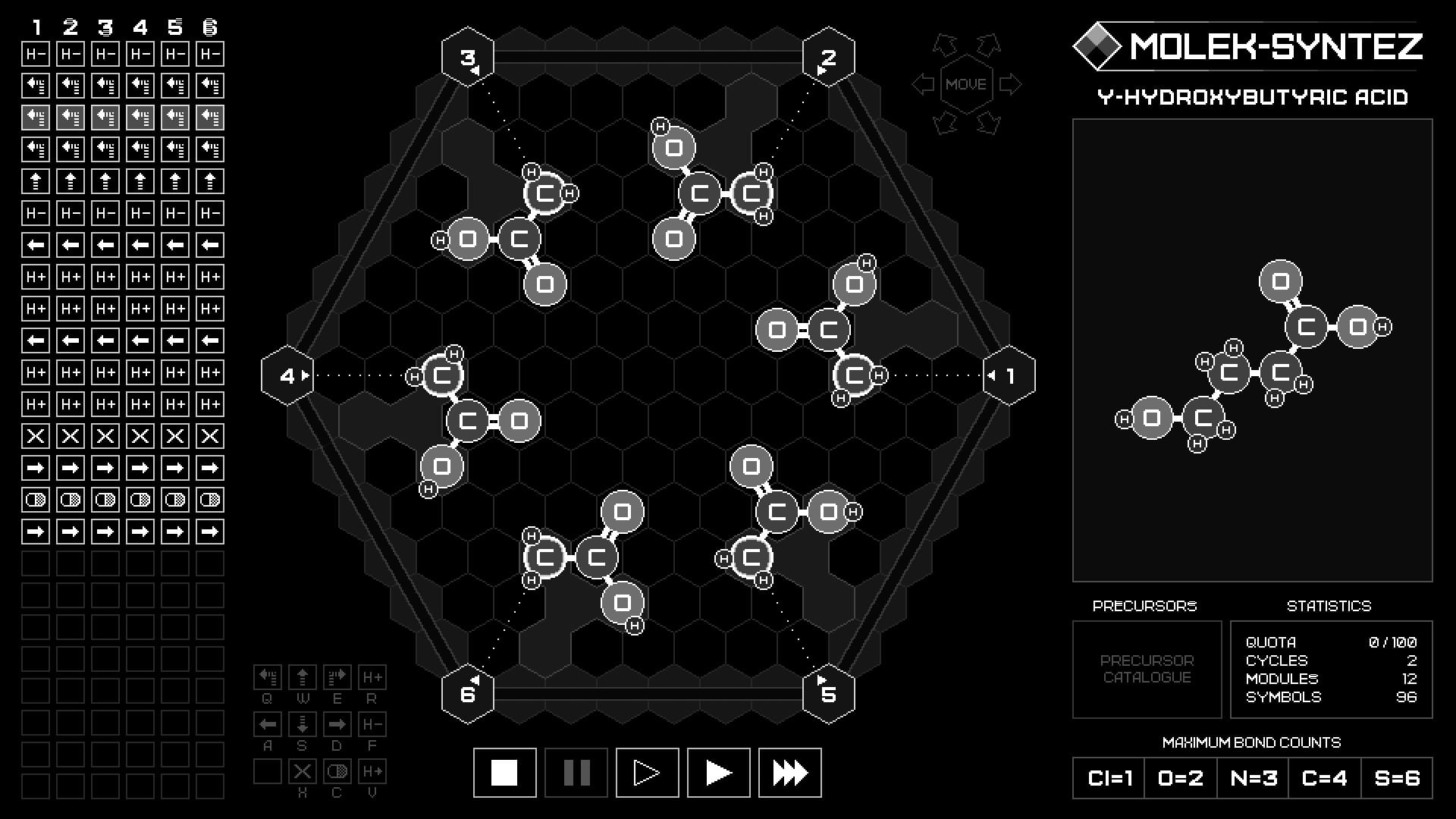
At the heart of Molek-Syntez is a deceptively simple mechanical premise. You are given a set of starting molecules and a target compound. To get from point A to point B, you must orchestrate a series of pushes, pulls, rotations, and bond manipulations. However, the constraints are where the genius—and the agony—lies. Unlike the flexible mechanical arms of Opus Magnum, your emitters in Molek-Syntez are stationary. They sit at the edges of the grid, firing commands that affect whatever is in their line of sight.
This creates a unique spatial reasoning challenge. You aren't just building a molecule; you are choreographing a dance within a claustrophobic box. To rotate a complex molecule without it crashing into the "walls" of your workspace, you must often perform a series of counter-intuitive shuffles. You might push a molecule three tiles to the left just to gain the clearance to rotate it 60 degrees, before dragging it back into the path of a hydrogen emitter. The iterative friction is high. You will spend twenty minutes building a loop that works perfectly for the first three cycles, only to realize that a stray hydrogen atom on the fourth cycle prevents the entire structure from resetting.
The Tyranny of the Histogram
The real "game" begins after you see the "Success" screen. Zachtronics’ signature histograms return here, and they remain the most effective meta-game in the genre. Seeing your solution sit in a lonely bar on the far right of the "Cycles" graph—indicating you are among the slowest, most inefficient chemists in the world—is a powerful motivator.
It forces a shift in perspective. A "working" solution is merely a draft. The true goal is optimization. You start looking for ways to run emitters in parallel, or how to use a single "rotate" command to satisfy two different bonding requirements simultaneously. This is where the game’s depth reveals itself. Because the emitters are fixed, you have to find clever ways to use the molecules themselves as tools, using one branch of a compound to "shove" another branch into place. It’s a brutal, rewarding cycle of refinement that mimics actual engineering far more accurately than any "sim" with better graphics.
Onboarding and Friction
It must be said that the learning curve isn't a curve at all; it’s a sheer cliff. The lack of a robust tutorial means you will spend your first hour in a state of productive confusion. The interface is utilitarian to a fault, mimicking a piece of specialized industrial software from the late 90s. While this reinforces the "Senior Scientist" fantasy, it creates significant onboarding friction. For those who haven't played a Zachtronics game before, Molek-Syntez is perhaps the worst place to start. It lacks the visual feedback and gentle ramp-up of its predecessors. But for the initiated, this lack of hand-holding is a badge of honor. It assumes you are smart enough to figure it out, and in a market saturated with games that over-explain their mechanics, that's a refreshing stance.