
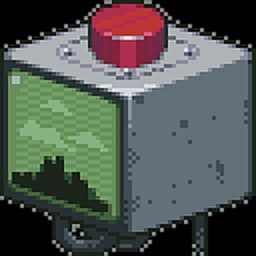
Bottom Line: A clever one-room puzzle game that turns a single forbidden button into about 25 endings, most of them darkly funny. It rewards patience and a notepad. Its most obscure solutions will send many players to a walkthrough.
The Gameplay Loop
The core loop is simple: touch, observe, reset, deduce. You press something, you watch what happens on the monitor, and you file that result away. After an ending plays, the station resets and you start again with what you now know. The reset is not a punishment. It is how the whole game advances.
Early on this loop is fantastic. The first presses of the red button produce immediate and ridiculous results, and the game teaches its central lesson without a tutorial: every input means something. That is good onboarding. There is no text box explaining the rules. The disobedience itself is the tutorial.
The game's real skill is escalation. Once you've used up the obvious inputs, the panel starts to show hidden depth. A compartment you ignored turns out to open. A keypad appears. A sequence of lights that looked decorative starts to look like a cipher. At its best, Please, Don't Touch Anything gives you the rare puzzle-game feeling of realizing the answer was in front of you the whole time.
Where Deduction Becomes Guesswork
The game also stumbles here, and the complaints in player reviews are fair. A handful of solutions ask for leaps of logic that are so obscure they break the deduction contract. Good puzzle design follows a simple rule: once you see the answer, it should feel inevitable. Too many of this game's late puzzles feel arbitrary instead. The clue exists, but reading it correctly takes either inhuman pattern recognition or a lucky accident.
Players then run into the second problem: the reset tax. Getting every ending takes a lot of trial and error, and each failed attempt means replaying a sequence of inputs to get back to the state you wanted to test. In the first hour, repetition supports the fun. By the fifteenth ending it is friction. A faster way to restore a known state would have taken much of the sting out of the completionist grind.
Pacing and Length
The game's biggest structural weakness is short shelf life. Its value is almost entirely knowledge-gated. Once you know the solutions, nothing is left to discover and very little to replay. An experienced player who knows the answers could get through most of the content in a small fraction of the time a first-time player spends. That does not ruin the game. It is a one-time experience, and it knows it. But you are paying for discovery, and discovery can't be repeated.
That is also why walkthroughs hurt more here than in most puzzle games. Look up one obscure solution and you have spent a meaningful share of the game's content. The best advice is also the hardest to follow: stay stuck longer than feels comfortable. Keep a physical notebook, write down every pattern, and treat the panel as a system to reverse-engineer rather than a list of buttons to cycle through.
Tone
It would be easy to undersell the writing, because there is so little of it. The humor comes almost entirely from consequence. It is the dark comedy of watching a pixelated city suffer for your curiosity, and the fact that no one comes back to stop you makes it funnier. It is the office-prank energy of being the bored person left alone with the equipment, scaled up to apocalyptic stakes. The game gets tension and comedy out of the same moment, which is harder than it looks.

