Bottom Line: A masterclass in "what-if" game design that transforms the ossified rules of chess into a visceral, high-stakes roguelike where every shell counts.
The brilliance of Shotgun King lies in how it weaponizes the player's existing knowledge of chess. We are conditioned to see a Knight’s "L" shaped move as a path for an attack; here, it is a vector for an incoming projectile. When the enemy Queen moves across the board, it’s no longer a strategic loss of a piece—it’s a charging boss coming to end your run.
The Gameplay Loop: Movement as Reload
The most significant design choice is the relationship between movement and ammunition. You don't have an "R" key to reload. You reload by moving. This creates a constant, agonizing tension: do you step into a dangerous square to get two shells back, or do you fire your last shot now and hope the spread pattern is kind? This turns the 8x8 grid into a claustrophobic dance floor. You are constantly calculating the movement patterns of Pawns, Bishops, and Rooks, not to trap them in a pincer movement, but to ensure you aren't standing in their line of sight when your gun clicks empty.
The soul-crushing difficulty of the higher ranks (Throne 1 through 20) reveals the depth of this system. At lower levels, you can survive by being a "cowboy," blasting anything that moves. At higher levels, you must become a Grandmaster of spatial awareness. You start to use the enemy’s own pieces as human shields, positioning a Pawn between yourself and a Rook to force the Rook to move rather than fire.
The Card Economy: Controlled Escalation
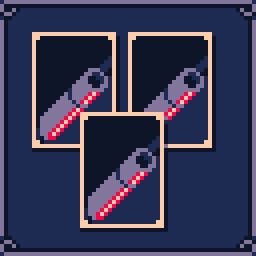
Most roguelikes suffer from "power creep," where the player eventually becomes an unstoppable god. Shotgun King avoids this by making every upgrade a Faustian bargain. If you want a wider blast radius, you might have to accept that every White Pawn now has a 10% chance to respawn as a Knight. This creates a compelling risk-reward dynamic. You aren't just building a character; you are curate-building your own nightmare.
The variety of these cards is impressive. Some change the fundamental rules—allowing you to move like a Knight or granting you a "soul" that lets you possess an enemy piece after killing it. Others are purely numerical but no less impactful. The psychological weight of seeing a "White King gets +5 HP" card paired with your favorite shotgun upgrade is palpable. It forces a level of strategic long-term planning that most coffee-break roguelikes lack.
RNG vs. Skill
There is a minor friction point regarding late-game RNG. Occasionally, a combination of card draws can result in a board state that feels genuinely impossible, particularly when the enemy army starts receiving multiple extra pieces. However, the inclusion of the Folly Shield and the "Turn Back Time" mechanic (if you have the right cards) mitigates most of the "unfair" deaths. Most failures can be traced back to a single misstep—a failure to respect the movement of a Bishop three squares away while focusing on the Pawn right in front of you.