
Overview
There’s a particular kind of arrogance in a puzzle game that refuses to tell you anything. No tutorial pop-up. No tooltip. No cheerful mascot explaining that hydrogen wants exactly one friend. Sokobond Express has that arrogance, and mostly earns it.
The game is a mashup sequel — a genuinely odd commercial proposition — welding together two of publisher Draknek & Friends’ best-known titles. From Sokobond it takes molecular chemistry as a movement puzzle: atoms have valence, valence dictates bonds, bonds dictate shape. From Cosmic Express it takes the single-continuous-path constraint: you draw one unbroken route across a grid, and that route is your entire vocabulary of action. Designer José Hernández handles the level design and the fusion, and the fusion is the interesting part. These two mechanics have no obvious reason to work together. They do, because the path is what makes bonding irreversible in space — once two atoms are locked, the shape they form has to fit through everything that comes after.
Draknek has spent a decade building a reputation as the boutique house for people who think Baba Is You was a bit loud. This fits the shelf. It also sits in an increasingly crowded corner: the premium, ad-free, no-monetization puzzle game, priced like a paperback, aimed at players who want forty-five minutes of quiet thinking rather than a live-service treadmill.
The reception has been warm; the store rating sits at 4.7 out of 5 from a small pool of ratings. That’s a strong showing, and mostly deserved. But “mostly” is doing real work in that sentence, because the complaints are consistent too: it’s short, the difficulty curve wobbles badly, and the hint system doesn’t hint so much as confess.
Key features
- Silent onboarding: Every mechanic — valence, double bonds, blockers, multi-molecule juggling — is taught through level layout alone. No text. The first level that introduces a rule is designed so that only one thing can possibly happen, and that thing is the lesson.
- Single-path routing: Each puzzle is one continuous, non-branching line drawn across a small grid. Atoms are collected as you pass over them and bond automatically per chemical valence rules.
- Bond-as-constraint: Bonded atoms move as a rigid body. Every atom you add rewrites how the shape can turn, which is the whole game in one sentence.
- No-fail architecture: Unlimited undo, no timers, no lose state, no move counter shaming you. Failure is just information.
- Hint unlocks: Stuck levels can be opened with an in-game hint, which — fair warning — is closer to a solution than a nudge.
- Scope: 100+ puzzles, achievements, full controller support, eleven languages, and touch path-drawing on mobile.
Analysis
The Gameplay Loop
The loop is almost insultingly simple to describe. You look at a grid. You trace a line from a start point, through some atoms, to a goal tile. If the molecule you assembled matches what the goal wants and physically fits, you win.
What makes it work is that the path and the molecule are fighting each other. In Cosmic Express, your route problem was about ordering — pick this up before that one. Here, ordering is only half of it, because the moment you pick up a second atom, you’re no longer steering a point. You’re steering a shape. A three-atom chain can’t take a hairpin turn in a two-wide corridor. Grab that oxygen early and you’ve made your own tail into an obstacle for the next six moves.
That’s the design insight, and it’s a real one. Sokobond’s chemistry was mostly a combinatorial puzzle — which atoms, in which order. Sokobond Express makes it a spatial one. Bonds stop being a scoring condition and become geometry.
The Teaching
This is the game’s genuine achievement, and it’s worth being specific about why. Most puzzle games treat onboarding as a separate system bolted to the front — a tutorial mode, a text box, a hand-holding first world you tolerate. Hernández treats it as level design.
When a new element appears, the level around it is constructed so that the wrong interpretation is physically impossible. You don’t learn that carbon takes four bonds because someone told you; you learn it because there’s exactly one route through the grid, you take it, and the resulting shape teaches you the rule retroactively. The next level assumes you understood. It’s the Portal method applied to a 6x6 board, executed with real discipline.
The knock-on effect is that the game never once condescends, and it never once stalls. There is no “press A to continue” between you and the interesting part.
Where the Curve Breaks
Now the problem. The difficulty progression is uneven, and it’s the most common complaint about the game for good reason. Late-game chapters put a thirty-second level directly adjacent to one that will eat fifteen minutes and a notepad. There’s no ramp between them — it’s a step function.
Some of this is inherent to hand-authored puzzle design; difficulty is subjective and one player’s wall is another’s warm-up. But a game this precise about teaching should be equally precise about pacing, and it isn’t. Several late puzzles read as though they were sequenced by mechanic introduction rather than by solve time.
The hint system compounds this. When you hit a wall, the button you press doesn’t graduate you toward the answer — it largely hands it over. That’s a design failure with a clear cost: the “aha” is the entire product here. A hint that removes the aha isn’t a hint, it’s a skip. A tiered system — reveal the first three tiles, then the constraint, then the route — would have cost little and preserved the thing players are actually paying for.
And a smaller irritation: a handful of late puzzles are fiddly to execute even after you’ve solved them. You know the route. You just have to draw it correctly through a cramped corner. That’s dexterity tax on a game with no dexterity component, and it’s the one place the interface intrudes on the design.
Identity
The fairest structural criticism is that Sokobond Express doesn’t have a hook of its own. It has two borrowed hooks, well-combined. That’s a real accomplishment in craft terms and a modest one in ambition terms. If you’ve played both predecessors, you’ll admire the joinery more than you’ll be surprised by it.
Visuals & performance
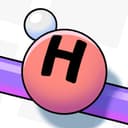
Flat pastel geometry, generous whitespace, atoms rendered as clean colored discs with bond-count dots. It’s not trying to be beautiful. It’s trying to be unambiguous, which for a puzzle game is a higher virtue, and it succeeds — a full board’s state parses in about a second, which is exactly the point.
The restraint is total: no particle effects, no screen shake, no confetti when you solve something hard. The ambient soundtrack is built to disappear, and it does. Some players will find the whole presentation cold. We’d call it appropriate. This is a game about thinking, and it has correctly identified that thinking hates decoration.
Performance is a non-issue by design. It’s a small grid with no physics, so a 2D game of this scope is light on hardware — and undo is your primary verb here, so the interface is built around it being instant.
Platform nuances
iOS and Android are the versions to get, and it isn’t close. Drawing a path with your finger is the natural input for this game — the interaction is literally the mechanic. It’s a rare mobile port where touch isn’t a compromise but the intended design. At $5.99, it’s an easy recommendation for the right audience.
Steam is fine. Mouse-drag works, controller support is complete and competent, and the larger screen helps on the busier late-game boards. But you’re doing with a cursor what your thumb does better.
Nintendo Switch is where we have to raise a hand. Handheld touch mode is good — same advantages as mobile. Docked-with-controller is the weakest input option in the package. And the $14.99 price is hard to defend against a $5.99 mobile build of the identical game, particularly for a campaign most players finish in two to three hours. That’s roughly $5/hour on a title that has no replay value once solved, because a solved puzzle stays solved. Switch buyers are being charged a platform tax for the worst-controlling version.
Final verdict
Sokobond Express is a small, sharp, well-made thing that knows exactly what it is. The mashup premise sounds like a novelty; the execution is more than that. Making bonds into spatial constraints rather than checklist items is a real design idea, and teaching a hundred levels’ worth of rules without writing a single sentence is the kind of craft most studios don’t attempt because it’s harder than a tutorial.
But it’s brief, it’s uneven in the back half, and its hint button quietly undoes the thing you came for. It’s a refinement of Draknek’s house style rather than a departure from it, and it will not surprise anyone who’s played the games it’s built from.
Buy it on your phone for six dollars, where the input matches the design and the price matches the runtime. It’s a solid three hours, and we recommend it to the right audience on that basis. On Switch at fifteen, wait for a sale — the game doesn’t get better at that price, and the controls get worse.
Reviewed by the Rankeno Puzzle & Casual Desk. Scores are out of 10; the overall score is the desk’s editorial judgement, informed by the four sub-scores above. How we review