
Overview
Tile-matching games are the comfort food of the app stores: free to start, quick to finish and built to fill the gaps in a day. The category is crowded with near-identical boards of stacked pictures, so a new entrant wins on polish, pacing and how it treats its players, not on invention. Tile Explorer - Triple Match, from Oakever Games, competes on exactly those terms.
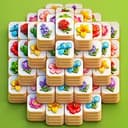
The premise fits in a sentence. A board holds stacked, overlapping tiles, each printed with a picture. Tapping a free tile sends it to a holding tray at the bottom of the screen, and any three matching tiles in that tray vanish. Clear every tile and the level is won. Fill the tray before completing a set and the level is lost. That failure condition separates the format from a pure matching exercise. Every tap spends a slot, so the player has to decide which tiles to uncover and in what order.
Around that rule, Oakever has built a familiar free-to-play package. The main progression opens with gentle warm-ups and escalates into denser layouts with more tile types. Boards rotate through visual themes (seaside scenes, rainforests, ancient ruins, colorful gardens), rendered with 3D-style tiles and ASMR-style sound effects. Regular events, challenges and competitive modes against other players run alongside the main progression, and boosters exist to rescue stubborn boards. The game works offline, is suitable for all ages, and is funded by ads and in-app purchases.
The store rating is 4.9 out of 5 from 343,865 ratings. A high average measures satisfaction, not depth, but at that scale it confirms the loop lands with its intended audience: people who want a calm, low-commitment puzzle with enough bite to feel earned.
Key features
- The holding tray: Every tapped tile occupies a slot until it completes a set of three. A full tray ends the level, so each tap is a resource decision.
- Long progression: A main campaign that starts with low-pressure warm-ups and ramps into dense, multi-layered boards with a wider spread of tile types.
- Themed boards: Seaside, rainforest, ancient ruin and garden themes rotate across levels, with 3D-style tiles that give the stacks visible depth.
- ASMR-style audio: Soft, tactile sound effects built for relaxation, plus an announcer voice that can be switched off in settings.
- Events and competitive modes: Regular events, challenges and modes against other players add scheduled goals beyond the main levels.
- Boosters: Optional aids for boards that refuse to break.
- Offline play: The game works without a connection, a practical advantage for commutes and flights.
Analysis
The Tray Is the Game
Strip away the theming and Tile Explorer is a resource-management puzzle with one scarce resource: tray space. Matching three identical pictures is trivial. Matching them before the tray fills is not, because the tiles a player needs often sit beneath tiles they don’t. Every board becomes a question of excavation order. Which top tile is worth a slot to expose what lies beneath it? Will that sacrifice pay off in a completed set two or three taps later, or leave a stranded tile clogging the tray?
This rule is the best decision in the design, and it is the genre’s standard mechanic, not Oakever’s invention. What matters is execution, and the structure here is sound. The loss condition is legible. The tray is always on screen, so a player sees failure approaching several moves ahead. That transparency keeps losses feeling fair. A board ends badly because of a choice that could have gone differently, not because of a hidden rule.
The flip side is variance. Stacked layouts hide information by design, and a tile buried three layers deep can force a bad commitment that no amount of planning would avoid. Boosters step in at exactly that tension point, and that is where the free-to-play model starts shaping the puzzle instead of sitting politely beside it.
Difficulty Curve and Onboarding
The early levels are gentle, gentle enough to read as too easy for experienced puzzle players. That reads as deliberate. An all-ages casual puzzler has to teach its one rule with zero onboarding friction, and a run of near-certain wins builds the habit before it builds the challenge. The cost falls on experienced puzzle players, who have to sit through a slow on-ramp before the boards start asking real questions.
Later levels do ask them. Denser layouts and more tile types shrink the margin for error, because more distinct pictures means more tiles competing for the same few slots at once. Later stages are designed to be challenging, which matches the curve the game sets out. A long campaign gives that curve room to stretch, but volume and variety are different things. Difficulty rises mainly through density and tile count, and a campaign this long, built on a single rule, will repeat itself no matter how many backdrops rotate behind it.
Events, Competition and the Trust Problem
Events, challenges and competitive modes give a solitary puzzle social stakes and a reason to return on a schedule. That is standard retention design, and it only works if players believe in it. Here the game hits friction. The percentile stats and competitive opponents invite suspicion. That dispute is not for a review to settle, but the perception itself is a design problem. Flattering percentile stats are a cheap reward, and once players doubt them, the doubt spreads to features that depend on honesty, competitive modes first among them. Plainer progress feedback would cost the game little and protect its credibility.
Monetization: Ads and Boosters
Ads are the dominant complaint: frequent, intrusive, and at odds with the relaxation pitch. An interruption every few minutes breaks the calm that the ASMR audio and soft themes work to build. Ad placement needs a fix, not a promise.
Boosters and in-app purchases share the same model, and that pairing is the genre’s familiar pressure point: the harder the board, the more tempting the shortcut. The game frames boosters as help for tough boards, which is a reasonable role. Players who dislike being nudged at moments of frustration should still expect the free-to-play machinery to show.
Visuals & performance
The art direction picks a lane and stays in it: bright, tactile and gently skeuomorphic. The 3D-style tiles give each stack visible depth, which matters for function as much as looks. In a game where a covered tile is untouchable, the eye needs to read layering at a glance. The rotating themes (seaside, rainforest, ancient ruins, colorful gardens) keep a long campaign from feeling visually static even though the underlying rule never changes.
The art’s real test is later levels. More tile types put more distinct icons on screen at once, which turns icon legibility into a gameplay concern. Two pictures that look alike at small sizes can cost a slot. Dense themed boards strain contrast and silhouette, and that strain grows with the campaign.
The ASMR-style sound design suits the relaxation brief. The announcer voice divides players, but a settings toggle turns it off. That is the correct fix.
A tile puzzle of this kind is a light workload by design: mostly static boards and simple tile animations. Offline support means the main game doesn’t depend on a connection, although modes against other players logically need one.
Platform nuances
Tile Explorer lives on iOS and Android only. There is no Steam or Nintendo eShop release. Both versions use touch, which suits the format perfectly. The entire interaction model is a single tap on a tile, so nothing gets lost in translation and neither platform has a control advantage.
The store rating is 4.9 out of 5 from 343,865 ratings. That average does not separate platforms, so it cannot show whether one version carries a weakness of its own.
Final verdict
Tile Explorer - Triple Match does one thing cleanly: the holding tray gives a familiar matching format real stakes. The themes and sound design support the relaxing tone the game promises. But frequent ads undercut the calm the game sells, and doubts about percentile stats and competitive opponents weaken its social layer. The early levels are too gentle for experienced puzzle players, and boosters sit at the frustration points. The core is solid; the package is not. We recommend it only to casual players who can tolerate interruptions. Anyone who wants an uninterrupted puzzle should look elsewhere.
Reviewed by the Rankeno Puzzle & Casual Desk. Scores are out of 10; the overall score is the desk’s editorial judgement, informed by the four sub-scores above. How we review