
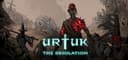

Overview
There’s a particular kind of strategy game that doesn’t want to be liked. It wants to be respected, and it will spend its first two hours proving you haven’t earned that yet. Urtuk: The Desolation is squarely in that lineage — a turn-based tactical RPG from Mad Sheep Studios, which is a grand-sounding name for what is essentially one person: David Kaleta, who spent years building this thing largely alone. It launched on Steam on February 27, 2021, as a paid title currently listed at $13.99.
The premise is functional rather than inspired. You’re Urtuk, a survivor of grotesque experiments that are killing you by degrees, dragging a warband of mercenaries across a dying continent looking for something like a cure. The story is scaffolding. Nobody is here for the narrative, and the game knows it — the writing exists to justify why a half-dead man is harvesting mutations out of corpses, and once that’s established it gets out of the way.
What Urtuk is actually selling is attrition. You move a party token across a procedurally generated overworld dotted with battles, camps, shrines, mercenary contracts and random events. Supplies run thin. Injuries accumulate. Fighters die and stay dead. Every node you choose is a resource calculation as much as a tactical one, and the campaign arc — roguelite, permadeath-inflected, with meta-progression bleeding between runs — means most first attempts end in a slow, humiliating collapse rather than a dramatic defeat.
Market positioning is easy to read: this is Battle Brothers wearing Darkest Dungeon’s coat, and the comparison gets made for a reason. It occupies the space between them — less economically punishing than Battle Brothers, less theatrically miserable than Darkest Dungeon, and cheaper than both. Its positive reception on Steam tracks with a game that has stopped receiving major updates but hasn’t stopped being difficult.
Key features
- Trait Extraction: Defeat an enemy and you can harvest its mutation or ability and graft it permanently onto one of your own fighters. This is the game’s signature idea and its best one — enemies stop being obstacles and become a build catalog you shop from mid-campaign.
- Physics-Flavored Tactical Combat: Positioning outranks raw statistics. You shove, ram, and knock enemies into spike pits, chasms and hazards, chain counterattacks off frontline shields, exploit elevation, and bleed opponents out over multiple turns rather than deleting them in one.
- Organic Skill Learning: Characters develop abilities by doing things in battle instead of spending points in a menu. Your archer becomes a better archer because it shot people, which is a quietly elegant alternative to the standard skill tree.
- Procedural Overworld Campaign: A generated map of battles, shrines, camps and hires, gated by scarce supplies, where every engagement carries real risk of permanent loss.
- Hand-Drawn Sketch Art: A deliberately unfinished, ink-and-charcoal visual identity that does enormous work on what must have been a nonexistent art budget.
Analysis
The Gameplay Loop
Urtuk’s loop is a pressure system. You enter a region with a warband, limited supplies, and a rough sense of how strong the local encounters are. You pick fights you think you can survive. You win, you extract traits, you patch up your wounded at a camp — and then you look at your supply counter and realize you can’t afford to be choosy about the next one.
This is where the game separates itself from its peers. Battle Brothers punishes you economically; Darkest Dungeon punishes you psychologically. Urtuk punishes you structurally. Wounds persist. Bodies wear out. A veteran who’s survived twelve battles is carrying accumulated damage that makes the thirteenth a real threat, and the game refuses to let you grind your way out of trouble because grinding costs supplies you don’t have. The result is a campaign that feels like a controlled slide downhill — you’re not building toward inevitable dominance, you’re managing the rate of your own decline and hoping the finish line arrives first.
Combat Is the Whole Argument
Strip away everything else and the combat would still be worth the price of admission.
Most tactical RPGs resolve to arithmetic. You compare hit chances, you take the better number, you move on. Urtuk resolves to geometry. The battlefield is littered with spikes, ledges, chasms and hazards, and the strongest play in almost any given turn is not “attack” — it’s “reposition the enemy into something that hurts.” Ramming a heavily armored knight into a spike wall bypasses his armor entirely. Shoving an archer off elevation strips his advantage and his health simultaneously. Pulling a unit out of a counterattack chain matters more than the damage you’d have done by swinging.
Layer trait extraction on top and the system starts producing builds the game never planned for. Every enemy archetype you kill is a potential component. You start assembling fighters who don’t resemble any class the game shipped with — a bleeding-focused skirmisher with a mutation that heals on kill, a shield-bearer who counterattacks twice and reflects damage. This is the mechanic that defines Urtuk, because it converts combat from a cost into an investment. Losing a fight hurts. Losing a fight where you almost extracted the trait you needed hurts differently.
Onboarding Friction, and There’s a Lot of It
Now the annoying part. Urtuk’s tutorial is inadequate and its interface is worse.
The game surfaces an enormous amount of information — status effects, terrain modifiers, counterattack ranges, trait interactions — through dense tooltips, small icons and menus that were clearly designed by someone who already understood the systems perfectly. Critical mechanics go unexplained. The distinction between mechanics that seem similar isn’t communicated. New players can reasonably expect to lose their first two campaigns not to tactical error but to information error — not knowing a rule existed.
That criticism is entirely fair. The onboarding friction here is not stylistic difficulty; it’s a UX failure. A game this mechanically rich needs a mechanically rich explanation layer, and Urtuk shipped without one. Expect to consult a wiki. Expect to restart once you finally understand what you were doing wrong.
Where the Design Thins Out
Two other complaints hold up under scrutiny. The overworld gets repetitive. The procedural generation produces variety in arrangement, not in kind, and by the third long campaign the map nodes read as a checklist rather than a journey. Encounters carry the game; the space between them doesn’t.
Difficulty spikes are real and occasionally unfair. Some encounter compositions arrive meaningfully above the local curve, and because supplies constrain your ability to retreat and rebuild, an unlucky draw can effectively end a run that was going fine. There’s a difference between a hard game and a game with variance you can’t plan around. Urtuk crosses that line more often than it should.
Visuals & performance
The hand-drawn sketch aesthetic is a smart resource decision for the entire project. Rather than attempting fidelity a solo developer can’t afford, Kaleta committed to a rough, inked, deliberately unpolished look — smeared charcoal figures, muddy palettes, a world rendered like a field journal kept by someone who’s given up. It reads as intentional artistic direction, not budget compromise, and that’s a difficult trick to pull off.
The UI does not share that grace. It’s cramped, icon-heavy, and inconsistent about where information lives. Tooltips explain the what and skip the why. Comparing two units requires more clicking than it should. The overworld interface in particular feels like a placeholder that shipped.
Technically, there’s little reason for concern. A 2D turn-based game of this scope is light on hardware by design, which suits a game you’ll want running on a laptop at an airport.
Platform nuances
Steam is the only home this game has, and mouse-and-keyboard is the right and only input. Combat is grid-based click-and-confirm, which suits the platform exactly — no controller mapping compromises, no touch-target problems.
What Steam gives Urtuk specifically is its review corpus. Positive user reception is the credibility signal that gets this game bought, because it has no marketing behind it. At $13.99 list price, it’s already reasonably priced for what it offers.
Steam Cloud saves and achievements are present. The Workshop is not a factor here. One practical note: budget an hour with a community guide open in your browser or the Steam Overlay. That’s not optional, and the platform at least makes it convenient.
Final verdict
Urtuk: The Desolation is a rough, clever, frequently irritating game, and the ratio of those three qualities lands in its favor — narrowly, and only for the right audience.
What one developer accomplished here is impressive — a combat system with more tactical texture than most funded studio efforts, anchored by a progression mechanic that other games would do well to study. Trait extraction reframes what defeated enemies are for, and once it clicks, the standard “kill enemy, gain XP” loop starts to feel lazy by comparison.
The failures are real and they’re concentrated in presentation, not design. The tutorial doesn’t teach. The interface obscures. The overworld runs out of ideas before the combat does. These are the kind of problems a full team with a UX designer would have solved, and their absence is exactly where the solo-development seams show.
But the core holds. Games this cheap are rarely this deep, and games this deep are rarely this cheap. That trade — a hostile first impression in exchange for a long campaign of smart, positioning-driven tactics — is one worth making for genre veterans, provided you know you’re making it going in.
Bring a wiki. Expect to lose.
Reviewed by the Rankeno Strategy & Sim Desk. Scores are out of 10; the overall score is the desk’s editorial judgement, informed by the four sub-scores above. How we review