
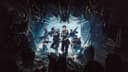
Overview
There have been a lot of Alien games. Most of them get one thing wrong in the same way: they hand you a pulse rifle and then hand you enough ammo to use it. Aliens: Dark Descent is the rare entry that treats your magazine count as a narrative device.
Developed by Tindalos Interactive — the French studio behind the Battlefleet Gothic: Armada games, a pedigree that matters more than it initially seems — and published by Focus Entertainment, Dark Descent is a squad-based, single-player real-time tactical game with an isometric camera and a pause button built to be worn out. You’re not steering a marine. You’re commanding a four-body fireteam as a single cursor-driven unit on the colony world of Lethe, where a Weyland-Yutani containment failure has done what Weyland-Yutani containment failures always do.
The positioning is deliberate and slightly contrarian. This is not XCOM with facehuggers — there’s no turn grid, no percentage-to-hit popup, no clean tactical abstraction. It’s closer to the old Commandos and Desperados lineage crossed with a roguelite campaign layer, wrapped in a persistent base sim aboard the USS Otago. Between deployments you research tech, fabricate gear, heal the wounded, recruit replacements, and watch an infestation clock tick upward whether you deploy or not.
The reception split is instructive. Steam players rate it Very Positive, while critics were cooler: Metacritic lands around 75 on PC. That gap isn’t noise. It’s the signature of a game whose systems reward investment and whose surfaces frustrate on first contact — friction up front, payoff for those who settle into the Otago.
Key features
- Squad-as-Unit Command: You issue orders to a fireteam, not a soldier. Movement is a single blob; abilities — sentry turrets, welders, flamethrowers, motion scans — are assigned per marine through a radial menu with real-time-with-pause layered on top. The pause is not optional. It is the game.
- Adaptive Hunt Escalation: Noise, gunfire, and corpses feed a colony-wide alert state. The hive responds with escalating patrol density and a persistent Hunt that tracks you across the map. Play loud, and the level materially gets harder for the rest of the deployment — and, through the campaign infestation clock, for the rest of the game.
- Permadeath and Psychological Attrition: Dead marines stay dead. Wounded marines need real campaign days in a medbay. And stress is a second health bar — max it out and your veteran gunner acquires a permanent phobia, a trauma, or a panic trigger that follows them into every future mission.
- Safe Rooms and Multi-Day Deployments: Missions are long, open, and interconnected. You can weld a door, secure a room, rest overnight, and push deeper — at the cost of another day on the infestation clock. Every extraction decision is a bet.
- Persistent Otago Base Layer: Research trees, gear fabrication, five marine classes with dozens of specializations, and a recruitment pipeline that never quite keeps pace with your casualty rate.
Analysis
The Gameplay Loop
The loop is a triage machine, and a well-built one.
A deployment begins with a mission objective that looks achievable and a squad that looks adequate. Neither assumption survives long. You drop, you sweep, you find the motion tracker pinging three contacts through a wall you can’t see past, and the tactical calculus becomes a question of whether any fight is worth the ammunition and stress it will cost. Most of the time the answer is no. The smartest design decision here is making retreat the default correct play — not through a difficulty slider, but through economics. Bullets are finite. Welding torches are finite. Marines are extremely finite.
That pressure produces the thing Alien games almost never produce: dread that isn’t jump-scare dread. When you crack a door and the tracker lights up like a slot machine, the fear is arithmetic. You know exactly what you can’t afford.
The stress system deserves specific credit. Most games model psychological damage as a debuff with a timer. Here it’s a permanent character ledger. A marine who survives a Praetorian ambush comes home changed, and the trauma they pick up — say, a panic response to being flanked — reshapes how you can deploy them for the rest of the campaign. It creates squad members with histories, and it does so mechanically rather than through cutscenes. Losing a high-level Recon with several specializations and one bad phobia hurts in a way few scripted deaths in this franchise have managed.
Where It Frays
The stealth controls are the loudest complaint in critical coverage, and fairly so. Because you command the squad as a single entity, precise positioning — the bread and butter of the Commandos lineage this borrows from — is imprecise by construction. You want your Tecker two meters left of your Sergeant; the game wants the squad to be a cohesive doughnut. Sneaking past a patrol frequently fails not because you misjudged the patrol but because pathfinding routes the blob through the one tile with line of sight. Form loses to function here, but only because the form was chosen first and the function had to follow.
The mid-game is the other soft spot. Lethe’s environments are genuinely varied — colony habs, industrial sprawl, a hospital that earns its reputation — but the objective vocabulary runs thin around the halfway mark. Restore power. Escort the technician. Hold the position until the timer expires. The escalation systems keep the tension fresh long after the tasks have gone stale, which is a strange and slightly uncomfortable place for a game to live.
Launch bugs were severe enough that several reviewers used the phrase “game-breaking,” and those scores are baked into the Metacritic aggregate permanently. Patches since have addressed the worst of it. Anyone buying now is buying a materially different, substantially more stable product than the one that shipped in June 2023 — worth remembering when you read a 75.
Interface
The UI is competent and information-dense, but it asks a lot. Command points, ammo, tools, stress, squad cohesion, the hunt meter, and the motion tracker all compete for attention during moments when you have about two seconds to make a decision. The radial ability menu is the weak link — it’s slower than a hotkey row would be, and in a pause-driven game, every extra click is a tax on the one resource the design is actually spending: your attention.
Visuals & performance
The art direction is the unsung win. Tindalos went full Cameron-era industrial brutalism — chunky CRT terminals, amber warning strobes, cable runs bolted to concrete, that specific 1986 vision of the future where everything is heavy and nothing is clean. It’s reverent without being a theme park. The xenomorph animation work sells the threat: when one drops from a ceiling vent, the read is instant and awful.
The isometric camera is a double-edged choice. It gives you the tactical legibility the genre requires, but it also holds the aliens at a distance, and some of the horror evaporates at that remove. The game compensates with sound — the pulse rifle report, the tracker’s pulse, the wet ambient noise of a hive — and the compensation mostly works. Headphones are the intended way to play.
As a 2023 mid-budget isometric game, this is light on hardware by design, and the post-launch patch train cleared out the crashes and objective-blocking bugs that defined its first month. Texture work is merely fine up close. Lighting is where the budget went, and it was the right call.
Platform nuances
Steam is the definitive version, and it isn’t close. This is a mouse game. Cursor-driven squad orders, drag-to-position turrets, and quick target selection under pause all want a pointer with sub-pixel precision, and mouse-and-keyboard delivers exactly that. Controller support exists and is serviceable, but stick-driven cursor movement adds latency to a game that already asks for fast calls under pause — a tax on every ability placement.
The PC version also benefits most from the patch history, since it’s the platform where players are most likely to be running the fully current build. Worth flagging for handheld players: the UI text is small and dense, and a small handheld screen is not kind to a game with six simultaneous resource readouts. Bump the scaling if your setup supports it.
One correction to a common search result: there is no iOS, Android, or Nintendo Switch release. The game shipped on PC, PS4, PS5, Xbox One, and Xbox Series X|S. Anything claiming otherwise is wrong.
Final verdict
Dark Descent is the most interesting thing to happen to this license in years, and its flaws are the honest kind — the kind that come from committing hard to a design thesis rather than hedging. Tindalos decided that an Aliens game should be about scarcity, consequence, and the slow degradation of people you’ve come to know by callsign. They built the systems to support that and then shipped them attached to controls that fight you.
The gap between the Steam player score and the critic aggregate is the whole review in one statistic. The friction is front-loaded. The payoff is buried deep in the campaign, when you’re choosing between extracting a squad with two wounded and one marine a few points from a permanent phobia, or pushing one more room because you need the intel and the infestation clock is bleeding you dry either way. Nothing else in this genre makes that decision feel like it costs something.
We rate it a solid recommendation for the right audience: tactics players with patience and franchise devotees who value tone over spectacle. Give it several hours before judging the stealth. Then let it take your best marine.
Reviewed by the Rankeno Strategy & Sim Desk. Scores are out of 10; the overall score is the desk’s editorial judgement, informed by the four sub-scores above. How we review