
Overview
Most platformers treat a wall as the edge of the level. Gecko Gods treats it as a road. Developed by Inresin and published by Super Rare Originals, this single-player puzzle-adventure casts you as a tiny gecko on a forgotten island archipelago. The choice of animal is the design pitch: you can climb walls and cliffs and cling to ceilings, so terrain that would block a human hero becomes a set of open routes. It is available on Steam, Nintendo and PlayStation, and releases April 16, 2026 at $19.99.
The structure around that verb is deliberately gentle. A small wooden boat carries you between islands in whatever order you choose, and each stop offers ruins and temples to pick apart through environmental puzzles. Piece by piece, those sites reveal the history of a vanished ancient civilization. There is no combat and no time pressure. The soft pastel art and calming music carry the same message: this is a game about curiosity, not mastery.
That places Gecko Gods in the relaxed-exploration niche, a crowded field where a single strong hook decides whether a game gets remembered. Its scope is modest. The appeal is easy to state: a compact island-hopper built around one movement verb. The risk is equally clear: a short, gentle game has little room for technical or signposting failures.
Key features
- Wall and ceiling climbing: The gecko sticks to walls, cliffs and ceilings, so routes run vertically and overhead as well as along the ground. Most locations can be approached from more than one angle.
- Free-order island hopping: A small wooden boat links the archipelago, and you pick the next destination yourself instead of following a fixed sequence.
- Environmental puzzles in ruins and temples: The challenge comes from reading and manipulating spaces, not from enemies or reflex tests.
- A lost civilization to reconstruct: The history of a vanished ancient culture comes together gradually across the islands.
- No combat, no timers: Nothing chases you and nothing counts down. Pacing stays entirely in your hands.
- Optional collectibles and gecko cosmetics: Extra incentives to search every corner, extending a compact story.
- Pastel art and a calming score: A soft visual palette and gentle music reinforce the low-pressure tone.
Analysis
Movement Is the Mechanic
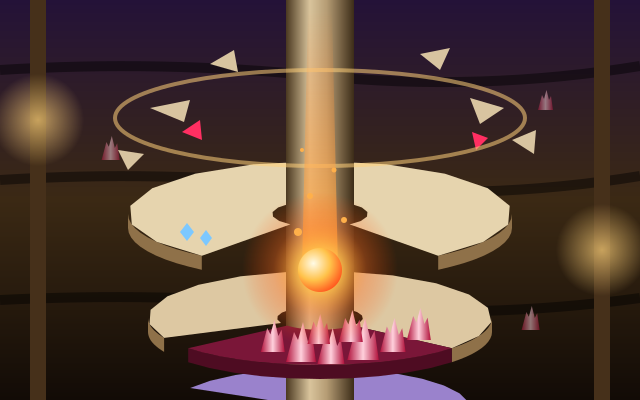
The climbing system does the job that combat does in most adventure games. It is the thing you do every second, and it shapes how every space has to be built. When a gecko can stick to any wall or ceiling, the classic platformer vocabulary of ledges, gaps and dead ends loses its meaning. A cliff face stops being an obstacle to route around and becomes the route. That pays off for exploration, because reaching a location becomes a small puzzle of its own.
The same freedom carries a cost, and the design explains it. A movement system that lets the player cling to almost any surface multiplies the seams, corners and edge cases a small team has to account for. Surface-sticking movement is also a hard control problem, because the meaning of “forward” shifts whenever the character’s orientation does. The control scheme is built around a controller; keyboard-and-mouse is the less natural fit for this kind of movement.
An Archipelago Without a Leash
Boat travel gives Gecko Gods its shape. Instead of a corridor of levels, you get a map of islands and the freedom to choose where to go next at your own pace. For a game built on curiosity, that is the right call. An island on the horizon becomes a goal you set yourself, and the climbing system means there is rarely only one way in once you arrive.
Non-linearity without combat has one weak point: it shifts all the friction onto signposting. When nothing can kill you and nothing hurries you, the only way to fail is not knowing what to do next. A temple that withholds clues is the most damaging kind of stall in a game this calm; it turns a relaxed afternoon into a wiki search. We count that as a design flaw, not a difficulty spike, because the problem is missing information, not excessive challenge.
Puzzles and Payoff
The environmental puzzles in the ruins and temples supply the challenge the game otherwise refuses to impose. The pairing works because puzzles and traversal draw on the same skill: reading a space. In a game where ceilings count as floor, spotting a reachable overhang or an overlooked cliff is half the solution. Exploration and puzzles reinforce each other instead of competing for attention.
The narrative is where the structure strains. Reconstructing a vanished civilization is a classic exploration hook because it promises a revelation at the end of the trail. The story is compact and the ending is soft. Brevity alone is no fault in a short game. A soft landing, though, undercuts the one long-term motivation the archipelago offers beyond its collectibles, and it weakens the reason to follow the trail at all.
Collectibles and Length
The optional collectibles and gecko cosmetics extend the search, and they fit this movement system better than such extras usually fit a game. Hidden items reward thoroughness, and a gecko that can reach every overhang makes “every corner” a broad search space. Cosmetics are a modest prize, but they match the tone: they change how the gecko looks, not how the game plays.
A compact length suits this kind of game. It respects the player’s time and avoids the padding that relaxed exploration titles often lean on. It also means technical or signposting failures take up a larger share of the whole than they would in a longer game.
Visuals & performance
The soft pastel art style suits a game about a small creature in a large, quiet world. A gentle palette keeps the islands inviting instead of imposing. The gecko protagonist gives the player a clear anchor in spaces meant to be read from unusual angles. The calming music and sound design also do structural work. Without combat cues or timers, audio is one of the few tools left for setting rhythm.
Interface demands are light by design. With no combat and no clock, there is no call for health bars, ammo counts or countdowns, which leaves the screen to the scenery.
Performance is the weaker story. A stylized game of this scope should not be demanding on hardware, so the risk is stability, not horsepower, and it sits where the climbing system’s complexity would predict. Anyone sensitive to technical rough edges should treat that risk seriously. A game-breaking bug would cost more in a short game than in a long one.
Platform nuances
- Steam: The PC version shares the same design as the console releases. Keyboard-and-mouse movement is the less natural fit, so a controller is the safer choice.
- PlayStation: The same climbing-led adventure, with controller input as the default.
- Nintendo: The portable option for the same island-hopper. The design does not change across platforms.
Platform choice is mostly about where you prefer to play. The climbing hook and the signposting risks travel with the game.
Final verdict
Gecko Gods has one well-chosen idea. Letting a gecko climb walls and cling to ceilings turns an island archipelago into a web of routes. The boat travel, environmental puzzles and calm presentation all serve that freedom instead of diluting it. The climbing hook is the reason to consider the game.
Execution caps the score. The climbing system’s flexibility invites technical risk, a temple that withholds clues can strand the pace, and a soft ending weakens the pull of a compact story. At $19.99, those problems are harder to overlook. We rate it a mixed proposition: patient explorers on PlayStation or a controller-equipped PC may find a short, gentle expedition with a real movement idea, but most players should wait for the rough edges to be addressed.
Reviewed by the Rankeno Action Desk. Scores are out of 10; the overall score is the desk’s editorial judgement, informed by the four sub-scores above. How we review