

Arcaea
game
8/4/2026

Arcaea

bylowiro
8.6
The Verdict
"Arcaea is the most important rhythm game of its generation, and it is undermined by its own storefront. The core is close to flawless — a mechanic nobody else has, chart design that treats the two-plane split as compositional rather than decorative, a difficulty curve that respects beginners without softening for experts, and an art direction disciplined enough to disappear when the music takes over. lowiro built something genuinely new on hardware everyone assumed had been fully explored, and they did it from Britain, in a genre dominated by Asian studios, with no franchise behind them." "What holds it back is not greed but opacity. The free tier is real and it keeps growing. The artists get paid. But a purchase system players can't parse converts good faith into suspicion, and that suspicion has become the loudest note in the game's public reception — the one complaint that recurs across both stores at every rating tier. Fix the store's clarity and this is a 9." "Install it on the largest screen you own. Play the Past charts without embarrassment. Give it three hours before you judge the difficulty. And decide what the music is worth to you before you open the shop, because the shop will not help you decide."

Gallery

Screenshot 1
View
Screenshot 2
View
Screenshot 3
View
Screenshot 4
View

Key Features

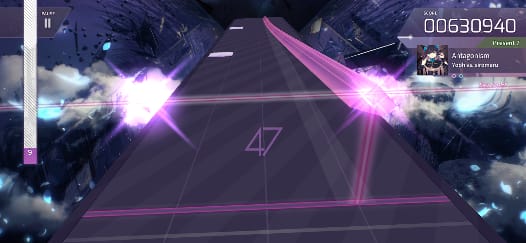
The Sky Plane (Arcs & Sky Notes): The defining mechanic. Curved arcs traced in the air above the main track, held and dragged in real time, layered on top of conventional lane tapping. This isn't a gimmick bolted onto a lane game — the charts are composed around the two-plane split, and the best ones use the vertical axis for phrasing the same way a good producer uses stereo width.
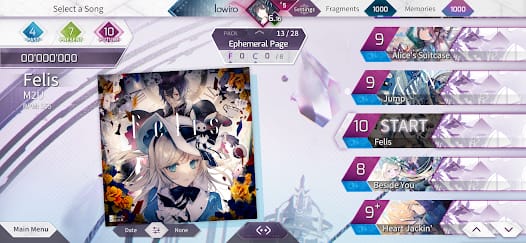
Four-Tier Difficulty Ladder (Past / Present / Future / Beyond): A genuinely rare achievement in this genre. Past charts are approachable enough for someone who has never played a rhythm game. Beyond charts sit among the hardest content in the medium, full stop. Same song, same audio, radically different game.
The Potential Rating (PTT): A single aggregate skill number computed from your best plays. It gates content, ranks you against friends, and functions as the game's real progression system — the thing you're actually leveling up is yourself, and the number just reports it honestly.
World Mode + Partner System: A step-based map where scores convert into forward movement, with unlockable partner characters carrying stat modifiers that alter your travel rate. It's the delivery mechanism for story chapters, new songs, and unlocks.
The Library: Hundreds of licensed tracks spanning electronic, doujin and hardcore, expanded through free updates and purchasable packs. The curation is the quiet triumph here — this is a scene soundtrack, not a stock-music dump.
Full Online Suite: Offline play, global leaderboards, friend rankings, and real-time multiplayer, on phones and tablets.

The Good

The Arc/Sky Note system is a real mechanical innovation, not a reskin
Difficulty ladder from Past to Beyond genuinely serves both newcomers and experts
Curated library of 200+ electronic, doujin and hardcore artists with ongoing free updates
Art direction is legible at speed, which is the metric that matters
Potential rating is an honest, consistency-based skill metric
Offline play, leaderboards, friend rankings and real-time multiplayer all included

The Bad

Song-pack and Memory currency economy is confusing and feels expensive
World Mode's stamina gating interrupts play exactly when engagement peaks
Small phone screens materially cap your skill ceiling — a tablet is near-mandatory
$39.99 Switch port has less music than the free mobile version
Systemic onboarding (Potential math, partner stats, step economy) is left to community wikis
Perception that the best charts live behind the paywall colors every purchase prompt

In-Depth Review

Bottom Line: lowiro built the most mechanically inventive rhythm game on mobile by dragging the genre off its flat plane and into the air, then wrapped it in a song-pack economy that's the single most-cited complaint in 146,000 Google Play reviews. The game is a 9. The store is a 5.

The Gameplay Loop

The moment Arcaea clicks is specific and memorable, and it usually happens two or three hours in. Up to that point you're consciously tracking two things — lanes below, arcs above — and your brain is task-switching between them, which is why early Future charts feel less like music and more like air traffic control. Then something reorganizes. The two planes stop being separate problems and become one shape. You stop reading the chart and start reading the song.

That transition is the entire design thesis, and it's why the difficulty ladder matters so much. Past charts are functionally a tutorial that lasts as long as you need it to. Present introduces the two-handed split without punishing you for fumbling it. Future is where the game actually lives. Beyond is where it stops negotiating. Crucially, the tiers aren't just density scaling — a Past chart isn't a Future chart with notes deleted. They're different arrangements of the same track, which means dropping down a tier is a legitimate way to enjoy a song rather than an admission of failure. Very few games in this space respect the low end that much.

The scoring model reinforces this. Potential rewards consistency across your best plays rather than a single lucky clear, so the optimal strategy is to actually get good at a spread of charts instead of grinding one to death. It's an honest metric, and honest metrics are rarer than they should be.

Where the Loop Frays

World Mode is the weak link, and it's weak for structural reasons rather than executional ones. Progression through the map is gated by a stamina resource, which means the game will, at some point, tell an engaged player to stop playing — or rather, tell them they may keep playing but their play will no longer count toward anything. That's a free-to-play retention pattern grafted onto a skill game, and the graft is visible. The friction lands hardest exactly where you least want it: right after the mechanic clicks, when you finally want to binge.

The economy compounds it. Content arrives as purchasable song packs, some bought directly and some through Memory currency, and the two-track system is opaque in a way that reviewers have flagged relentlessly. The recurring complaint across the Play Store's 146,000 reviews isn't that the game costs money — rhythm fans are among the most willing spenders in gaming, because they know licensing music is expensive. The complaint is that it's hard to tell what you're buying, what it costs in real currency, and whether you're getting a good deal. When a player has to build a spreadsheet to evaluate a $4 purchase, the storefront has failed.

There's a fairness point that deserves saying plainly: the free tier is substantial and grows with updates, and lowiro pays actual artists for actual music. But the game's own reputation works against it here. Word of mouth says the best charts sit behind packs, and once players believe the paywall guards the good stuff, every purchase prompt reads as a toll rather than an offer.

Onboarding

Getting in is easy; getting told things is not. Arcaea explains its inputs competently and then leaves you to reverse-engineer Potential math, partner stat interactions, and World Mode's step economy from community wikis and Discord. That's genre-typical, but genre-typical isn't the same as good. The mechanical onboarding is excellent. The systemic onboarding barely exists.

Editorial Disclaimer

The reviews and scores on this site are based on our editorial team's independent analysis and personal opinions. While we strive for objectivity, gaming experiences can be subjective. We are not compensated by developers for these scores.