
Overview
Nobody asked for a game where you manually operate each leg. That’s precisely why it works.
Baby Steps is a collaboration between Gabe Cuzzillo, Maxi Boch, and Bennett Foddy — a trio whose collective résumé (Ape Out, Getting Over It with Bennett Foddy) reads like a manifesto against comfortable game design. Published by Devolver Digital and released September 23, 2025 on Steam, it bills itself as a “literal walking simulator,” and for once the marketing copy undersells the concept. Walking, the thing your brainstem handles for free, is here a full-time job. You raise a leg with a trigger. You swing it forward. You commit your weight. You either take a step or you eat dirt.
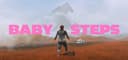
You play as Nate, an unemployed “failson” in a sweat-stained onesie who is deposited at the base of a vast, misty mountain and discovers — slowly, wetly, face-first — that he can put one foot in front of the other. The setup is a joke, but it’s also the entire thesis. Where Getting Over It trapped you in a cauldron with a hammer, Baby Steps hands you an open, expansive landscape and dares you to traverse it at whatever agonizing pace your thumbs can sustain.
The market positioning is shrewd. Foddy games occupy a niche that streaming culture built and Devolver knows how to sell: games that are as entertaining to watch fail as they are to play. But dismissing Baby Steps as rage-bait content fodder misses what’s actually here — a genuinely ambitious physical comedy about failure, shame, and the stubborn dignity of trying again.
Key features
- Fully Manual Locomotion: Nothing about walking is automated. Each leg lift, swing, and plant is under your direct control, governed by a full-body physics simulation that treats Nate’s mass, momentum, and balance as real, punishing quantities.
- An Open Mountain, No Checkpoint Mercy: The landscape is expansive and largely non-linear. Falls are real — a slip can undo long stretches of climbing, which makes every ridge you crest feel earned rather than dispensed.
- A Dynamic Soundtrack: The score reacts to movement and momentum, swelling as a rhythm develops and collapsing along with Nate. It’s one of the smartest uses of adaptive audio in recent memory.
- Deadpan Slapstick Narrative: An awkward, mumbling story about failure and perseverance, delivered with the comic timing of people who understand that a well-earned faceplant is funnier than any written joke. Collectible hats included, because of course they are.
Analysis
The Loop: Suffering as Craft
The core loop of Baby Steps is simple on its face: look at terrain, plan a route, execute steps, fall, scream, repeat. What makes it work is that the skill curve is real. Early on, the controls feel like operating a marionette with a drunk at the strings; with practice, the design rewards reading slopes, feathering weight transfers, and stringing together confident strides across scree that would end a novice instantly. The game never gets easier — the player gets better, and the design is built to tell the difference. That distinction is the entire Foddy design philosophy, and it’s executed here with more generosity than Getting Over It ever offered.
The mountain itself does enormous heavy lifting. Because the landscape is open rather than a fixed gauntlet, failure rarely means total reset. A fall usually deposits the player somewhere lower and demoralizing, but the route back up is theirs to choose, and alternate paths often reveal themselves mid-tumble. This is the crucial evolution from the developers’ earlier work: frustration is still the fuel, but exploration is the exhaust valve. When one ascent breaks a run, there’s room to wander sideways, find a hat, stumble into one of the game’s strange deadpan characters, and come back with the ego partially reassembled.
Comedy as a Physics Property
Most games write their jokes. Baby Steps simulates them. The physics system is tuned to a precise comedic frequency — Nate doesn’t ragdoll like an action-game corpse, he crumples like a man who has disappointed everyone, including gravity. The mild nudity, the drug references, the strong language: all of it services a specific tone, a kind of mumblecore Sisyphus. The narrative about an unemployed thirty-something learning to literally stand on his own is not subtle, but it’s delivered with enough awkward restraint that it lands as melancholy rather than sermon.
Where It Grinds
Honesty check: this game’s pace is divisive by design, and the design occasionally overplays its hand. Some late-game surfaces — wet rock, certain scrambles — cross the line from “demanding mastery” into “auditing your patience for its own amusement.” A single bad step erasing a long stretch of progress is thrilling exactly once; by the third time, it’s a genuine test of willpower. The single-player-only, roughly-13-achievement package also means that once the mountain is summited, there’s little structural reason to return beyond self-imposed challenges and speedrun ambitions. The game knows what it is and refuses to soften. Respect that — but know what you’re signing up for.
The onboarding deserves specific praise, though. The opening stretch teaches the leg mechanics through terrain rather than tutorial text, escalating from flat mud to inclines with the confidence of designers who trust their systems. There’s no difficulty selector, no assist mode, no mercy — which will rightfully exclude some players, and the game is at peace with that.
Visuals & performance
The aesthetic is doing something sneaky. The mountain is rendered in a soft, hazy naturalism — mist-shrouded ridges, damp grass, mud with alarming material properties — while Nate himself is a sweaty, jiggling cartoon of a man. The clash is intentional: the world is beautiful and indifferent; the player is ridiculous and soft. Lighting shifts across the ascent give real altitude to the climb, and breaking above the cloud line is staged as a genuine, earned payoff.
Technically, the physics simulation is the star. Nate’s full-body model interacts with terrain convincingly, and a full-body simulation of this scope is light enough on modern hardware that the spectacle of Nate cartwheeling down a cliffside, dragging every joint behind him, should hold up without strain. The dynamic soundtrack deserves its own paragraph: it swells with momentum and drops out with dignity, functioning as both mood and feedback system — the audio itself signals when the walking is going well. That’s clever, and it’s load-bearing.
Platform nuances
On Steam, controller is the intended instrument — the leg mechanics map to triggers and stick movement in a way that a keyboard technically supports but spiritually opposes. Play this with a gamepad or don’t bother. Steam’s 13 achievements are sparse but appropriately sadistic, and the platform’s review culture has become part of the game’s ecosystem: a game like this invites an archive of player suffering all its own. The long, tense sessions and physics load also make it more of a docked experience than a commute game — this is not something to play for ten relaxed minutes.
Final verdict
Baby Steps takes the most hostile design philosophy in games — Foddy-style earned failure — and grafts it onto an open world, a reactive score, and a sad-sack comedy about getting up when you fall down. The result is more accessible than Getting Over It without betraying it, funnier than almost anything else this year, and quietly moving in a way physics comedies have no right to be. It is not for everyone, and it would be a worse game if it were. We recommend it without hesitation to anyone with the patience — the mountain is worth it. Every single step.
Reviewed by the Rankeno Action Desk. Scores are out of 10; the overall score is the desk’s editorial judgement, informed by the four sub-scores above. How we review