
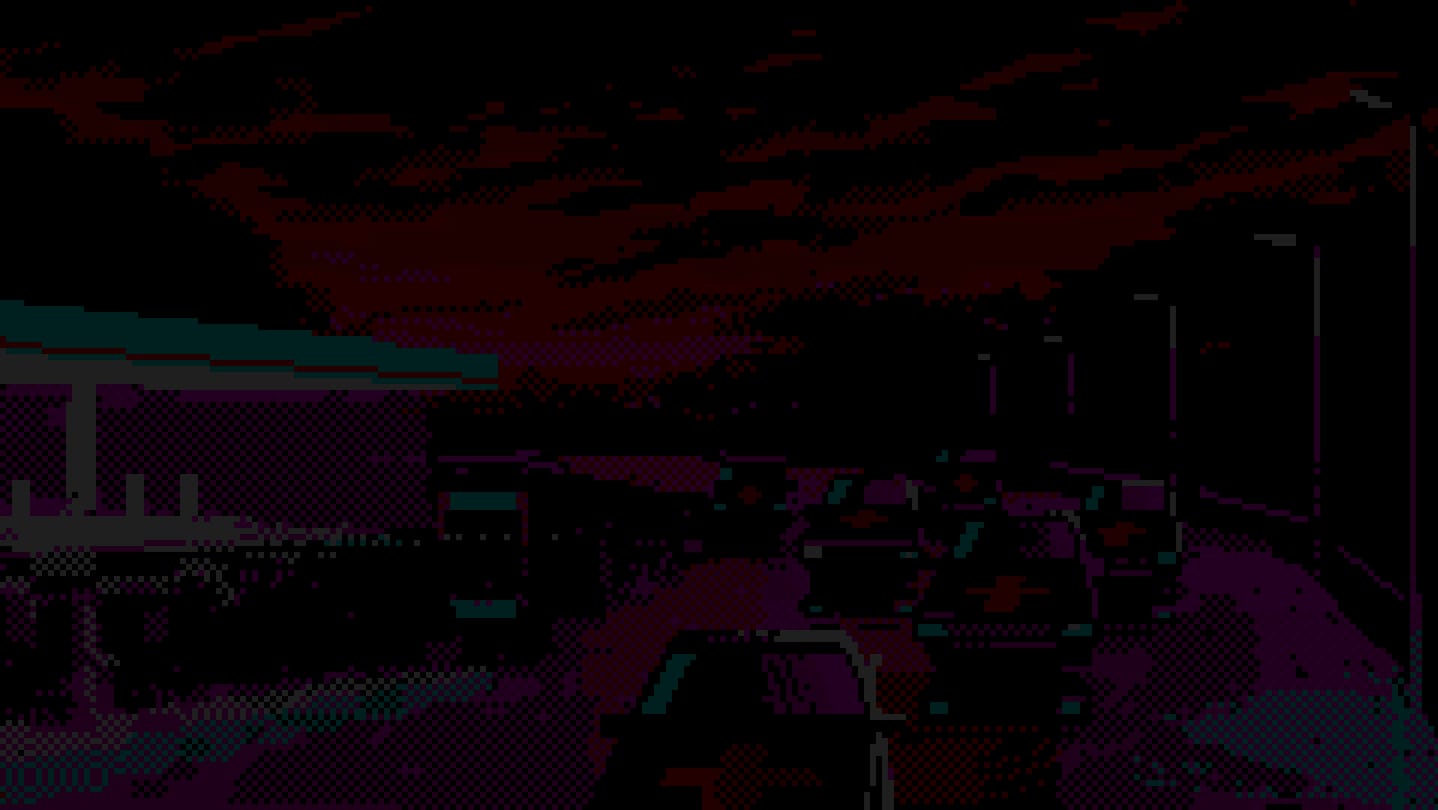

Bottom Line: LCB Game Studio's third Pixel Pulp is the sharpest-looking, best-written thing in its niche — a two-hour cult thriller that earns every pixel of its Amiga-era swagger — but its card minigame is a tollbooth, not a mechanic, and the runtime will make some buyers wince at checkout.
The Narrative Loop
The core loop is simple and unusually well-tuned: read, decide, live with it. What separates Bahnsen Knights from the mass of "your choices matter" marketing copy is that its choices are legible in the fiction rather than in a menu. You're undercover. Every line you speak is either building your cover or burning it. That framing turns the trust meter into something you feel rather than something you monitor — an infiltration fantasy where the tension is social, not mechanical.
Saraintaris's prose is the engine here, and it's genuinely good pulp: economical, mean, occasionally very funny. The premise — a car salesman who realized the closing techniques worked just as well on souls — is the kind of joke that could collapse into camp in a weaker script. It doesn't. Toni is written as an actual charismatic, which is the hardest thing to pull off in a cult story and the thing most cult stories fumble. You understand why people follow. That's the whole ballgame, and the game wins it.
The branching is substantive. Trust doesn't just tint dialogue; it opens and closes chapters, which means a first run leaves real content unseen. For a 2–3 hour game, that's the right structural bet — the game is designed to be experienced twice, and the second run is genuinely a different route rather than a fast-forward with a new ending card. Whether it's designed to be experienced twice by a player who paid full price is a separate question, and one the game answers less convincingly.
The Card Problem
Now the part that keeps this out of the top tier. The solitaire-style minigame is the game's one piece of sustained interactivity, and it does not carry the weight assigned to it. Mechanically it's thin. Thematically it's a stretch — the fiction says you're winning over a cult member, the interaction says you're clearing a tableau. And structurally it's repetitive, appearing often enough that its novelty is exhausted well before the second act.
This is the most common complaint in user reviews and it's the correct complaint. The minigame functions as a speed bump: something placed between you and the next slab of good writing, ostensibly to give your hands something to do. That's the failure mode of a lot of narrative games — the reflexive belief that reading isn't "gameplay" and must be interrupted with a task. Bahnsen Knights would be a tighter, more confident product with half the card interludes, or with a version of the card game whose state actually persisted into the story in a way you could feel. The light puzzle interludes fare somewhat better, mostly because they're briefer and don't repeat the same rhythm.
Pacing and Friction
Onboarding is close to frictionless. There's no tutorial wall, no glossary, no series recap demanding you care about Mothmen 1966 first. You're on the road inside a minute, and the game trusts you to assemble the world from context. That trust is the correct instinct and it's applied consistently.
Pacing is the real triumph. Two to three hours is exactly as long as this story can sustain its atmosphere, and LCB knows it. There's no padding, no second-act sag, no filler chapter to hit a runtime target. Compare that to the twelve-hour visual novels that pad an eight-hour story and it's clear which team had editorial discipline. The counterargument — and users make it — is that discipline reads as value problem at the price point. Three hours across two runs is a strong afternoon. It is not, for many buyers, a full-price purchase, and pretending otherwise would be dishonest.
The one structural nag: with content gated behind trust, a player who plays honestly and reads carefully can still finish having missed material, with no in-game signal about what they walked past. That's authentic to the fiction. It's also the kind of design that rewards a wiki, which is a strange thing to say about a game this handmade.