
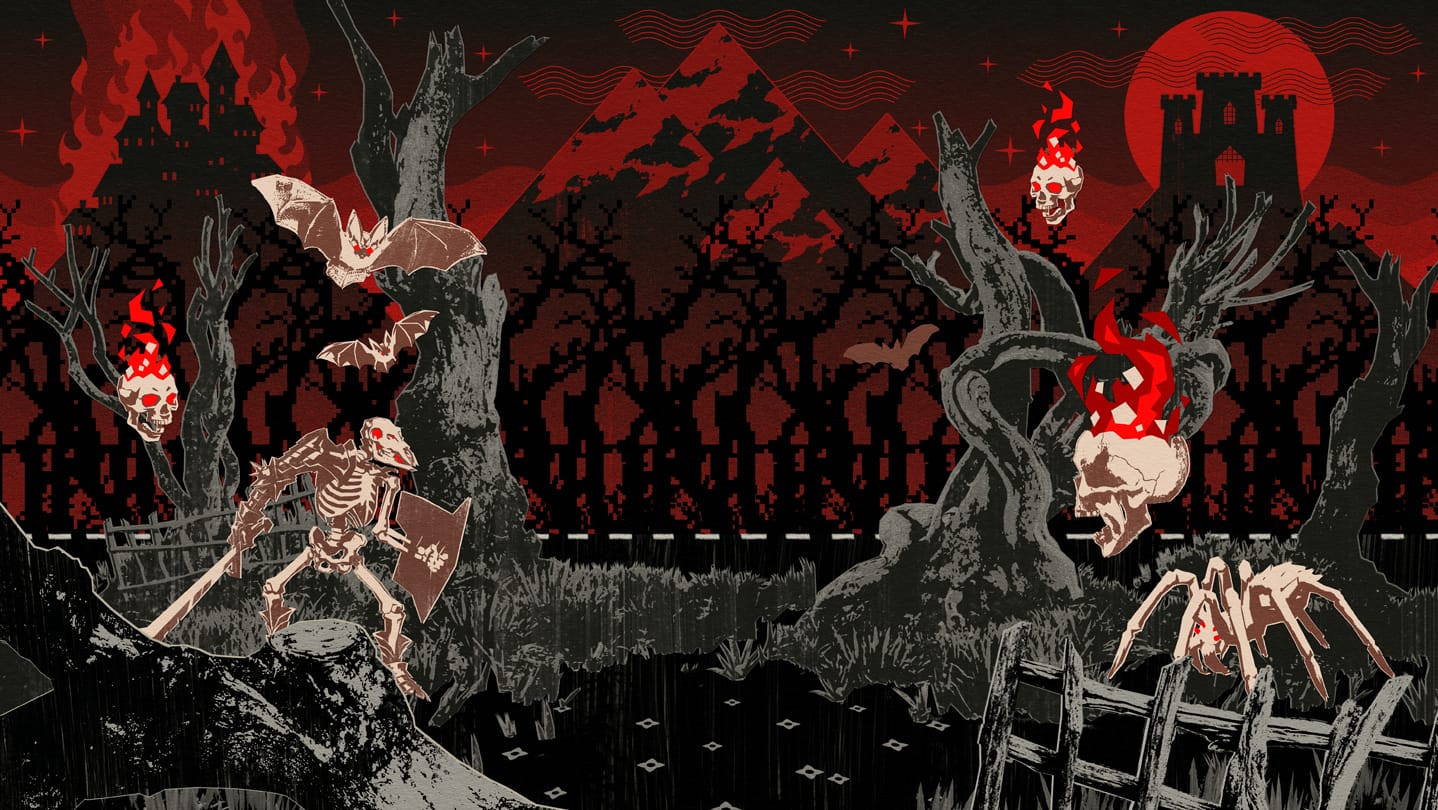


Bottom Line: more8bit has built a dark fantasy brawler out of pixel-art dioramas and timing windows, and at ten dollars it cuts deeper than games costing six times as much — right up until the late chapters start swarming you and the fixed camera stops telling you the truth about where things are.
The Gameplay Loop
The loop is almost aggressively simple, and that simplicity is a design position, not a shortcut. You drop into a diorama. Two to six enemies occupy it. You have a roll, a dodge, an attack, a parry, and a counter. There is no stamina meter to babysit in the way you'd expect, no lock-on system to hide behind, no camera to swing around looking for an opening. Everything relevant is already on screen. What you don't have is time.
The first hour is a re-education. Every action commits. The animation for a swing is long enough that starting it at the wrong moment is functionally a decision to take damage, and enemies telegraph with tells that are readable but short. The correct play is almost always to wait, absorb the first pattern, and counter into the recovery gap. When it works — and it works often — the game produces a specific kind of satisfaction that bigger action games spend forty hours trying to manufacture: the feeling that you personally got better, and that the game did not lower itself to meet you.
The RPG layer sitting underneath is thinner than the marketing suggests, and that's fine. Stats, weapon finds, weapon upgrades, magic, consumables — it's a numbers scaffold, not a build-crafting sandbox. You will not spend an evening theorycrafting. What it does provide is a pressure valve. When a chapter walls you, the progression system gives you a lever to pull that isn't purely "get better at parrying," and for a game this hard, that lever matters more than its depth.
Where It Frays
Two problems, and they compound each other.
The first is repetition. Twelve chapters of "enter room, kill things, leave room" is a lot of the same verb sequence, and the environmental variety — forest, swamp, castle, dungeon — is cosmetic. The dioramas are gorgeous, but a diorama is not a place. By chapter eight, the novelty of the presentation has fully paid out, and you're running on combat quality alone. Combat quality is high. It is not infinitely high.
The second is difficulty distribution, which is where the real criticism lands. The early game is fair and legible — hard, but the kind of hard where death is obviously your fault. The late chapters lean on enemy swarms, and swarming is exactly the thing this combat system handles worst. A system built around one-on-one reads and committed animations does not gracefully absorb four enemies attacking from four angles on a fixed camera. Deaths stop feeling like feedback and start feeling like tax. That's not difficulty; that's a design system being asked to do something it wasn't built for.
The fixed isometric angle makes it worse. Depth perception on these stages is genuinely unreliable. Because the camera never moves, you're constantly estimating whether an enemy is on your plane or slightly behind it, and the answer determines whether your attack connects or whiffs into a punish. On a clean one-on-one it's a manageable quirk. In a swarm, it's the difference between a run and a restart, and it's the most legitimate complaint in the player base.
The Touchscreen Inheritance
You can feel the Apple Arcade origin in the inputs, and the DX rework didn't fully exorcise it. The original was designed around swipes and taps — a control scheme where direction and commitment were the same gesture. Translated to a gamepad, some actions retain a stickiness, a sense that the input is being interpreted rather than executed. more8bit clearly did work here; the recent-review uptick to 85% is not an accident. But the DNA shows. If you come in from Hollow Knight or Katana ZERO expecting frame-perfect responsiveness, the first thirty minutes will feel like arguing with a translation.