

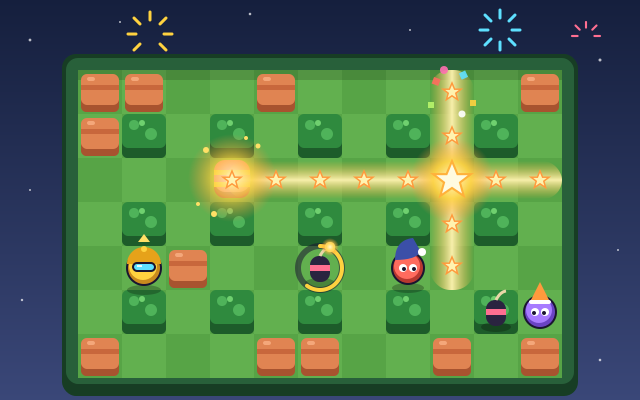
Overview
Some games are built around a single, load-bearing idea. Bopl Battle is built around a single, load-bearing question: what happens if you let players combine abilities that were never designed to coexist? The answer is a small legend among couch-multiplayer diehards.
Developer Johan Grönvall — and this is worth sitting with — built a game this mechanically ambitious largely as a solo-scale indie effort. That context matters, because Bopl Battle doesn’t read like a game with a modest team behind it. It reads like a physics engine that someone weaponized for comedy. You control a squishy, expressive blob — a “Bopl” — and you fight other blobs on small, readable arenas until one is left standing. That’s the skeleton. Every genre has that skeleton.
What Grönvall bolted onto it is the hook: a draft system. Before each round, you pick from a deck of wild abilities — a shrink ray, a black hole, a time-freeze, a growth ability that turns you into a lumbering giant, and, memorably, a rocket engine you can attach to the arena itself to launch the entire stage into orbit. These abilities aren’t siloed. They stack. They interact. They produce outcomes the designer clearly anticipated and plenty he almost certainly didn’t.
Market-wise, this sits in the crowded, brutal neighborhood of local-multiplayer brawlers — the space occupied by Duck Game, Stick Fight, TowerFall, and Gang Beasts. That’s not an easy block to stand out on. Bopl Battle earns its corner through emergent combinatorial depth rather than raw content volume. It’s affordable, it’s tight, it’s light on hardware, and it understands exactly what it is: a machine for generating the specific kind of laughter that only happens when four friends watch a plan collapse in real time. It is also, pointedly, multiplayer or nothing — a decision that defines the experience as much as any ability in the deck.
Key features
- Draft-Based Ability Loadouts: Before each round you build a kit from a deck of physics-driven powers. The pre-round draft turns every match into a fresh puzzle instead of a memorized routine.
- Combinable, Synergistic Abilities: Shrink rays, black holes, time-stop, giant-growth, and stage-launching rockets don’t just coexist — they compound. The joy is in discovering interactions the game never explicitly advertises.
- Fast, Readable Rounds: Matches are short and legible at a glance, which keeps a full lobby engaged and makes “one more round” the default state of any session.
- Flexible Multiplayer Plumbing: Local couch play, online matchmaking, and Steam Remote Play Together — the last of which lets friends join without owning a copy.
- Low-Friction Hardware Footprint: Windows 10 64-bit, full Steam Deck compatibility, and a deliberately affordable price.
Analysis
The Gameplay Loop
The loop is almost aggressively simple to describe and deceptively deep to master. You draft. You fight. Someone dies laughing. You draft again. Round-to-round, the variables shift because your loadout shifts, and because your opponents’ loadouts shift against you. This is the core insight Bopl Battle gets right where lesser party games stumble: the game isn’t the arena, it’s the interaction between the tools.
Consider what “freeze time” means in a vacuum. It’s a strong ability. Now hand your opponent a growth power and a grappling hook at the same moment. Now add a black hole one of you spawned three seconds ago that’s still exerting pull on every loose object on screen. The freeze doesn’t just stop a character — it freezes a system mid-collapse, and whoever reads that frozen tableau fastest wins. This is emergent design working exactly as intended. The developer built the physics and the abilities; the player builds the moment.
That emergent quality is Bopl Battle’s genuine competitive edge. Most party brawlers front-load their fun and then decay into repetition once you’ve seen the bag of tricks. Here, the combinatorial math keeps generating novelty well past the point where you’d expect familiarity to set in. Two players who know every individual ability cold can still surprise each other, because the combinations outnumber anyone’s ability to rehearse them.
The Skill Ceiling Problem — and Why It Isn’t One
There’s a legitimate worry hiding in a game this chaotic: does skill actually matter, or is it a slot machine? Bopl Battle threads this well. The chaos is readable. Arenas are small and uncluttered, character silhouettes are clear, and the physics — while unpredictable in outcome — are consistent in behavior. A skilled player isn’t someone who memorized a build; it’s someone who reads a chaotic board faster and improvises a response. The randomness is in the situation, not the controls. That distinction is everything. It’s the difference between Mario Party luck and Smash Bros. mastery, and Bopl Battle lands closer to the latter than its goofy blobs suggest.
The Onboarding and the Ceiling of Access
Here’s where the cheerleading stops. Bopl Battle has no single-player campaign and no bots. None. This isn’t an oversight — it’s a stated design philosophy. And the honesty deserves respect. But respect isn’t the same as endorsement.
The practical consequence is severe: anyone booting this game up alone finds functionally nothing to do. There’s no way to learn the abilities in a low-stakes environment. No way to practice reading the chaos. No way to even confirm the game is fun before dragging three friends into a lobby. For a game whose entire value proposition is discovering synergies, the absence of any solo sandbox to discover them in is a real, self-inflicted wound. A single practice mode against dumb bots — not a campaign, just a sandbox — would have removed the one asterisk that follows this game everywhere. Its absence means the onboarding friction isn’t in the design; it’s in your social calendar.
Visuals & performance
The art direction is smart precisely because it’s restrained. The Bopls are squishy, elastic, and expressive without being detailed — they deform and squash in ways that telegraph physics state, which is a functional aesthetic choice masquerading as a cute one. You can read a blob’s momentum from its shape. That’s good design doing quiet work.
The arenas follow the same logic: clean, high-contrast, and uncluttered so that a screen full of black holes and flying debris never becomes an unreadable mess. This is the hardest problem in chaos-based multiplayer, and Bopl Battle mostly solves it through visual discipline. Performance should be a non-issue by design: a 2D game of this scope is light on hardware, its short rounds and controller-native design make it a natural fit for the Steam Deck, and the physics simulation is built to stay stable even when the whole stage is mid-launch into space.
Platform nuances
On Steam, Bopl Battle leans hard into the platform’s social infrastructure, and it’s the right call. Remote Play Together is the standout — it lets one player host a full local-style session where friends stream in without owning the game. For a title this dependent on having bodies in the lobby, that’s not a feature, it’s a lifeline. It meaningfully lowers the barrier that the no-bots decision raised.
One hard truth about local play: controllers are effectively mandatory. The game supports one keyboard player per PC, which means a genuine couch session requires everyone but one person to bring a gamepad. Plan accordingly. Online matchmaking exists, but like every game in this niche, its long-term health depends on population — and that’s the variable no review can guarantee.
Final verdict
Bopl Battle knows exactly what it is and refuses to apologize for it. That confidence is both its greatest strength and its one glaring limitation. As a combinatorial physics brawler, it stands out among small-scale multiplayer games on Steam — the ability synergies produce the kind of unscripted, funny moments that most party games only promise. Johan Grönvall built a machine that manufactures laughter, and the design suggests it works.
But it only works when you feed it people. The complete absence of any solo mode isn’t a dealbreaker so much as a filter: it sorts players into “this is a keeper” and “this is unplayable for me” with almost no middle ground. We rate it a Good — solid but unremarkable for anyone outside its narrow audience. Judge it on its own terms — as the multiplayer-only brawler it openly declares itself to be — and it’s a confident execution of a deliberately narrow idea. Bring friends. It rewards them well.
Reviewed by the Rankeno Action Desk. Scores are out of 10; the overall score is the desk’s editorial judgement, informed by the four sub-scores above. How we review