

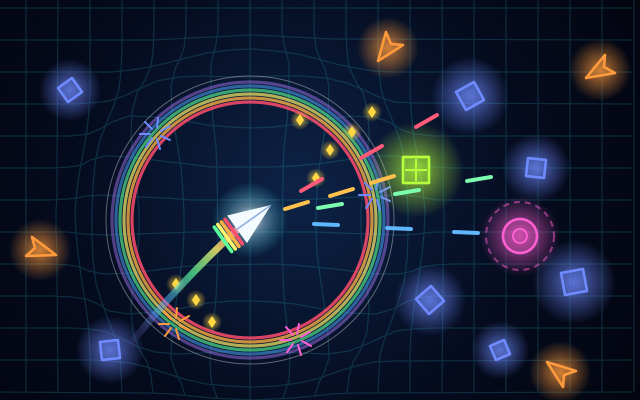
Overview
Co-op survival builders are not in short supply. Neither are roguelikes, extraction games or horde shooters. GRAVHOUNDS stacks all four together and bets that one tool, the Grav Beam, can hold them in a single design. On paper, it is a smart bet.
The game comes from Octopus Panic, Inc., which handles both development and publishing. That self-published setup fits a systems-driven project with a playful premise.
The premise: players control bio-engineered canine workers who drop onto hostile alien planets to harvest valuable materials. Each drop is a “shift”. The crew builds a base from turrets, generators, fabricators and pipeline networks, then defends it as alien swarms grow more aggressive. The decision that drives everything is when to leave. Staying longer raises both the danger and the payout.
GRAVHOUNDS launched in Early Access on November 2, 2026 for Steam. It is a paid release at $19.99. Its market position is clear. It targets the co-op group that wants a repeatable weeknight game with builder depth, action pacing and roguelike variance. The open question is how much there is to unlock and how quickly Early Access fills in the rest.
Key features
- Grav Beam: Every hound carries a beam that flings objects to teammates or knocks enemies around. It serves as logistics tool, weapon and source of slapstick at once.
- Extraction risk/reward: The longer the crew stays on a planet, the greater the danger and the better the rewards. Riskier planets yield better materials.
- Base building under pressure: Turrets, generators, fabricators and pipeline networks form a base that must be built and defended in the same shift.
- High-mobility movement: Directional boosting, hovering and a pipeline boost make repositioning fast, and they tie movement to what the crew has built.
- Stacking run upgrades: Abilities and upgrades picked up mid-shift stack to reshape each run.
- Persistent progression: New Gravhounds with different strengths, plus weapons and upgrade paths, unlock across runs.
- Solo and online co-op: The game supports solo and online co-op.
Analysis
The Extraction Loop
The central design decision is the simplest: the shift ends when the crew chooses. A fixed wave count would make this a tower defense game with extra steps. The open-ended timer makes greed the main mechanic instead. Each minute on the surface raises the question of whether the base can take one more escalation, and the answer depends on what the crew built, what it picked up and how honest it is about its own competence.
This structure suits co-op well because it creates disagreement. One player wants to bank the haul; another wants one more fabricator cycle. Tiered planet risk adds a second layer of the same wager before the drop even begins. The loop gives a group something to argue about, and that is what brings a group back.
The Grav Beam as Connective Tissue
Most builder hybrids split into two modes, with construction and combat taking turns. The Grav Beam is the attempt to stop that split. If the same tool passes materials across the base and shoves enemies off a turret line, hauling and fighting become one skill set instead of two competing demands.
It also brings physics unpredictability, which cuts both ways. Flung objects and displaced enemies produce the improvised saves and disasters that co-op games live on. They also threaten precision. A builder asks for careful placement and reliable throughput; a physics sandbox supplies neither on demand. Whether a late, high-stakes shift feels like earned chaos or arbitrary loss depends on tuning, and tuning is exactly what Early Access exists to adjust. We count this as the design’s main strength and main risk.
Building and Movement
The building kit reads as conventional: power, production, defense, transport. The interest lies in the pipeline network doubling as a traversal system. A pipeline boost means layout decisions affect how quickly a hound can reach a breach as well as how resources flow. Infrastructure that works as both economy and escape route is an efficient idea, and it rewards crews who plan their base as a map.
Directional boosting and hovering point toward an action game’s tempo. That fits the swarm pressure, since a slow character in a horde game spends the match being punished. The risk is cognitive load. Base management, beam logistics, aerial movement and escalating enemies all compete for attention, and a new player will need time to absorb them.
Roguelike Layer and Progression
Mid-shift upgrades that stack are a familiar structure, and they do necessary work: they stop later drops from resembling the first. Persistent unlocks, including new hounds with different strengths, weapons and upgrade paths, supply the long-term pull and suggest role differentiation within a crew.
The size of that unlock pool is not established, and it decides the game’s lifespan. A stacking-upgrade system is only as good as the number of meaningful combinations it supports. An Early Access roguelike lives on that number.
Solo Versus Crew
Solo play is supported, but the design leans toward groups. A beam built to fling objects to teammates loses much of its purpose with nobody on the receiving end. Solo players should expect a more conventional build-and-defend game, competent in structure but missing the feature that defines it.
Visuals & performance
The art concept commits to a tone: engineered working dogs on shift at an alien job site. That frames a harvest-and-defend loop with humor instead of military grimness, and it gives the game a recognizable identity in a genre crowded with interchangeable space marines. Static art can only do so much for a game that sells itself on motion and physics; the presentation has to communicate that energy.
The UI has a hard job. It must convey base state, swarm escalation, resource flow and extraction status during fast aerial movement. Readability under swarm density is the standard a design like this must meet, and it is a common area for Early Access iteration.
On performance, the expectation is plain. Physics objects, large enemy counts and player-built structures all scale CPU load, and the load peaks in the late-shift moments the design encourages. Early Access status means polish and optimization are still evolving, and buyers should treat both as moving targets.
Platform nuances
On Steam, GRAVHOUNDS is a paid Early Access release at $19.99. Boost-and-hover movement combined with beam aiming suits mouse and keyboard, where placement and targeting benefit from pointer precision. The control scheme also has to work with a gamepad, but the beam’s aiming demands make mouse and keyboard the more natural fit.
Online co-op is the main mode on Steam. At $19.99, the entry price is low enough to sample an unfinished game, but the value depends on how the content pool grows.
Final verdict
GRAVHOUNDS has a clear thesis: one beam, one timer, and a base that doubles as a transit system. Each of those ideas does more than one job, which is the mark of an economical design. The extraction structure gives the co-op crew a real argument to have each shift, and the Grav Beam gives building and fighting a shared vocabulary.
The reservations are the usual Early Access ones, and they are specific. Physics tuning will decide whether late-shift failure feels fair. The upgrade and unlock pool will decide whether the game holds a group past its opening weeks. Solo players get a lesser version of the concept.
We recommend it to co-op groups who want a repeatable session game and suggest everyone else wait. The central ideas are worth the asking price for the right group. What remains is the amount of game built on top.
Reviewed by the Rankeno Strategy & Sim Desk. Scores are out of 10; the overall score is the desk’s editorial judgement, informed by the four sub-scores above. How we review