
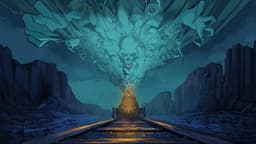
Bottom Line: Hard West 2 builds one of the most gleefully broken combat systems in modern turn-based tactics — a kill-chain engine that turns every encounter into a bloody logic puzzle — then wraps it in an overworld and a story that never earn the same devotion. Play it for the shootouts. Tolerate the rest.
The Gameplay Loop
Here's what separates Hard West 2 from its peers: it removed randomness as an excuse.
In most squad tactics, a 78% shot that misses is a story you tell later. Here, the Luck meter makes damage legible. Every shot that "misses" is chewing through a finite buffer, and you can watch it drop. That single change reorients the player from gambler to engineer. You're not praying to the dice. You're solving.
And solving is the operative verb, because Bravado turns combat design inside out. In an XCOM-style game, the question is how do I survive the enemy turn? Here, the question is how do I make sure there isn't one? Every encounter opens as a puzzle with a hidden solution: which enemy is the weakest link, which reposition after the kill opens the next lane, which ricochet cracks the guy behind the wagon so the chain doesn't break.
When it works, it's transcendent. A single character crossing an entire map, killing four enemies, and ending on high ground without the opposition ever acting is a rush this genre almost never delivers.
When it doesn't work, the failure mode is ugly and specific: you reload. Because if the chain breaks on step two, you're not in a bad tactical position — you're in an unrecoverable one, with two characters exposed in the open and a full enemy turn incoming. The game's greatest strength is also its narrowest tolerance. Hard West 2 doesn't reward improvisation nearly as much as it rewards foreknowledge, and foreknowledge on a first attempt means save-scumming. Reviewers flagged sharp difficulty spikes, and the spikes aren't really about numbers. They're about encounters where the intended solution is singular and the game gives you no signal you've missed it.
Where the Structure Frays
The tactical layer is a 9. The connective tissue is a 6, and the gap shows.
The overworld is the clearest offender. It's attractive, it branches, it dispenses events with real stakes — and it never develops the mechanical weight to justify the time you spend in it. Traversal costs supplies, events resolve via stat checks and choices, and the whole thing functions as a pleasant intermission rather than a second game worth mastering. Compare it to how Battle Brothers or Darkest Dungeon make their strategic layer genuinely adversarial, and Hard West 2's map reads as a menu with scenery.
The story has the opposite problem: it's swinging. The Weird West premise is terrific, the writing has genuine snarl, and the posse are memorable in a way tactics-game squads rarely are. But the narrative rarely intersects with the combat that constitutes 80% of your time. You make a consequential choice, then you shoot forty men in a canyon, then you make another one. The two halves are roommates, not partners.
The Card System Is the Quiet Triumph
Buried under the flashier mechanics, the poker-card artifact system is the best-integrated idea in the game. It's thematically perfect — a game about a Devil's card game where your gear is cards — and mechanically it creates a genuine build-crafting layer. Chasing a flush across your posse while balancing who gets which unlocked ability is the kind of optimization loop that keeps a 25-hour campaign from calcifying. More games should steal this.


