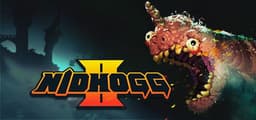
Nidhogg 2
game
•Updated Aug 2026SteamIndie Games

Nidhogg 2

Messhof built a sharper, deeper, faster duel than the 2014 original — then dressed it in a fleshy hand-drawn grotesquerie that half its audience actively resents. Buy it for the couch, not the lobby browser.

Where it ranks in Action

Scores 7.7 against a category average of 8.6 — below the Action average, ranking 676 of 742 Action games we've reviewed.

Price
$14.99
one-time or subscription
Released
Aug 15, 2017
Platforms
Steam · Nintendo Switch
Developer
Messhof
Metacritic
80 / 100

More Steam / PC app reviewsMore Indie Games ranked by score

Quick summary

Nidhogg 2 (Steam) — scored 7.7: Messhof built a sharper, deeper, faster duel than the 2014 original — then dressed it in a fleshy hand-drawn grotesquerie that half its audience activ...

Pros

  • Four-weapon reroll adds genuine matchup depth to every respawn
  • Fastest, crispest, most readable *combat* the series has had
  • Ten arenas with real mechanical identity, not reskins

Cons

  • Weapon randomness occasionally hands you an unfair draw
  • Busier art actively hurts *visual* readability mid-scramble
  • Online matchmaking is effectively dead; lobbies only

Scores

Score breakdown

How the overall score splits across the categories we review.

Design
7.5/10
Innovation
6.5/10
Value
8.5/10
Utility
7/10

Verdict

Is Nidhogg 2 worth it?

Nidhogg 2 is a better game than Nidhogg 1 and a less iconic one. Messhof took a design that was already close to perfect and asked the harder question — what if it had more depth instead of more polish — and got the answer right. The weapon roulette, the expanded unarmed game, and the ten arenas turn a beautiful one-note joke into something with a real metagame. That's the version of a sequel most studios don't attempt.

The art direction is the tax, and it's a real one. Not because it's ugly — it's confident, specific, and genuinely well-drawn — but because it spends readability that a one-hit-kill twitch game can't easily afford. Some of you will stop noticing after an hour. Some of you never will, and you should trust that instinct and stay with the original.

The bigger caveat is structural: this is a couch game with an online mode attached, and you must buy it on those terms. At its usual sale price it's one of the best entertainment-per-dollar propositions in local multiplayer. At full price with no friends nearby, it's a soundtrack purchase with a demo attached.

7.7 / 10. Sharper steel, uglier scabbard, and still the most thrilling twelve seconds in party gaming.

Pros

  • Four-weapon reroll adds genuine matchup depth to every respawn
  • Fastest, crispest, most readable combat the series has had
  • Ten arenas with real mechanical identity, not reskins
  • Near-zero onboarding friction — newcomers are dangerous in minutes
  • Excellent soundtrack; flawless technical performance
  • 8-player local tournaments and deep match modifiers

Cons

  • Weapon randomness occasionally hands you an unfair draw
  • Busier art actively hurts visual readability mid-scramble
  • Online matchmaking is effectively dead; lobbies only
  • AI opponents are practice dummies, not sparring partners
  • Switch Joy-Con d-pad is a real handicap for stance switching
  • Zero value if you have nobody to play with in person

Pricing: $14.99

From Rankeno

Our verdict, on your site

A scored review out of 10 and a permanent review page on rankeno.com. Submit your app and see where it stands.

Get reviewed

Gallery

Screenshots

4 screenshots · tap to enlarge

What stands out

Key features

  1. Four-weapon roulette: Rapier, broadsword, dagger, and bow, redealt on every single respawn. Each has distinct reach, throw arc, swing speed, and parry timing — the dagger is a knife-fight in a phone booth, the broadsword is a slow guillotine, the bow rewrites the entire spacing game the second it appears.
  2. The momentum tug-of-war: Kill your opponent and the screen's directional flow reverses in your favor. Die and it snaps back. A four-arena lead can evaporate in eight seconds, and the game is built around that cruelty.
  3. A full unarmed moveset: Disarm, throw, tackle, dropkick, slide, and stomp a downed opponent's skull. Losing your weapon is a setback, not a death sentence — which keeps exchanges alive far longer than they have any right to be.
  4. Ten arenas with real mechanical identity: Castles, an airship, a wheat field, and the fetid interior of the Nidhogg itself. These aren't reskins; verticality, hazards, and chokepoints change which weapon is actually good.
  5. 8-player local tournaments and 10+ match modifiers: Bracket play for a room full of people, plus toggles for weapon sets, jump height, respawn timing, and more.
  6. Online matchmaking and private lobbies: Present. Functional. Mostly empty. More on that below.

Full review

Nidhogg 2 in depth

Bottom Line: Messhof built a sharper, deeper, faster duel than the 2014 original — then dressed it in a fleshy hand-drawn grotesquerie that half its audience actively resents. Buy it for the couch, not the lobby browser.

The Gameplay Loop

Nidhogg's core insight is that a fighting game doesn't need a health bar. It needs positional stakes. Every duel is sudden death — one clean hit and you're gone — but death costs you territory, not the match. That single design decision does an enormous amount of work. It removes the punishment spiral that makes traditional fighters miserable for newcomers, and it converts each exchange into a discrete, readable unit of drama. You know exactly how you're doing at all times because you can see it: the screen is either scrolling your way or it isn't.

The sequel's weapon roulette is the biggest change to that loop, and it is genuinely the right call. In the original, both players held the same rapier forever, which meant the metagame calcified around a narrow band of optimal spacing. Nidhogg 2 breaks that open by making every respawn a new matchup problem. You come back holding a bow against a broadsword and you have maybe half a second to recognize that your entire plan has to change — you want distance, they want to close, and the arena geometry decides who wins that argument. Then you die, respawn with a dagger, and the argument inverts.

This is asymmetry-as-a-verb, and it's what keeps the game fresh across the couple hundred rounds a Nidhogg night actually produces. It also introduces the sequel's most legitimate criticism: the reroll is random, and randomness in a one-hit-kill game occasionally hands you a losing draw. Getting a dagger against a broadsword in an open field is not unwinnable — that's the point of the disarm and tackle systems — but it's a hill you didn't choose to climb. Competitive purists have been arguing about this since launch. They're not wrong that it's less pure. They're wrong that it's worse. The original's purity was also its ceiling.

Readability and the Skill Curve

Where the sequel takes a real hit is visual parsing. The original's minimalism wasn't just an art choice, it was an interface. A stick figure has exactly one silhouette, and the sword position was the single loudest piece of information on screen. Nidhogg 2's characters have volume, texture, costume variation, flailing limbs, and a gore system that sprays viscera across the exact space you're trying to read. In a busy arena with two customized fighters mid-scramble, you will occasionally lose track of where a blade actually is — and in a game decided by three-frame parry windows, that isn't a cosmetic complaint. It's a mechanical one. This is the strongest version of the anti-art-direction argument, and it deserves more respect than the "it's ugly" takes it usually gets bundled with.

That said, the combat underneath is faster and cleaner than the original's. Movement has more snap. The parry — tapping attack at the moment of contact to knock a weapon aside — feels crisper and more consistently rewarded. Throws arc predictably enough to learn. The dropkick is a real option, not a novelty. Someone who put fifty hours into Nidhogg 1 will find Nidhogg 2's ceiling higher, not lower.

Onboarding and the Single-Player Problem

Onboarding friction is close to zero, which remains the franchise's superpower. Two buttons and a d-pad. A newcomer is competent in ninety seconds and dangerous in ten minutes, because the sudden-death structure means a lucky throw beats a good player. That's a feature. It's why Nidhogg works at parties and Street Fighter doesn't.

Solo play is the weak leg. The AI opponents are serviceable practice dummies — they'll teach you spacing fundamentals and they scale reasonably — but they don't bluff, don't bait, and don't panic, and Nidhogg is a game about all three. Treat single-player as a tutorial with a scoreboard, not as content. If you are buying this to play alone, you are buying the wrong game.

The Online Question

Here's the uncomfortable part. Matchmaking exists, works, and is largely a ghost town years past launch. You can sit in a queue and get nothing. Private lobbies with friends remain the viable path, and they're fine — but understand that a game decided on single-frame reads and parry timing is brutally unforgiving of network jitter. Even a modest connection turns the parry from a read into a prayer. Buy Nidhogg 2 as a local game with an online option, and you'll be happy. Buy it as an online game and you'll be refunding it.

Your rating for Nidhogg 2:
Was this helpful?

Alternatives

If not Nidhogg 2, then what?

Best alternatives to Nidhogg 2

Head to head

Compare with rivals

FAQ

Common questions

Is Nidhogg 2 worth it in 2026?

Nidhogg 2 is a better game than Nidhogg 1 and a less iconic one. Our experts scored Nidhogg 2 7.7 out of 10 — recommended.

Is Nidhogg 2 good?

With a score of 7.7 out of 10, Nidhogg 2 lands in our recommended band. Value is its strongest category at 8.5 out of 10. Innovation is the weakest at 6.5.

How much does Nidhogg 2 cost?

Nidhogg 2 costs $14.99. Its Value category scores 8.5 out of 10.

What do users like most about Nidhogg 2?

Four-weapon reroll adds genuine matchup depth to every respawn. Fastest, crispest, most readable combat the series has had.

What do users dislike most about Nidhogg 2?

Weapon randomness occasionally hands you an unfair draw. Busier art actively hurts visual readability mid-scramble.

What platforms is Nidhogg 2 available on?

Nidhogg 2 is available on Steam, Nintendo Switch.

Who makes Nidhogg 2?

Nidhogg 2 is made by Messhof.

What are good Nidhogg 2 alternatives?

The closest alternatives to Nidhogg 2 are Chorus, Warhammer 40,000: Boltgun, Patapon.

Is our Nidhogg 2 review up to date?

We last refreshed our Nidhogg 2 review in Aug 2026.

About this review

How we scored Nidhogg 2

Nidhogg 2 was scored on Design, Innovation, Value and Utility — each from 1 to 10, with the same rubric as every other game in its category — for an overall 7.7. Research and drafting follow Rankeno's fixed editorial rules; the rubric, the checks before publishing and the decision to publish are ours. Published Aug 11, 2026.

Editorial disclaimer The reviews and scores on this site are based on our editorial team's independent analysis and personal opinions. While we strive for objectivity, gaming experiences can be subjective. We are not compensated by developers for these scores.

For developers

Get your app or game reviewed

A scored review on the same rubric as this one and a permanent review page on rankeno.com. Paid tiers buy a place in the queue — never a score.

Submit for review
Embed this score badge on your site

Embed this review badge

Paste this snippet on your site to show your Rankeno score. The link back to rankeno.com is a normal link — no redirect, no tracking.

From Rankeno

Finished reading? Get your own verdict.

Submit your app for a scored review out of 10, published as a review page on rankeno.com.

7.7Nidhogg 2Steam