

Bottom Line: Phantom Brigade's timeline-based combat is the most genuinely original idea the tactics genre has produced in a decade — a four-second window of predicted violence you choreograph like a fight scene. The campaign wrapped around it never quite earns that brilliance, but the brilliance is real, and after 2.0 it's finally sitting in a game worth finishing.
The Four-Second Chess Match
Here's what actually happens when you play Phantom Brigade, and why the description undersells it.
You enter a battle. The game shows you a five-second slice of the immediate future: ghost outlines of enemy mechs walking, turning, raising weapons, and the projected paths of the shots they're about to take. You can scrub this timeline like a video editor's scratch track — forward, back, frame by frame. Then you author your own five seconds. You drag a movement spline across the ground. You place a dodge at second 2.4 because that's when the enemy railgun fires. You queue a shotgun blast at 3.1, timed to land the instant your target's cover finishes collapsing from your teammate's missile at 2.9.
Then you hit execute, and everything resolves at once, in real time, with camera work good enough that you'll watch replays you don't need to watch.
The design achievement here is that the enemy prediction is honest but incomplete. You see what they intend to do based on current conditions. Change the conditions — flatten the building they're behind, sever the arm holding the weapon, move somewhere they weren't planning for — and their plan degrades in ways the projection couldn't have shown you. The result is a tactical layer with something almost no turn-based game achieves: genuine anticipation. You are not calculating hit percentages. You are reading intent and then invalidating it.
This is a strategy game about latency and commitment. Every order is a bet placed four seconds before it resolves, and the skill ceiling lives entirely in how precisely you can sequence actions inside that window. When it clicks — when you thread a mech through a collapsing street to shear the legs off a heavy at exactly the moment its escort is mid-reload — nothing else in the genre feels like it.
The Campaign Layer Is the Weak Limb
And then you return to the overworld, and the temperature drops.
The campaign is the part of Phantom Brigade that has always been outrun by its own combat, and it's the source of nearly every credible criticism in the player base. Mission variety is thin. You will attack bases, defend positions, ambush convoys and hunt patrols, and the deltas between these are smaller than the four-second sandbox deserves. The tactical engine can generate a hundred unforgettable situations; the mission designer keeps asking for the same six.
The 2.0 update did real work here — reworked progression pacing, better faction structure, improved map generation, and a long list of quality-of-life fixes that returning players noticed and appreciated. The province-capture loop has more shape than it did at launch, and the escalating regime response gives the map a pulse it previously lacked. But the fundamental rhythm is unchanged: extraordinary combat, adequate connective tissue. By the late campaign, the strategic layer reads less like a war and more like a mission dispenser with an inventory screen attached.
Difficulty balance also swings hard. Early attrition can spiral — lose two mechs in an ambush you couldn't have scouted, and the repair economy punishes you for hours. Later, once your fabrication chain matures and your pilots have stacked the right traits, encounters that should be climactic get dismantled in one timeline. The 2.0 progression rework smoothed this, not solved it.
Onboarding Friction
Phantom Brigade is bad at explaining Phantom Brigade. This is the single most fixable flaw it still carries.
The timeline system is intuitive to watch and unintuitive to operate. Concepts that turn out to be load-bearing — how action queuing interacts with movement momentum, why a shot whiffs when the reticle looked green, how dodge timing actually resolves against projected fire, what the difference is between concurrent and sequential orders on one unit — are underexplained or left to be inferred. New players routinely spend their first three hours losing fights for reasons the UI never surfaces. Players who push through consistently describe the moment it clicks as a revelation, which is exactly the problem: a revelation gated behind an information deficit is a design failure, not a rite of passage.
Pathfinding compounds it. Mechs occasionally take routes you did not draw and would not have chosen, and because your entire plan is timing-dependent, a two-second navigation hiccup doesn't cost you a step — it costs you the whole sequence. It's not constant. It's frequent enough to remember.
Customization and the Salvage Loop
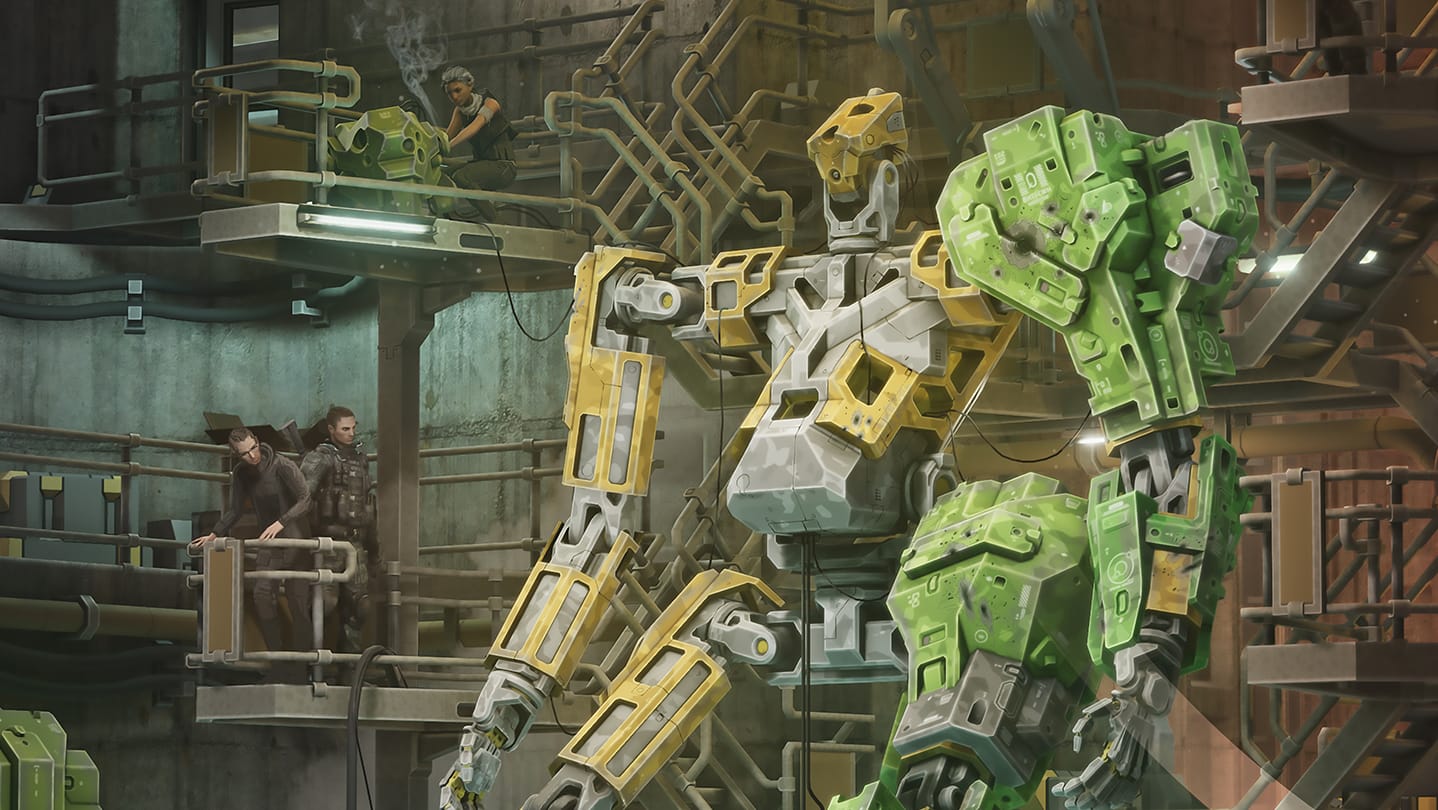
The fabrication side is quietly one of the best-tuned systems here. Because damage is localized and persistent, salvage is specific: you don't loot a generic parts pile, you strip the arm you shot off, the chassis you cracked, the railgun whose owner you legged. That creates a direct causal line from a tactical decision to an economic outcome, which is the kind of loop most strategy games only gesture at. Deliberately disabling rather than destroying a target — shooting off the weapon arm to keep the torso intact — is a real, rewarded tactic. That's excellent design.
Trait-driven pilot builds pair with it well. With a hundred-plus traits in the pool, squads develop identities, and the good loadouts are the ones built around a pilot's quirks rather than around a spreadsheet optimum.