

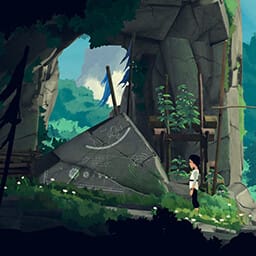
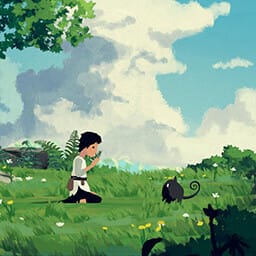
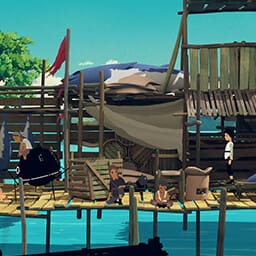
Bottom Line: Wishfully’s Planet of Lana crafts a compelling, if occasionally deliberate, puzzle-platforming experience, leveraging an arresting hand-painted aesthetic and wordless narrative to deliver potent emotional resonance often missed in the cacophony of modern gaming.
The gravitational pull of Planet of Lana lies squarely in its nuanced gameplay loop and profound narrative delivery. From the moment Lana is thrust into her impossible journey, the player is inducted into a world where survival is contingent on observation, patience, and the inseparable bond with Mui. The controls are intuitive, deliberately pared back to prioritize interaction over complex command chains. Lana’s movement is fluid, capable of the requisite platforming precision, while Mui’s directed actions are generally responsive, allowing for swift execution of puzzle solutions once understood. This streamlined interface ensures that the mental heavy lifting remains focused on the environmental conundrums rather than wrestling with mechanics.
The environmental puzzles themselves are a masterclass in elegant design, albeit sometimes leaning into familiar tropes. Many challenges demand a clever manipulation of line-of-sight, leveraging Mui’s diminutive size to squeeze through vents or distract robotic sentinels, while Lana activates switches or clears paths. The "A-to-B" progression is punctuated by moments of genuine "A-ha!" as solutions click into place, often requiring a thoughtful sequence of commands for Mui, followed by Lana's own actions. While the game rarely invents a new wheel in puzzle design, it polishes existing ones to a gleam, presenting scenarios that feel organic to the world and its inhabitants. The integration of stealth is equally well-executed, transforming sections into tense cat-and-mouse sequences where mistiming a move means swift, often brutal, reprisal from the planet's mechanical overlords. These stealth segments break up the puzzle-solving rhythm, injecting a welcome dose of tension and urgency.
What truly elevates Planet of Lana beyond its mechanics is its mastery of visual storytelling. The lack of dialogue could have been a perilous gamble, yet Wishfully wields it as a powerful artistic tool. Every frame is imbued with information: the oppressive scale of the machines, the resilience of the natural world pushing back, the subtle shifts in Lana's expressions, and the endearing loyalty of Mui. The narrative is not delivered; it is experienced. We witness Lana’s determination, Mui’s unwavering companionship, and the unspoken threat permeating their existence. This approach bypasses exposition dumps entirely, fostering a far more immersive and empathetic connection to the characters and their plight. The game understands that some stories are best felt rather than told, allowing the player’s imagination to fill in the gaps, making the experience uniquely personal. However, a minor critique surfaces in Lana's movement speed; there are moments, particularly during backtracking or traversing larger, less puzzle-dense areas, where the pace feels deliberately slow, bordering on sluggish. While this might be an intentional choice to reinforce the cinematic feel or emphasize the journey's arduous nature, it occasionally introduces an unwelcome friction point into an otherwise fluid experience. This deliberate pacing occasionally pulls the player out of the flow, reminding them of the game's artificial constructs rather than maintaining the illusion of a seamless world. The balance between artistic intent and player engagement is delicate, and here, it occasionally falters.
Co-dependent Flow
The success of the co-dependent mechanics hinges on Mui’s AI, which is, for the most part, exceptionally robust. Mui follows commands with surprising fidelity, navigating environmental hazards with an almost preternatural instinct. There’s a palpable sense of trust that develops between the player and Mui, mirroring the in-game bond between Lana and her companion. This rapport is critical; a failure here would unravel the entire premise. The emotional weight of the game often rests on Mui’s vulnerability and resilience, a testament to Wishfully's ability to imbue a non-verbal creature with genuine character.