
Overview
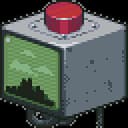
Every puzzle game has to answer one question: why should anyone care about this room? Four Quarters, a Russian indie studio, answers it in one line of dialogue. A coworker heads off for a bathroom break, asks the player to watch their station, and tells them not to touch anything. Then they leave a big red button behind.
That setup is the whole pitch, and it works because it plays on an old human reflex. Please, Don’t Touch Anything began as an entry for Ludum Dare 31, a game jam built around a one-screen constraint, and those jam roots still show. The game never leaves its single viewpoint. There is a control panel, a green-screen monitor showing a pixelated live view of a city, and a growing sense that this is no ordinary office.
Pressing the button sets off strange and often disastrous events on the monitor. Poking at the rest of the panel reveals hidden switches, keypads, codes, and eventually tools such as a screwdriver that open things no one was meant to open. Each discovery leads to one of about 25 endings. They range from absurd gags to full nuclear catastrophe.
The game sits in an interesting spot in the market. It is not a sprawling adventure or an escape-room franchise with dozens of levels. It is closer to a mechanical riddle box, a digital cousin of the puzzle boxes that hide one more drawer after you think you’ve found them all. It carries a 3.8 out of 5 store rating from 373 ratings — a mixed reception that tracks with its uneven late-game design. It is available on Steam, iOS, Android, and Nintendo Switch. The Switch version is an enhanced port rather than a straight conversion.
Key features
- One Room, One Button: The whole game takes place in front of a single control panel. That constraint forces the design to reward close observation instead of exploration.
- About 25 Endings: Every solved chain ends in a distinct outcome, from slapstick to apocalyptic, so each experiment has a payoff.
- Layered Hidden Mechanics: Switches, keypads, codes, and physical tools reveal themselves step by step, so a simple panel slowly becomes a dense system.
- Environmental Clue Design: Answers are hidden in the room, in patterns on the panel, and in what plays out on the monitor. Players are pushed to take real notes.
- Enhanced Switch Edition: The Nintendo release adds redrawn visuals, new mechanics, and more endings and solutions.
Analysis
The Gameplay Loop
The core loop is simple: touch, observe, reset, deduce. Press something, watch what happens on the monitor, and file that result away. After an ending plays, the station resets and the player starts again with what they now know. The reset is not a punishment. It is how the whole game advances.
Early on, this loop is strong. The first presses of the red button produce immediate and ridiculous results, and the game teaches its central lesson without a tutorial: every input means something. That is good onboarding. There is no text box explaining the rules. The disobedience itself is the tutorial.
The game’s real skill is escalation. Once the obvious inputs are used up, the panel starts to show hidden depth. A compartment that looked inert turns out to open. A keypad appears. A sequence of lights that looked decorative starts to look like a cipher. At its best, Please, Don’t Touch Anything delivers the puzzle-game feeling of realizing the answer was in front of you the whole time.
Where Deduction Becomes Guesswork
The game also stumbles here. A handful of solutions ask for leaps of logic that are so obscure they break the deduction contract. Good puzzle design follows a simple rule: once you see the answer, it should feel inevitable. Too many of this game’s late puzzles feel arbitrary instead. The clue exists, but reading it correctly takes either inhuman pattern recognition or a lucky accident.
Then comes the second problem: the reset tax. Getting every ending takes a lot of trial and error, and each failed attempt means replaying a sequence of inputs to get back to the state being tested. Early on, repetition supports the fun. By the fifteenth ending it is friction. A faster way to restore a known state would have taken much of the sting out of the completionist grind.
Pacing and Length
The game’s biggest structural weakness is a short shelf life. Its value is almost entirely knowledge-gated. Once the solutions are known, nothing is left to discover and very little to replay. A player who knows the answers could get through most of the content in a small fraction of the time a first-time player spends. That does not ruin the game. It is a one-time experience, and it knows it. But the price buys discovery, and discovery can’t be repeated.
That is also why walkthroughs hurt more here than in most puzzle games. Look up one obscure solution and a meaningful share of the game’s content is gone. The best advice is also the hardest to follow: stay stuck longer than feels comfortable. Keep a physical notebook, write down every pattern, and treat the panel as a system to reverse-engineer rather than a list of buttons to cycle through.
Tone
It would be easy to undersell the writing, because there is so little of it. The humor comes almost entirely from consequence. It is the dark comedy of watching a pixelated city suffer for someone’s curiosity, and the fact that no one comes back to stop it makes it funnier. It is the office-prank energy of being the bored person left alone with the equipment, scaled up to apocalyptic stakes. The game gets tension and comedy out of the same moment, which is harder than it looks.
Visuals & performance
The original release uses chunky pixel art and a chiptune soundtrack, and the choice is a smart one, not just nostalgia. The low-resolution green monitor looks like old surveillance hardware. The limited palette also serves the puzzles: when the screen is sparse, every changing pixel is a possible clue. The design stays out of the way until something important happens.
This is a 2D game of modest scope, and it is light on hardware by design, so there is little technical risk on any platform. The chiptune score does a lot for the atmosphere, building that isolated, slightly anxious feeling of being alone in a room you shouldn’t be running.
The Switch edition’s redrawn visuals are the most noticeable aesthetic upgrade. They sharpen the presentation and keep the same one-room framing. Purists may prefer the rawness of the jam-era pixel art, but the update is not a betrayal of the original look.
Platform nuances
- Steam (PC): The reference version. Mouse input suits a game that rewards precise clicking on small panel parts, and having a browser or text file open next to the game makes note-taking easy.
- iOS and Android: The mobile version is built for touch screens, and the metaphor translates naturally. Pressing a virtual button with a finger feels more physical than clicking it. Smaller phone screens make some fine detail harder to read, so a tablet is the better mobile choice. Mobile also suits the short, experimental bursts the game encourages.
- Nintendo Switch: The best starting point for new players. Redrawn visuals, new mechanics, and extra endings and solutions make it more than a port. Handheld mode also brings the tactile pleasure of the touch versions. Returning PC players get new content here rather than a rerun.
Final verdict
Please, Don’t Touch Anything stays true to its game-jam constraint. It takes one room and one button and gets a surprising amount of design out of them. The early game is its strongest stretch, with a steady stream of “what does this do?” moments that pay off. It does not hold up as well at the end. Obscure late solutions and the chore of resetting over and over wear down the discovery that makes the early game work, and once the secrets are known there is little reason to return.
Still, it has a clear identity and turns the urge to disobey into its main mechanic. We recommend it to puzzle fans who will play it blind, keep a notebook, and hold off on the walkthrough for as long as they can. New players should pick the Switch edition, which has the most content.
Reviewed by the Rankeno Puzzle & Casual Desk. Scores are out of 10; the overall score is the desk’s editorial judgement, informed by the four sub-scores above. How we review