

Overview
The space sim is a genre that keeps getting exhumed. Every few years someone digs up Wing Commander: Privateer or Elite, dusts off the bones, and promises the crowd that this time the corpse will dance. Most of these projects collapse under their own ambition — see the decade-long open casket that is Star Citizen — or arrive so systemically cold that flying feels like operating a spreadsheet with thrusters.
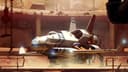
Rebel Galaxy Outlaw does something smarter and considerably rarer. It picks one specific 1993 game, understands exactly why that game worked, and rebuilds it with modern hands.
The studio matters here. Double Damage Games is a two-person operation founded by Travis Baldree and Erich Schaefer — the former behind Torchlight and Fate, the latter a co-creator of Diablo. These are people who have spent careers building compulsive loops, and it shows in the parts of Outlaw that sing. Their 2015 debut, Rebel Galaxy, was a clever oddity: a space combat game that locked you to a 2D plane and turned every fight into a naval broadside duel. Outlaw is its prequel, and a full structural pivot — cockpit view, six degrees of freedom, and a protagonist with a name and a grudge.
That protagonist is Juno Markev, a retired smuggler pulled back into the trade by a debt she can’t clear and a killer she intends to put in the ground. Players of the first game will recognize her as the aunt whose ship you inherited. The setting is the Dodge Sector: dozens of systems of blue-collar rust, where the stations smell like fryer grease and everyone at the bar owes somebody money.
Market position is the awkward part. Outlaw launched as an Epic Games Store exclusive, arriving on Steam and Switch on September 22, 2020, to an audience that had already decided how it felt about that. The lukewarm Steam user score, with recent reviews trending lower, is only partly a verdict on the game. Some of it is a verdict on the release strategy. Critics were warmer — the game sits at a respectable 77 on Metacritic — but nobody would call either number a triumph.
Key features
- Autopursuit combat: A toggleable lock that automatically flies your ship into the correct pursuit curve behind a target, converting dogfights from a stick-skill test into a tactical resource-management problem — which gun, which missile, when to burn countermeasures.
- A living, indifferent economy: Dozens of systems of commodity prices, cargo runs, bounty contracts, convoy escorts, asteroid mining, and piracy. The sector does not wait for you, and it does not scale to you.
- A deep bench of radio stations and licensed music: Blues, country, metal, surf rock. Not background ambience — a genuine authored element that does more tonal work than most games’ entire art direction.
- Space bars as a hub layer: Pool (a full, functional physics-based game), slots, dice, dialogue-tree job negotiation, guild recruitment, and station investment. Docking is a destination, not a menu.
- Deep ship customization: Component-level upgrades across a modest fleet, plus a 3D livery painter for people who want their bounty hunter’s rig to look like a 1978 Trans Am.
Analysis
The Gameplay Loop
The core loop is old and it is load-bearing: take a job, fly the job, get jumped, survive, sell the salvage, upgrade a component, take a bigger job. Outlaw executes the opening hours of that loop about as well as anyone ever has. The player starts broke, in a wheezing Platypus with two hardpoints and no shield worth the name, and every pirate wing is a legitimate threat. Scarcity does enormous design work early on. A single missile matters. A repair bill hurts.
The problem arrives in the midgame, and it’s structural rather than cosmetic. The mission generator has a small vocabulary. Strip away the flavor text and Outlaw offers roughly five verbs — kill this, escort that, carry this there, mine that rock, scan that thing. By the midgame every permutation has been seen, and the game’s answer to that is arithmetic: the same missions, with bigger numbers, gating a ship you want. That’s not progression. That’s a toll booth. The economy’s mid-tier grind is the single most common complaint in the user reviews, and it’s a fair one.
The main storyline compounds this. Juno’s revenge plot is well-written — Baldree’s dialogue has a dry, lived-in quality, and the voice performances are far above the budget bracket — but it is thin and short, a few hours of critical path spread across a game that expects many times that. Worse, story missions are frequently gated behind ship or reputation requirements, which means the best-written content in the package is what the grind is holding hostage. Invert that relationship and this is a substantially better game.
Autopursuit, and Why It’s the Smartest Thing Here
Autopursuit deserves more credit than it got. Space sims have a chronic accessibility failure: the skill of staying behind a moving target in three dimensions is difficult, unglamorous, and completely orthogonal to the fantasy of being a space pilot. Most games make you master it before the fun starts.
Double Damage simply removed it. Hold the button, the ship glues itself to the target’s six, and the actual decisions surface — trigger discipline on the capacitor, when to dump chaff, whether the turret should be on auto or under your thumb, which of three weapon groups is right for a shielded target versus an armored one. It is an elegant piece of design that trades simulation fidelity for decision density, and the trade pays off.
The purists’ complaint — that the flight model is too arcadey, that Autopursuit flies the ship for you — misreads the intent. This is not Elite Dangerous. It’s a game about being a working-class pilot in a beat-up ship, and the combat is tuned for that. Where the criticism does land is the AI: hired wingmen are unreliable, prone to wandering off mid-engagement or dying to trash they should handle, and escort missions in particular can fail for reasons that have nothing to do with player competence.
The Interface and the Bars
The UI is skeuomorphic in the best sense. Every menu is a diegetic screen inside Juno’s cockpit — the nav map, the comms panel, the trade terminal, the radio dial with a physical tuning knob. The game never pulls you out of the ship. It costs some efficiency (comparing commodity prices across systems involves more clicks than it should), but it buys atmosphere no flat menu could.
The bars are the game’s best trick. Docking drops you into a first-person seedy lounge where you shoot a fully simulated game of pool, feed a slot machine, roll dice, and work a dialogue tree with a bartender who has opinions about you. It’s mechanically slight and completely essential — it makes the sector feel populated by people rather than mission-dispenser icons. More space games should steal this immediately.
Visuals & performance
Outlaw is not a technical showcase and knows it. The art direction carries the load instead: a used-future aesthetic of scorched hull plating, hand-lettered station signage, and nebulae that look like they were painted on the side of a 1975 van. Cockpits are the highlight — cluttered, worn, specific to each hull, with Juno’s hands visibly working the controls. Ship models hold up to close inspection. Station interiors and NPC character models do not; faces in particular sit in an unflattering middle ground between stylized and realistic.
As a design matter, a game of this scope is light on hardware, and the PC version asks little of a modest machine. But user reviews still mention occasional hitching during system transitions, sporadic mission-state bugs, and crashes, on a game that has been out for years and is no longer under active development. That’s the sting: what’s on sale now is what it will always be.
The soundtrack is the technical and creative standout, full stop. A huge library of licensed blues, outlaw country, metal and surf across multiple stations, with the radio audible in the cockpit and diegetically muffled in the bars. Users repeatedly call it the best part of the game. They’re right, and that’s both a compliment and a quiet indictment.
Platform nuances
Steam (PC): The definitive version, with the caveat that it arrived to a fanbase already irritated by a year of Epic exclusivity — a meaningful chunk of that lukewarm user score is retaliatory rather than critical. Mouse-and-keyboard is the intended input; joystick and HOTAS support, however, was rough at launch and never got the attention the intended input did, a real problem for the flight-sim crowd this game’s marketing courted. Gamepad has since become the smoothest path. Ultrawide and high-refresh support are present and unremarkable in the good way.
Nintendo Switch: A more competent port than it had any right to be. Double Damage cut resolution and effects density hard — the image is soft docked and softer in handheld, with reduced particle work and simplified station interiors — but the arcade-leaning combat model tolerates those concessions far better than a simulation would. This is a strong handheld commuter game: missions chunk naturally into “one cargo run, one bounty,” and the radio is a natural fit for headphones. Just budget for the Joy-Con drift risk on a game that leans hard on the analog stick. Pro Controller strongly recommended.
Final verdict
Rebel Galaxy Outlaw is a small game with a large soul, and its failures are almost entirely failures of scale rather than vision. Two people built a sector that feels more inhabited than most open worlds staffed by far larger teams. The combat model is a legitimately clever piece of design thinking. The bars, the radio, the hand-lettered signage, Juno’s tired delivery of a bad joke — that texture is the whole reason to be here, and no amount of budget buys it.
But texture isn’t structure, and structure is what most people buy. Somewhere past the tenth identical escort contract, the seams show, and what looked like a living sector reveals itself as a slot machine wearing a leather jacket. The main story — the best content Double Damage produced — is short, and the game hides it behind exactly the grind that wears players down. That’s a self-inflicted wound, and it’s why this lands as a Mixed verdict rather than a rave.
At $5.99 the entry fee is trivial, but the price isn’t the problem — the repetition is. Expect a handful of excellent hours rather than dozens, turn the radio up, and only board if the atmosphere is the point. Judged as the mid-budget love letter it actually is rather than the genre revival it was sold as, it earns a niche — just not a spot on most shelves.
Reviewed by the Rankeno Strategy & Sim Desk. Scores are out of 10; the overall score is the desk’s editorial judgement, informed by the four sub-scores above. How we review


