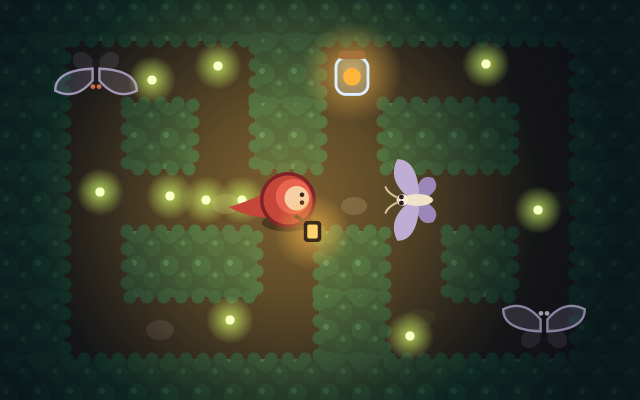
Overview
Most personality tests are transactions. You answer questions, a formula spits out four letters, you nod or shrug, and you forget it by lunch. Refind Self: The Personality Test Game rejects that entire premise. It never asks a single direct question about the player. Instead, it hands you an android, drops you into a warm pixel-art world, and then watches. Every door you open, every character you help or ignore, every moment spent loitering versus rushing forward—all of it feeds a silent engine that infers who you are from how you behave.
The game is the work of Lizardry, a solo Japanese developer, and it’s published by PLAYISM, the outfit with a long track record of ushering idiosyncratic Japanese indies onto Western storefronts. That pedigree matters. This is not a slick, venture-funded “wellness” app dressed up as a game. It’s an authored, hand-built experience with a point of view, and it wears its craft openly.
The setup is simple at first, with the behavior-tracking doing the real work. You’re an android waking at the grave of the Doctor who created you. From there, you wander a world populated by robots of every conceivable shape, revisiting locations tied to fragments of memory. There are no game-overs and no wrong answers—a design choice that isn’t a gimmick but the whole thesis. A single loop runs about an hour, and the complete portrait only emerges after three playthroughs, each peeling back a deeper layer of your inferred traits. Hit 100% analysis, and the game reveals your results, stores them in an online database, and hands you a shareable results ID to compare against friends and strangers.
It positions itself in an unusual market gap: too narrative to be a toy, too playful to be therapy, too personal to be forgettable. Lizardry is careful to frame the whole thing as entertainment, not rigorous science. Respect that framing, and the game delivers something genuinely rare.
Key features
- Behavioral personality inference: The core hook. Instead of surveying you, the game analyzes your choices—where you go, who you engage, how you treat the world—and builds a personality read from observed action.
- Three-layer playthrough structure: A full result requires three roughly hour-long runs. Each pass surfaces deeper traits, rewarding a different mindset and discouraging min-maxing.
- Shareable results ID + database: Completing analysis mints a unique ID stored online, turning a private introspective exercise into a social comparison game with friends and strangers.
- Consequence-free exploration: No fail states, no punishments. The absence of game-over screens is a mechanical guarantee that you can only ever play “honestly.”
- Authored narrative: A quietly emotional story about identity, memory, and what the Doctor entrusted to you—delivered through warm pixel art and an evocative soundtrack.
Analysis
The Gameplay Loop
Strip away the framing and the moment-to-moment play is a gentle top-down adventure: walk, talk, examine, choose. You explore memory-linked locations, meet robots, and make decisions that carry no scorekeeping and no branching “you died” penalty. If that sounds thin, it is—deliberately. The mechanical surface is intentionally low-friction so that nothing distracts the real system running underneath.
That system is the star. Refind Self treats your behavior as data. Do you rush to the objective or wander every corner first? Do you help the robot in distress or walk past? Do you hoard, share, confront, or avoid? The game logs these tendencies and, over three runs, assembles them into a personality archetype. It’s the difference between a survey asking “Are you kind?” and a system quietly noting that you spent ten minutes helping an NPC with nothing to gain. The second is far harder to game, and far harder to lie to yourself about.
That’s the genuine innovation here. Self-report personality tests suffer from a fatal flaw: people answer as the person they wish they were. By inferring from action, Refind Self sidesteps the aspirational fib. The results carry weight precisely because you weren’t performing for them—you were just playing.
Onboarding and Friction
The onboarding is elegant. The game doesn’t lecture you about its mechanics because explaining them would corrupt the data. You’re simply in it from the first step, and the realization that your behavior is being read tends to dawn gradually. That slow reveal is the intended experience, and it’s smartly handled.
The friction shows up in the three-playthrough requirement. Structurally, it’s defensible—a single hour can’t capture a person, and the repeated runs let the game distinguish a fluke choice from a genuine pattern. But the second and third loops are built to retread familiar ground, and the exploration that feels fresh in run one risks curdling into backtracking by run three. Pacing wobbles by design, and that’s the most legitimate criticism to level at the game.
Utility and the Introspection Payoff
To be blunt: do not confuse this with clinical psychometrics. Lizardry doesn’t. The value isn’t diagnostic accuracy—it’s the provocation to reflect. When the game hands you a result derived from your actual choices, it functions as a mirror, and mirrors are useful even when they aren’t scientific instruments. A read that lands with uncanny resonance is the product working exactly as designed.
The results ID transforms a solitary experience into a shared one. Comparing your archetype against a friend’s—and arguing about who got read more accurately—is where the game finds its second life. It’s a low-key social hook, and a clever one, because the comparison is grounded in behavior rather than self-flattery. That gives the water-cooler conversation actual stakes.
The honest caveat: replay value is finite. Once the three runs are complete and the result is earned, the systemic novelty is spent. This is an experience you have, not a live-service loop you inhabit. Priced and understood accordingly, that’s fine. Expecting dozens of hours is a category error.
Visuals & performance
The pixel art is warm, legible, and quietly expressive—robots rendered with enough character to make you care about metal creatures you’ve known for ninety seconds. It’s not technically showy, and it doesn’t need to be. The art direction serves the mood: melancholic but never grim, cozy but never saccharine. The soundtrack does heavy lifting, threading an emotional undercurrent through what would otherwise read as low-stakes wandering. Together they carry the story’s themes of memory and identity more effectively than the sparse dialogue alone could.
Technically, this is a lightweight game with a small footprint—a 2D game of this scope is light on hardware, with no demanding physics or rendering to strain a device. That’s exactly what you want from an experience that lives or dies on atmosphere and reflection rather than reflexes.
Platform nuances
Refind Self spans iOS, Android, Steam, and Nintendo Switch, and the design translates unusually well because the interaction model is so undemanding.
- Steam (PC): Mouse-and-keyboard or controller both work, and the larger screen flatters the pixel art. This is the “sit and absorb” version—best for players who want to give the narrative their full attention.
- iOS & Android: Touch controls are a natural fit for a slow exploration game, and the mobile format suits the introspective, one-hour-per-sitting cadence. This is a game built for a couch or a commute without losing anything. Arguably the most fitting home for it.
- Nintendo Switch: The later Switch port splits the difference—handheld intimacy plus the option of the big screen. The undemanding design ports cleanly across form factors.
There’s no platform where this game seems compromised, and no meaningful feature gap between them. Pick the screen you’re most likely to sit quietly in front of.
Final verdict
Refind Self: The Personality Test Game is a title where the concept and the execution largely align. Lizardry took a tired format—the personality quiz—and rebuilt it around the one thing quizzes can’t fake: your behavior. The result is a short, thoughtful, faintly haunting experience that earns its emotional beats and its shareable payoff. Its flaws are honest ones. The three-run structure taxes your patience, the back half meanders, and the whole thing is over in an afternoon. But what it does, almost nothing else does. We recommend it to anyone with three hours and any curiosity about the gap between who they think they are and how they actually behave—a small, strange experiment worth the modest asking price. Just don’t mistake the mirror for a microscope.
Reviewed by the Rankeno RPG & Adventure Desk. Scores are out of 10; the overall score is the desk’s editorial judgement, informed by the four sub-scores above. How we review