
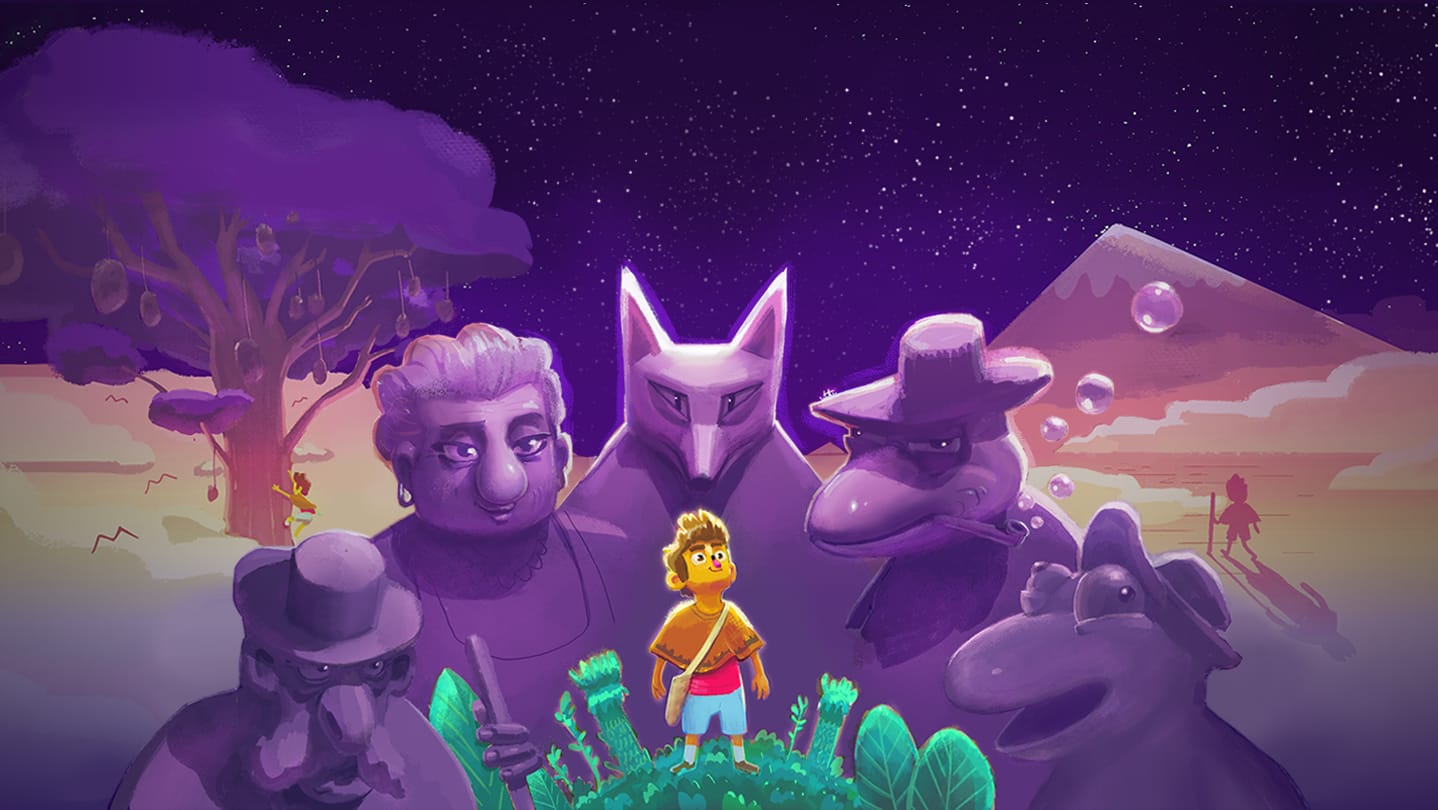
Bottom Line: StudioBando has made one of the most beautiful small games on Steam — a warm, funny, hand-crafted adventure that earns its emotional payoff in under five hours. It stumbles whenever it tries to be an action game, and its refusal to let you save manually is an act of design stubbornness that will punish anyone chasing achievements.
The Gameplay Loop
SOPA is a narrative adventure that uses gameplay as punctuation, not as engine. You walk, you look, you talk, you pick things up, you combine them, you solve a thing, you move on. If you came up on Monkey Island or Grim Fandango, you already know this rhythm. The verbs are few and the friction is deliberately low. That is a defensible design choice — this is a game about a boy on an errand, and the errand structure is the whole joke — but it does mean that anyone arriving expecting mechanical depth is going to feel the floor arrive early.
Where the loop genuinely sings is the return-to-kitchen structure. Most short adventures are one-way corridors: you leave, you journey, you arrive changed. SOPA instead runs a hub-and-return cadence, and it uses that repetition as a delivery mechanism for change. You come back to the same room, and something's different. A new object on the counter. A line of dialogue that lands differently now. It's the same trick a good short story pulls with a repeated image, and it's the reason the ending works on players who spent the previous four hours laughing at talking animals. Themes of family, inheritance, and what gets handed down are not stapled to the credits — they're built into the level structure.
Puzzle Design and Difficulty Calibration
Here is the first real crack. The puzzle difficulty is inconsistent, and not in an interesting escalating way — in a scattered way. Some sequences telegraph their solutions so plainly you're clicking before the character finishes explaining. Others hinge on a piece of environmental logic that the game never teaches, and the player's reasonable next move is a browser tab. Critics flagged this repeatedly, and it's the classic small-team problem: without a large external playtest cohort, the team's own fluency with their systems becomes invisible to them. Every designer knows where the lever is. Nobody on the inside can un-know it.
The fix isn't a hint system, necessarily. It's calibration. When a game is four hours long, a single twenty-minute wall consumes eight percent of the entire experience, and it consumes it in the worst possible emotional register — frustration, in a game whose entire currency is warmth.
Where It Breaks: The Action Segments
The chase and action sequences are the weakest thing in the box, and it isn't close. StudioBando's strengths are staging, animation, writing, and mood. None of those are the strengths you need to build a satisfying pursuit sequence, which requires precise input response, readable failure states, and generous checkpointing. What's here is serviceable at best and floaty at worst — the moments where the game stops being an authored experience and starts being a set of hit detection rules that don't quite hold. They're mercifully brief. They're also the only stretches where you're aware you're playing an indie game rather than watching a very good one.
The Save System Problem
This is the design decision I'd argue with the team about. SOPA has no manual save and no chapter select. Combine that with 31 achievements, many of them missable — a figurine you walked past, a conversation you clicked through, an optional beat you didn't trigger — and completionists face a hard wall: replay the entire game to recover a single miss.
For a linear cinematic game, autosave-only is a defensible purity argument. Add missable collectibles to that same game, and the argument collapses. You've created a completion incentive and then removed every tool a player needs to act on it. Chapter select is not a luxury feature in 2026; it's plumbing. Its absence converts an optional metagame into a chore, and it's the single most fixable complaint on this list.
Onboarding and Accessibility
Onboarding friction is low, appropriately. The game teaches its handful of interactions inside its first environment without a tutorial overlay, trusting the player, which is correct for the audience. The dual-Spanish localization deserves specific credit — treating LatAm and Spain Spanish as distinct rather than shipping one and calling it done is the kind of respect for audience that costs money and wins loyalty.