

Bottom Line: Swing Swing Submarine built an entire puzzle game on a single mechanic — swallow a block, spit it out — and then wrung more genuine invention out of it than most studios manage with a full toolbox. It's warm, it's gorgeous, and by hour twelve it will make you question your own competence.
The Gameplay Loop
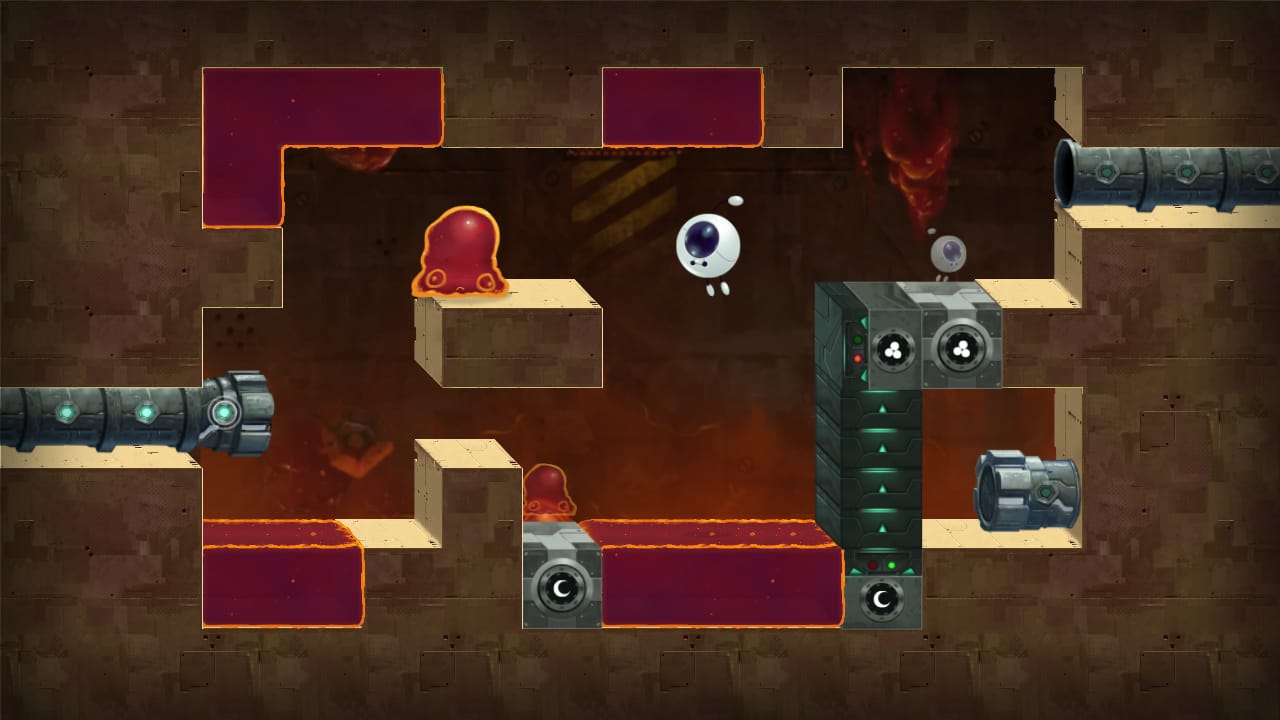
Every level is a sealed box. You enter, you survey, you reconfigure, you exit. There's no timer, no enemy pressure, no resource drain. The pressure is purely cognitive, and Tetrobot & Co. is unusually honest about that — it doesn't dress up its puzzles with combat filler or a padding layer of traversal.
What makes the loop work is the interaction density of the materials. Consider what happens when you combine two rules the game taught you separately. Iron conducts, so an iron block completes a circuit and opens a door. Glass shatters on impact, so glass can't be dropped from height — but it can be used as a fragile temporary platform. Ice melts near heat, so ice is a timer disguised as a block. Wood burns, so wood is both a bridge and a fuse. Individually these are elementary. The design's cleverness is that levels almost never ask you to use one rule; they ask you to use three rules in a sequence where step two destroys the material you needed for step one — unless you did step three first.
That's the "diabolical" Gamekult was pointing at. The puzzles aren't hard because they're obscure. They're hard because the solution space collapses the moment you commit to a wrong order, and the game trusts you to notice.
Why Infinite Rewind Is the Real Design Achievement
I want to be specific about this, because "unlimited undo" reads like a quality-of-life checkbox and it isn't. In a game where a single misplaced block permanently poisons a level state, the absence of instant rewind would force one of two bad outcomes: either full-level restarts (tedious, punishing, and hostile to experimentation), or defensive design where the developers soften the puzzles so mistakes are less catastrophic (boring).
Swing Swing Submarine took the third path. Rewind is instantaneous and infinite, which lets them make the puzzles as brittle and precise as they want. You're encouraged to burn the wood just to see what happens. You're encouraged to shatter the glass. The failure cost is roughly one second of your life. The result is a game that teaches through consequence without ever taxing you for curiosity, and it's the reason the difficulty curve stays tolerable far longer than it has any right to.
This is also where the design shows its intelligence about onboarding friction. There is no tutorial wall. Materials are introduced one at a time, in levels engineered so the new property is the only thing that could possibly work. You learn by doing the wrong thing three times in eight seconds.
Where It Breaks
Two things, and both are real.
First, the late-game difficulty spike is genuinely steep. Not gradual — steep. There's a stretch in the back third where the level design shifts from "clever" to "adversarial," and the game offers essentially no hint system, no skip, no soft assist. If you stall, you stall. Players consistently flag this, and it's the primary reason a game with a 97% user rating sits at a 72 on Metacritic: reviewers on deadline hit that wall and had to write around it.
Second, the memory blocks are a different game wearing the same skin. Collecting all three per level is where the twenty hours lives, and the challenge escalation there is brutal in a way the main path never is. Treat them as an optional expert mode, not as completionist busywork, and the pacing makes far more sense. Ignore them entirely and you'll finish in a fraction of that time — which is exactly the "it's short" complaint some players raise, and it's largely self-inflicted.
The narrative is the weakest column holding the thing up. Maya, the broken Tetrobots, the fifteen-year gap since Blocks That Matter — it's atmosphere, not story. It gives the levels a reason to look like machine interiors and gives the memory blocks a reason to matter. That's the extent of its ambition, and I'd rather have honest set dressing than a puzzle game straining for pathos.