
Bottom Line: Unciv is a volunteer-built, ad-free reconstruction of Civilization V that fits in less space than a single podcast episode and plays better on a five-year-old phone than most premium ports do on flagships. The interface fights you on a small screen, but this is the rare free game that owes you nothing and delivers everything.
The Gameplay Loop
Unciv does not soften the loop. That is the first thing worth understanding, and the thing that will either delight you or send you back to something with a tutorial that holds your hand for forty minutes.
You start with a settler and a warrior on an unexplored map. You found a city. Then you begin the compounding decisions that make 4X the most quietly stressful genre in games: does this city work the wheat tile for growth or the hill for production? Do you push toward Pottery for a library economy, or Bronze Working because there's a Songhai border two hexes east and you have precisely one warrior? Every choice forecloses another. The tension isn't in any single turn — it's in the slow realization, around turn 90, that a decision you made on turn 12 has quietly determined which victory condition is still open to you.
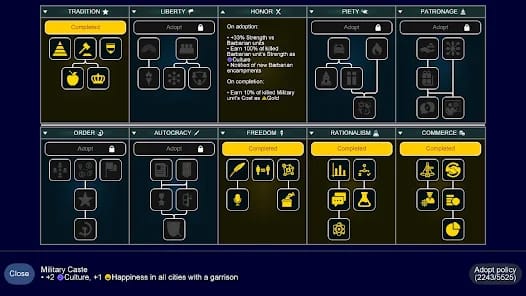
This is faithfully done. Not approximately faithful, not "inspired by" — the systems interlock the way Civ V's did. Science scales off population and buildings, so your empire's width and height genuinely trade against each other. Social policies fork into branches you cannot fully explore in one game. Faith accumulates into a pantheon, then a religion whose beliefs you select and spread, and that spread has real diplomatic consequences with neighbors running competing faiths. City-states aren't decoration; they're a currency of influence that a diplomacy-focused player farms deliberately with gold and quest completion.
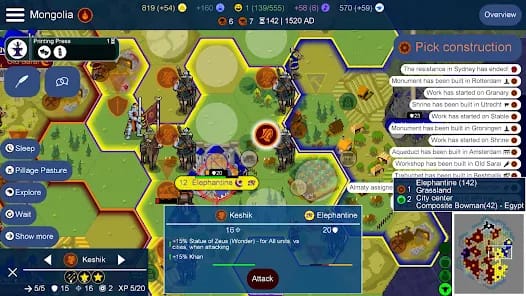
Combat is the hex-based, one-unit-per-tile system that made Civ V's tactical layer interesting — ranged units matter, terrain matters, and a stack-of-doom steamroll isn't available to you. The AI here is the game's honest weak spot. On lower difficulties it plays a coherent, recognizable game. Push into the upper tiers and you'll notice the pattern most 4X veterans notice: the challenge comes increasingly from the AI's economic bonuses rather than its cleverness, and a player who understands force composition can outfight armies that badly outnumber them. It is not a solved AI. It is also, in fairness, not appreciably worse than what shipped in commercial Civ games of the same generation.
Onboarding Friction
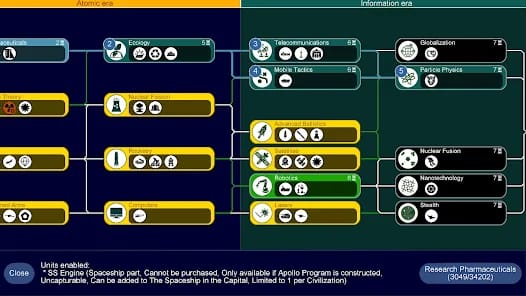
Here is where Unciv asks something of you. The in-game tutorial exists, and it is functional, and it is nowhere near enough. If you have never played a 4X game, you will open the tech tree, see roughly eighty interconnected nodes, and feel something close to vertigo. The game explains what a granary does. It does not explain when a granary is the wrong build.
That gap is real and the community knows it — better tutorials sit near the top of every feature-request thread. Newcomers should expect to lose their first two or three games to their own ignorance, then discover on game four that the losing was the point. Veterans returning from Civ V will be productive within ten minutes.
Quality of Life
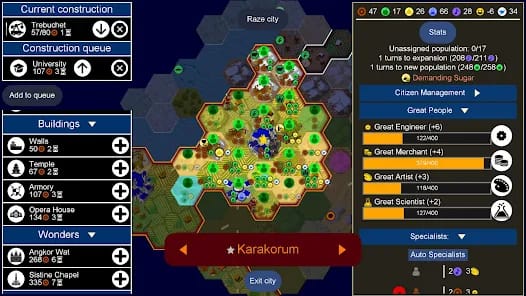
The rough edges cluster here rather than in the systems design. Production queues — the ability to line up three builds in a city and stop micromanaging it — have been a standing request. Late-game turn processing on the largest maps slows noticeably as the AI resolves dozens of civilizations' worth of decisions; on a big continental map in the industrial era, you will wait. Not catastrophically, but you'll notice it, and on a modest phone you'll notice it more.
What offsets this is the development cadence. Unciv updates constantly. Bugs raised on GitHub get triaged and fixed at a pace that shames studios with revenue. The mod manager means that when the base game doesn't do what you want, someone in the community has probably already built the ruleset that does — and installing it takes two taps, not a folder full of zip files.