Overview
Warhammer 40,000 has been strip-mined for four decades. Real-time strategy, boomer shooters, ARPGs, mobile gacha, an entire shelf of tactical squad games — the license gets handed out like communion wafers. Almost none of it has been about the setting. It uses 40K as texture: skulls, gothic arches, a voice actor growling about the Emperor. Rogue Trader is the first video game in a long while that treats the Imperium as a subject rather than a mood board.
Owlcat Games arrived here with a specific and hard-won pedigree. The studio spent two games — Pathfinder: Kingmaker and Pathfinder: Wrath of the Righteous — learning how to translate a dense tabletop ruleset into an isometric CRPG without sanding off the sharp edges. Both shipped in rough shape. Both became cult favorites after eighteen months of repair work. That pattern repeats here almost beat for beat, which is either a studio signature or a studio problem depending on how charitable you feel.
The adaptation source matters. This is built on the Rogue Trader tabletop ruleset — the 2009 Fantasy Flight line about merchant-explorers holding an Imperial Warrant of Trade, not the Space Marine power fantasy the license usually sells. You command a voidship and a dynasty, not a squad. You push into the uncharted Koronus Expanse as something closer to a Renaissance mercantile prince with orbital bombardment privileges. It’s a fundamentally stranger premise than “shoot the xenos,” and it gives the writers room to ask questions the setting normally forecloses.
Positioned against Baldur’s Gate 3, this loses on production polish, cinematic presentation, and reactivity per hour. It wins on density of systems and on the willingness to make you complicit. Owlcat isn’t chasing the mass market. They’re serving the CRPG faithful who want spreadsheets, faction politics, and moral choices with no clean option. It’s a niche appeal, and the game knows it.
Key features
-
The Conviction System: Three alignments — Dogmatic, Iconoclast, Heretical — that function as ideological commitments rather than a good/evil slider. Dogmatic is faith in the Imperium’s machinery. Iconoclast is compassion that the Imperium considers a weakness. Heretical is the pragmatism of someone who has stopped pretending. Each unlocks distinct abilities and reshapes dialogue and outcomes. Crucially, none of them is the correct answer, and the game refuses to tell you which one it prefers.
-
Layered Turn-Based Tactics: Cover, positioning, environmental hazards, and chained companion abilities. The combat rewards setup over stats: a properly built Officer granting extra turns to a properly built Assassin can end an encounter before the enemy acts. Character creation spans origin, homeworld, and archetype, and those choices propagate into dialogue from the first hour.
-
The Dynasty Layer: Void-ship combat, colony management across claimed worlds, and star-system exploration sit on top of the party RPG. These are not minigames bolted on for the back of the box — they’re the mechanical expression of what a Rogue Trader actually is, though they vary wildly in depth.
-
Companions Who Argue Back: A retinue running from devout Imperial zealots to unstable psykers to outright xenos allies, each with personal arcs and an approval system. Recruiting an eldar aboard an Imperial vessel is a political act, and the game treats it as one.
Analysis
The Gameplay Loop
The core rhythm is planet-side exploration, dialogue, and tactical combat, punctuated by voidship travel and periodic returns to your ship for colony and dynasty management. On paper that’s standard CRPG architecture. What distinguishes it is how much authority the game hands you and how rarely it flinches from the consequences.
You are not a wanderer who stumbles into world-saving. You are an aristocrat with a fleet, a warrant, and the legal right to conduct war. When a colony asks for help, you can send resources, send troops, send nothing, or send an Inquisitorial purge team. The game does not stage these as trolley problems with a hidden third option that saves everyone. Choosing to be efficient usually means choosing to be monstrous, and the game logs it without editorializing. That restraint is the writing’s greatest asset.
The dialogue system deserves specific credit for how origin and homeworld feed back into it. A character born to the void nobility reads a room differently than one dragged out of a hive world’s underbelly, and those markers appear early and often rather than being frontloaded in Act I and forgotten. It’s the kind of reactivity that costs enormous writing hours and pays off invisibly.
Combat and Build Depth
The tactical layer is strong and eventually breaks itself. Early combat is built to be tense — cover matters, ammunition types matter, a squishy psyker parked in the open is dead. Encounters ask you to read terrain before you read the enemy roster.
Then the build system takes over. The class and archetype architecture allows extremely specialized parties, and by the late acts a well-optimized group can chain turns into what amounts to an infinite loop. Officers grant extra turns. Those turns generate resources that generate more turns. The power curve doesn’t just steepen — it goes vertical, and the last chapters can dissolve into watching your own combo execute rather than playing. Patches have trimmed the worst outliers, but the underlying math still permits absurdity.
Whether that’s a flaw depends on your temperament. Some consider “build a machine that breaks the game” the entire point of a CRPG. But it does mean the tactical tension the opening acts establish so well doesn’t survive to the finish line.
Where the Structure Sags
The dynasty and colony systems are the weakest link. Void-ship combat is a competent broadside-management puzzle with real tactical texture — turning your ship to present shielded facings, managing torpedo spreads — but it’s undertuned relative to ground combat and becomes a formality once your ship outclasses the region. Colony management is thinner still: a resource-and-timer layer that produces numbers rather than stories. It’s thematically essential and mechanically undercooked.
Pacing is the other structural problem, and it’s the one patches can’t fix. The mid-game is superb. The later chapters are where the seams show — quest density drops, travel time inflates, and the narrative momentum built across dozens of hours starts running on fumes. A 130-hour campaign has no obligation to sustain peak intensity throughout, but the falloff here is steep enough that the back half asks real patience. If you’re going to bounce off this game, it will happen around hour 70, not hour 7.
Onboarding Friction
This is a hard game to start. The tutorial explains the rules but not the setting, and 40K’s vocabulary — Astropaths, the Warp, the Mechanicus, Gellar fields — arrives at volume with minimal scaffolding. The in-game encyclopedia is thorough, but reading it is homework. Newcomers should expect the first five hours to feel like being handed the fourteenth book in a series. It gets much better once the terminology clicks, and the design is more welcoming to 40K novices than its reputation suggests — but the ramp is real, and Owlcat never quite solved it.
Visuals & performance
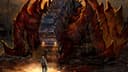
The art direction is the best-realized Imperium in any 40K game. Not the most technically impressive — the most correct. The gothic industrial excess reads as genuinely oppressive rather than cool: cathedral bridges the size of city blocks, servitors wired into consoles, ornamentation piled on ornamentation until the aesthetic tips into pathology. That’s the point. This is a civilization that has forgotten how anything works and compensates with gold leaf.
The isometric camera is a limitation Owlcat mostly works around through environmental scale and lighting. Character models are functional rather than beautiful; the game asks for more time reading portraits and text than admiring faces. The UI is dense — layered tooltips and nested stat breakdowns everywhere — and it prioritizes information over elegance. For this genre that’s the right call, though the ability-bar layout is built for mid-game kits and gets crowded in late-game encounters.
Technically, the game launched in rough shape — the same pattern that marked Owlcat’s Pathfinder titles. Two years and two expansions later — Void Shadows and Lex Imperialis — the picture is substantially different, with an extended patch campaign addressing the worst of it. Residual jank remains part of the design reality: a game of this systems density carries trigger hiccups, UI inconsistencies, and heavy transitions by nature. It’s a game that has been repaired, not one that was built clean.
Platform nuances
Steam is the definitive way to play, and it isn’t close. Mouse-and-keyboard is the native input for a game built on stat inspection, precise positioning, and dialogue trees. Hovering a tooltip to read a damage breakdown, then hovering a nested tooltip inside it, is a mouse gesture. The PC version also gets patches first, supports mods, and lets settings scale to hardware — meaningful when late-game encounters get crowded.
Nintendo Switch 2, which arrived December 11, 2025, is a more interesting proposition than skeptics might expect. The port exists because the hardware finally could support it; this game on the original Switch would have been an act of violence. The controller scheme is a genuine adaptation rather than a mapped-over PC layout — radial menus for abilities, a cursor-and-snap system for targeting. It is also, unavoidably, slower. Actions that take one click on PC take a menu traversal on a pad, and across 130 hours that friction compounds.
The handheld case is the real argument. A slow, text-heavy, turn-based game is well suited to being played in twenty-minute increments on a couch, and the design travels well to portable mode — with the caveat that text scales down to sizes that will test your eyes. A 2D-heavy, turn-based game of this scope is light on hardware by genre standards, but the port still trades draw distance, texture quality, and load times to fit. If you own both, buy it on Steam. If the Switch 2 is what you have, this is a competent port of a good game, not a compromised version of a mediocre one.
Final verdict
Rogue Trader is a solid, deeply flawed game, and the flaws are exactly the ones Owlcat always ships with. Too much game, unevenly finished, sagging where it should sprint, held together by writing much better than the license demands. What Owlcat understood — and what four decades of 40K games mostly missed — is that the Imperium is not a cool faction to belong to. It’s a horror. The game hands you power over millions of lives and then makes you use it, repeatedly, with no option that leaves you clean. That’s not edgelord posturing. That’s the setting being read correctly.
The technical debt is real and some of it is permanent. The last thirty hours are weaker than the first hundred. The colony layer never fulfills its promise. None of that stops this from being one of the most substantial things built with this license, and the patch history means anyone buying it now gets a far better game than the one that shipped December 7, 2023 at $49.99.
Bring patience. Bring a lexicon. Bring a willingness to be complicit. For the right player, what’s here is worth it.
Reviewed by the Rankeno Strategy & Sim Desk. Scores are out of 10; the overall score is the desk’s editorial judgement, informed by the four sub-scores above. How we review