


italki
educational
8/2/2026

italki

byITALKI HK LIMITED
8.3
The Verdict
"italki is a great service running on average software, and it has been that way long enough that the gap now looks like a choice rather than a backlog." "The marketplace is the achievement. Aggregating tens of thousands of teachers across 150+ languages, pricing them transparently in two tiers, and making a single 45-minute conversation lesson cost less than a restaurant lunch — that is a genuine restructuring of who gets access to a human language teacher. For most of history, that was a privilege of geography and money. Now it's an app and twelve dollars. The 4.8-star ratings across every store and review site are earned, and they were earned by teachers." "But the engineering is coasting. The complaint pattern is remarkably consistent — excellent tutors, clunky app — and it points at fixable things: a calendar that surfaces the information a booking decision requires, an interface that doesn't hide your lesson history, and above all a Classroom that doesn't fail during the sixty minutes that justify the entire company's existence. italki has the supply-side advantage of a decade's head start. That advantage does not protect against a rival that matches the catalog and simply builds better software." "Buy it anyway. The teachers are worth the friction, and no automated drill app is going to argue with you about the subjunctive at 7 PM on a Tuesday. Just do your booking on a laptop, and keep Zoom installed."

Gallery

Screenshot 1
View
Screenshot 2
View
Screenshot 3
View
Screenshot 4
View

Key Features

Deep tutor discovery with real filters: Search by language, price, availability, specialization, student rating, and — critically — accent. British versus American English is a selectable parameter. So is a tutor's willingness to teach a specific CEFR band or exam. Every tutor posts an introduction video, which does more work than any written bio: you hear the accent, gauge the energy, and decide in ninety seconds whether this is a person you can spend an hour with.
Pay-per-lesson pricing, no mandatory subscription: You load prepaid italki credits and spend them per booking. Lessons come in 30, 45, 60, or 90-minute blocks. Package discounts exist for committing to a run of lessons with one teacher, but nothing auto-renews and nothing locks you in. In a category addicted to recurring revenue, this is close to a moral stance.
CEFR-aligned, goal-driven instruction: Teachers calibrate to your level from A1 through C2 and to a stated objective — conversation fluency, business language, grammar repair, or exam prep (IELTS, DELE, JLPT, HSK). Compare this to app-based learning, which teaches everyone the same sentence about a bear drinking beer.
italki Classroom, plus escape hatches: Lessons run in the built-in video conferencing tool, or over Skype or Zoom if the tutor prefers. That fallback is not a courtesy. It's a safety valve, and users use it.
A free layer that isn't a trial: Language exchange partner matching pairs you with someone learning your native language. The community feed lets you post questions, submit writing for native-speaker correction, and practice with other learners. You can extract genuine value here without spending a cent.

The Good

Unmatched tutor depth — 150+ languages including rare dialects competitors ignore
No subscription. Pay per lesson, discounts on packages, nothing auto-renews
Two-tier pricing lets you mix cheap conversation practice with structured professional instruction
Accent, specialization, and CEFR filtering that reflects real learner needs
Genuinely useful free tier: writing correction, exchange partners, community Q&A
Intro videos make tutor selection fast and low-risk

The Bad

Clunky navigation and muddled information architecture throughout
The calendar hides critical booking info, making scheduling error-prone
italki Classroom is unreliable — video drops, connection failures, blank screens
Prepaid credit system adds friction between you and a purchase
Tutor quality varies; vetting the teacher is your job, not the platform's
Android build shows more bug reports across fragmented hardware

In-Depth Review

Bottom Line: italki solved the hardest problem in language learning — putting a real human on the other end of the call, cheaply, in 150+ languages — and then wrapped that achievement in an interface that fights you at every booking. Buy it for the tutors. Tolerate the software.

The Marketplace Loop

The core loop is simple: browse, watch, book, learn, rebook. Its quality depends almost entirely on how well the first step works, and that's where italki's design debt gets expensive.

Finding a tutor should be the most delightful part of the product. You're shopping for a person who might change your relationship with a language, and the raw material — video intros, transparent hourly rates, star ratings, lesson counts, specialization tags — is genuinely excellent. The filter set is thoughtful in ways only a company that has watched real learners struggle would produce. Accent filtering is the tell. Somebody at italki understood that a Japanese engineer preparing for a Silicon Valley job interview and a Spanish retiree planning a Cornwall holiday need different English teachers, and built for it.

Then you try to book, and the product turns to sand.

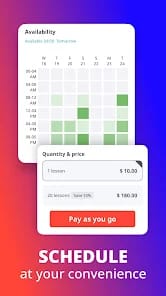
The calendar is the single weakest surface in the app, and it's the one you interact with most. Availability is presented without enough context to make a decision: you're squinting at a grid trying to reconcile a tutor's timezone with your own, work out which slots are actually open versus tentatively held, and figure out whether the 45-minute option is even available at the time you want. Users complain about this constantly, and they're right to. A scheduling marketplace whose scheduling UI requires guesswork is failing at its primary job. You will book a lesson at 6 AM by accident. Ask anyone who's used it.

Where the Money Goes

The economics deserve real credit. The credit system is the mild annoyance of any prepaid model — you're converting cash into scrip, and scrip always feels slightly worse than cash — but the absence of a subscription wall changes the psychology of the whole product. You are never paying for a month you didn't use. You are never staring at a renewal charge for an app you abandoned in February.

The two-tier teacher structure is the smartest piece of product design here. Professional teachers are the expensive, structured option — they'll build you a syllabus and correct your case endings. Community tutors cost substantially less and exist to let you talk. For an intermediate learner, the optimal strategy is obvious and italki lets you execute it: one professional lesson a week for structure, three cheap community sessions for volume. That's a fluency plan that costs less than most gym memberships, and no automated app can replicate it, because the thing you actually need at B1 is not more flashcards. It's a patient human who will let you flounder through a sentence and then fix it.

The Community Layer

The free tier is better than it needs to be. Writing correction by native speakers is the standout — you post a paragraph, and people who actually speak the language mark it up. It's slower than an LLM and considerably more useful, because native speakers flag the thing that's grammatically correct but that nobody would ever say. Language exchange matching is more variable; the quality of an exchange partner is a coin flip, and the feature functions best as a funnel into paid lessons once you realize how much easier a trained teacher is.

The Central Tension

Here is the honest framing: italki's product quality and italki's service quality are two different scores. The teaching is a 9. The software is a 6. The 4.8-star aggregate exists because the teaching is so good that users forgive the app — a reservoir of goodwill that italki has been drawing down for years without visibly refilling it. That works right up until a competitor with equal supply and better engineering shows up.

Editorial Disclaimer

The reviews and scores on this site are based on our editorial team's independent analysis and personal opinions. While we strive for objectivity, gaming experiences can be subjective. We are not compensated by developers for these scores.