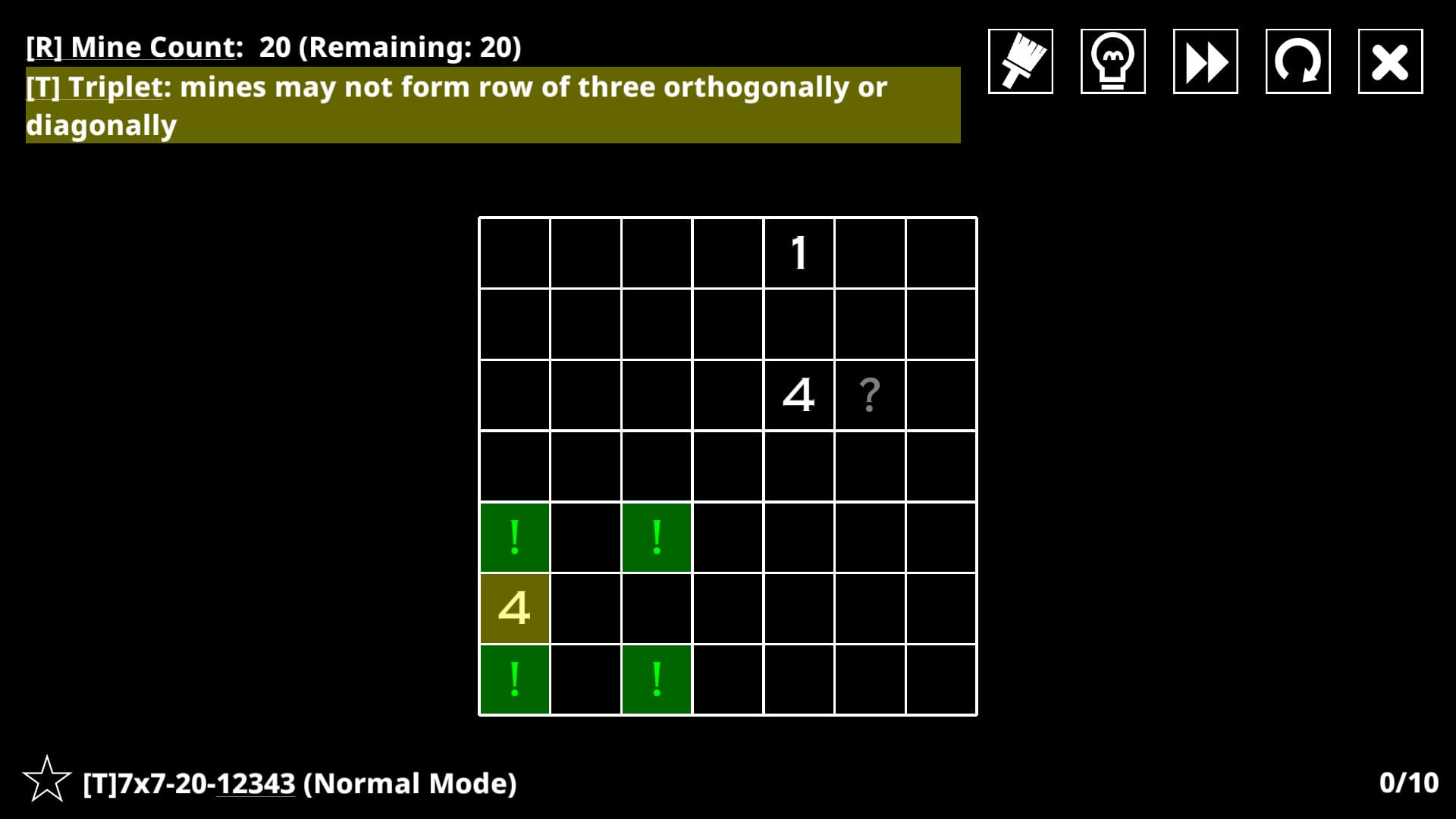



Bottom Line: A stripped-down grid game that quietly rebuilds Minesweeper into fourteen separate logic systems, then removes the coin flip entirely. It's one of the purest deduction games on Steam, and its refusal to let you guess is both the best design decision here and the reason some players will bounce off in twenty minutes.
The Gameplay Loop
The loop is austere and it works. Pick a variant, pick a tier, get a grid, solve it, unlock more. There's no energy meter, no daily streak, no cosmetic economy. The reward for solving a puzzle is a harder puzzle. If that sentence sounds thin to you, this game is not for you and it will not try to convince you otherwise.
What makes it hold up over dozens of hours is the variant architecture. Standard Minesweeper has, functionally, one solving technique that you scale up: local constraint satisfaction on adjacent cells, occasionally supplemented by global mine-count arithmetic at the end. That's it. Here, a connectivity constraint means information propagates across the entire board — a cell in the top-left corner can be resolved by a deduction made in the bottom-right, because the mines must form a single connected chain and certain placements would orphan a group. That's a fundamentally different kind of reasoning, closer to a network flow problem than to pattern-matching.
The liar variants are nastier still. When every clue is guaranteed wrong by exactly one, your brain keeps trying to read the numbers at face value and keeps punishing you for it. The information content is identical — a "3" means two or four — but the cognitive load of maintaining that translation across twenty cells is brutal in a way that's genuinely novel. Cross-variants, which stack rulesets, are where the game stops being clever and starts being borderline hostile. Connectivity plus liar clues on an 8x8 grid is a puzzle you solve on paper over a lunch break, not something you click through.
The No-Guessing Rule Is the Whole Game
Let's be precise about why the board-rearranging punishment matters, because it's easy to read as a gimmick.
Any game could claim its puzzles are logically solvable. Most guarantee it and then let you guess anyway — because if a guess happens to be right, nothing stops you. That quietly destroys the design. The player who guesses at the 60%-confidence point never learns the technique that would have gotten them to 100%, and the game's difficulty curve silently converts into a luck curve.
By making a speculative click a guaranteed loss, the developers close that escape hatch. You cannot brute-force your way past a deduction you haven't learned. You have to sit there and stare at the grid until the logic surfaces. It's the same philosophy as a good Sudoku variant channel — the constraint is the teaching mechanism.
The tradeoff is real and worth naming: there is no partial credit and no graceful failure. Players who use guessing as a pressure-release valve when they're stuck will find this suffocating. The Steam consensus reflects the flip side — reviewers repeatedly describe failure as reading like "a skill issue, not bad design," which is about the highest compliment a difficulty curve can receive.
Interface & Tooling
The annotation layer is the unsung feature, and it's the thing that separates this from a dozen jam-quality variant Minesweepers. Hard deduction requires externalizing state — you cannot hold six overlapping constraint chains in working memory. Free-drawing lets you sketch connectivity paths, circle candidate groups, and cross out eliminated regions directly on the board. Without it, the cross-variants would be effectively unsolvable in-app and you'd be reaching for graph paper. With it, the game is self-contained. Steam reviewers call this out constantly, and they're right to.
The hint system shows equally good judgment. Most puzzle games treat hints as a solution dispenser: click, get the answer, feel nothing. Here, a hint highlights the region where the next forced deduction exists and stops talking. You're told where to look, not what to see. That preserves the moment of insight — the only currency this genre actually trades in — while still functioning as a genuine unstick mechanism. It's a small design decision that reveals a developer who understands what their players want out of the experience.
Onboarding is the weakest link in the flow. Variants unlock progressively, which paces things sensibly, but rule explanations are terse. Several variants require you to fail a board before the constraint really lands.