
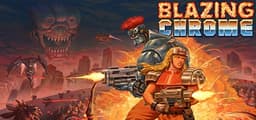
Bottom Line: JoyMasher didn't just imitate Contra III — it reverse-engineered why that game felt so good and rebuilt the machine with modern precision. The two-hour runtime and couch-only co-op are real limits, but the moment-to-moment shooting is as good as this genre has ever been.
The Gameplay Loop
The core loop is arcade-simple: enter a screen, read the threat layout, kill everything, don't get touched. What separates Blazing Chrome from a hundred pretenders is input fidelity. Mavra and Doyle move with almost no acceleration curve — you press left, you go left, on that frame. Jumps have a fixed, learnable arc with no drift and no ledge-magnetism forgiveness. Firing has zero perceptible latency between input and muzzle flash.
That sounds like a low bar. It isn't. This precision is load-bearing for the entire design, because the game builds difficulty almost exclusively out of pattern legibility rather than reflex punishment. Enemy attacks telegraph clearly, hitboxes are honest, and death is nearly always traceable to a decision you made two seconds earlier. That traceability is the difference between a hard game and an unfair one, and Blazing Chrome lands on the right side of it more consistently than the games it's modeled on. Contra III had cheap moments. This mostly doesn't.
The weapon-loss-on-hit rule is the design's sharpest idea, inherited from the genre but tuned smarter. Getting hit doesn't just cost health — it costs your build. You dropped your spread shot right before the miniboss, and now you're fighting it with a peashooter. The result is a risk calculus running under every screen: push forward aggressively, or play cautious to protect the loadout you've assembled. Weapon swapping on the fly adds a layer of loadout management that Contra never bothered with, and it's the one place where Blazing Chrome meaningfully improves on its source material rather than matching it.
Structure and Onboarding
Letting you attack the five stages in any order is doing more work than it appears to. Traditional run-and-guns are difficulty staircases — if stage three walls you, you're stuck against stage three. Here, you re-route. You take your accumulated pattern knowledge somewhere else, come back sharper, and clear it. It converts a brick wall into a detour, and it drops the onboarding friction of a genre that historically had none — you either got good or you fed quarters.
The friction that remains is intentional and mostly earned. Limited continues on higher difficulties enforce the arcade contract: your run is a run, and a bad one ends. Some players will read this as artificial padding on a two-hour game. I read it as the point. This is a game designed for repeat runs, where mastery is the actual content and the campaign is just the test you keep re-taking. Judging it by first-clear runtime is like judging a racing circuit by lap length.
Where the Design Strains
Two things keep this from being an unqualified triumph.
First, the vehicle sections are the weakest material in the box. The hoverbike chases and jetpack sequences are competently made and visually spectacular, but they simplify the control language down to dodge-and-shoot on rails. After the sophistication of the on-foot combat — where positioning, weapon choice, and jump arcs all interact — these stretches feel like the game putting its own best system on pause to show you a cutscene you can die in. The mech armor fares better; it changes your capability set rather than removing it.
Second, and more fundamentally: this game has almost no authorship of its own. Every mechanical idea here existed in 1994. The weapon economy, the boss patterns, the vehicle interludes, the two-player chaos — Blazing Chrome executes all of it at a higher standard than the originals and invents essentially none of it. JoyMasher is a world-class cover band. The performance is impeccable. The songwriting is somebody else's. That's a legitimate artistic choice and it produces a genuinely excellent game, but it caps how high the ceiling goes.


