
Overview
Most games that borrow from FromSoftware borrow the wrong things. They take the bonfires, the cryptic item descriptions, the vaguely ossified lore, and the punishing boss health bars, then bolt them onto a sprawling open world nobody asked for. Bleak Sword DX takes exactly one thing: the idea that a fight is a conversation, and that losing means not listening.
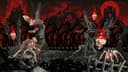
The game comes from more8bit, a Spanish studio, published by Devolver Digital — a pairing that tells you most of what you need to know about the pitch. It began life as an Apple Arcade exclusive, a touchscreen curiosity that got more attention for its look than its mechanics. The DX release is the argument that the mechanics were always the point. You play a cursed warrior working to break the hold of the legendary Bleak Sword across twelve chapters of forests, swamps, castles and dungeons, each one built as a compact, self-contained pixel-art diorama viewed from a locked isometric angle. Think of a tabletop miniature scene, lit like a horror film, that you fight your way out of in ninety seconds.
That structure is the real positioning. This is not a sixty-hour epic and doesn’t pretend to be. It’s an arcade brawler wearing Souls clothing, built in bite-sized encounters designed around a commute, a lunch break, or the twenty minutes before an appointment. At $9.99, it sits in the impulse-purchase tier, competing less with Elden Ring and more with the growing shelf of stylish, mean little action games that ask for an hour and give back a headache and a grin. The catch, as the analysis below lays out, is that the design frays exactly where it matters most.
Key features
- Diorama-Based Combat Arenas: Twelve chapters of fixed-angle, self-contained pixel-art stages. No exploration, no navigation, no fat. Enter a scene, fight, leave — or die and try again.
- Minimalist, Demanding Combat: Roll, dodge, parry, attack, counter-attack. That’s the whole verb list. Mashing is designed to get you killed inside three seconds; reading enemy tells and punishing recovery frames is the only route forward.
- RPG Progression With Teeth: Level up between fights, distribute stats, find and upgrade weapons, and burn magic and consumables to survive escalating encounters and twelve boss battles.
- Three New DX Modes: Randomizer remixes the campaign layout, Boss Run chains all twelve bosses back to back, and Arena is a gladiatorial survival gauntlet. All three exist to answer the original’s biggest complaint: what to do when it’s over.
- Reworked Controls and Smarter AI: New attacks, retuned inputs, and enemies designed to behave less like touchscreen targets and more like opponents.
- A Genuinely Great Audio Team: Jim Guthrie (Sword & Sworcery) on score, Joonas Turner (Nuclear Throne, Downwell) on sound design. This is not a budget hire.
- Platform Plumbing: 37 Steam achievements and Steam Cloud support.
Analysis
The Gameplay Loop
The loop is almost aggressively simple, and that simplicity is a design position, not a shortcut. You drop into a diorama. Two to six enemies occupy it. You have a roll, a dodge, an attack, a parry, and a counter. There is no stamina meter to babysit in the way you’d expect, no lock-on system to hide behind, no camera to swing around looking for an opening. Everything relevant is already on screen. What you don’t have is time.
The opening chapters are a re-education. Every action commits. The animation for a swing is long enough that starting it at the wrong moment is functionally a decision to take damage, and enemies telegraph with tells that are readable but short. The correct play is almost always to wait, absorb the first pattern, and counter into the recovery gap. When that loop lands, the design produces a specific kind of satisfaction that bigger action games spend forty hours trying to manufacture: the feeling of getting better, and of a game that does not lower itself to meet you.
The RPG layer sitting underneath is thinner than the marketing suggests, and that’s fine. Stats, weapon finds, weapon upgrades, magic, consumables — it’s a numbers scaffold, not a build-crafting sandbox. Nobody will spend an evening theorycrafting. What it provides is a pressure valve. When a chapter walls you, the progression system gives you a lever to pull that isn’t purely “get better at parrying,” and for a game this hard, that lever matters more than its depth.
Where It Frays
Two problems, and they compound each other.
The first is repetition. Twelve chapters of “enter room, kill things, leave room” is a lot of the same verb sequence, and the environmental variety — forest, swamp, castle, dungeon — is cosmetic. The dioramas are gorgeous, but a diorama is not a place. By chapter eight, the novelty of the presentation has fully paid out, and the game runs on combat quality alone. Combat quality is high. It is not infinitely high.
The second is difficulty distribution, which is where the real criticism lands. The early game is fair and legible — hard, but the kind of hard where death is obviously the player’s fault. The late chapters lean on enemy swarms, and swarming is exactly the thing this combat system handles worst. A system built around one-on-one reads and committed animations does not gracefully absorb four enemies attacking from four angles on a fixed camera. Deaths stop feeling like feedback and start feeling like tax. That’s not difficulty; that’s a design system being asked to do something it wasn’t built for.
The fixed isometric angle makes it worse. Depth perception on these stages is built to be unreliable. Because the camera never moves, the player is constantly estimating whether an enemy is on their plane or slightly behind it, and the answer determines whether an attack connects or whiffs into a punish. On a clean one-on-one it’s a manageable quirk. In a swarm, it’s the difference between a run and a restart.
The Touchscreen Inheritance
The Apple Arcade origin is baked into the inputs, and the DX rework didn’t fully exorcise it. The original was designed around swipes and taps — a control scheme where direction and commitment were the same gesture. Translated to a gamepad, some actions retain a stickiness, a sense that the input is being interpreted rather than executed. more8bit clearly did work here, but the DNA shows. Anyone coming in from Hollow Knight or Katana ZERO expecting frame-perfect responsiveness should expect the first stretch to feel like arguing with a translation.
Visuals & performance
This is the reason the store page earns clicks, and the art direction earns the attention. It’s lo-fi in the deliberate sense — chunky pixel work, restricted palettes, heavy shadow — assembled into miniature scenes that look like something a very patient person built in a shoebox and then lit with a single candle. The DX pass adds post-processing, adaptive depth of field, filters, improved particles, foliage and weather, and the depth-of-field work in particular does heavy lifting: it sells the diorama as a physical object rather than a flat plane of sprites.
The irony is sharp. The adaptive depth of field that makes the game beautiful is adjacent to the depth-perception problem that makes it frustrating. Blur the background to sell the miniature effect, and you’ve also blurred the spatial information a player needs in a fight built on precise positioning. It’s form and function pulling in opposite directions, and form is winning by a margin the late-game encounters can’t afford.
Audio is the strongest craft in the package, full stop. Guthrie’s score is restrained and oppressive where a lesser composer would have reached for bombast, and Turner’s sound design does what it always does — makes small pixel impacts land with disproportionate physical weight. Turn the music off and the game loses a full point.
Performance is a non-issue on paper. A 2D game of this scope is light on hardware.
Platform nuances
Steam is the version to buy for the modes, the achievement structure, and the ability to sit with it at a desk. All 37 achievements and Steam Cloud are here, and the Randomizer and Arena modes are where the long tail of value lives. Gamepad is the recommended input by a wide margin — keyboard and mouse technically function, but the game’s directional commitment maps to an analog stick in a way it never maps to WASD. Expect a settling-in period regardless; the touchscreen inheritance is most obvious in the early hours on any controller.
Nintendo Switch is, in principle, the better fit for what this game actually is. Bite-sized encounters, self-contained stages, a run that fits between subway stops — this is handheld software in its bones. The compact screen also, in theory, softens the depth-perception issue somewhat; less physical screen real estate means less spatial ambiguity to parse. What you give up is precision. Joy-Con drift and a game built on frame-tight parries are not friends, and a Pro Controller is close to mandatory if the goal is finishing Boss Run.
The added DX modes matter more on Switch than on Steam, because handheld play is where “one more Arena run” becomes a habit rather than a session.
Final verdict
Bleak Sword DX is a small game that knows precisely what it is and executes it with more craft than its price implies — and then stumbles in the last third by asking its combat system to do something it was never architected for. The swarms are the problem, and the fixed camera compounds them. Everything upstream of those failures — the reads, the counters, the weight of a landed parry, the way Turner’s sound design makes a pixel sword feel like it has mass — is excellent, and the DX modes finally give that excellence somewhere to go after the credits.
But excellence in the first two-thirds doesn’t balance out a back half that turns feedback into punishment. For most people, this is a game to admire from a distance rather than a purchase to make with confidence. Dedicated action fans with patience for its flaws, and handheld players who fit its structure perfectly, will find real value here — and if more8bit’s next project fixes the camera legibility, it’ll be a studio worth watching closely.
Wait for a sale, or buy it only if the diorama aesthetic alone sells you. And wherever it’s played, turn the music up.
Reviewed by the Rankeno Action Desk. Scores are out of 10; the overall score is the desk’s editorial judgement, informed by the four sub-scores above. How we review