
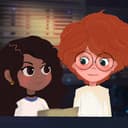

Overview
There’s a specific kind of ache that shows up in people who were good at something young and then stopped. Not failure, exactly. Drift. Blue Wednesday is about that drift, and it’s remarkably unsentimental about it.
You play Morris, a pianist who was once on the way to something and now stocks shelves at a grocery store. The instrument is still there. The talent is presumably still there. What’s missing is whatever used to make sitting down at the keys feel obvious. Korean developer Buff Studio builds the entire game around that gap — the walk from the apartment to the bar, the conversation you avoid having with a mentor, the record you buy instead of the practice session you skip.
The game arrives on Steam, Switch, iOS and Android, and that broad reach is both its commercial strategy and, as we’ll get to, its structural weakness.
Mechanically it’s a hybrid: point-and-click exploration through the neon-soaked Evans City, branching dialogue with a tight cast of bandmates and family, and over twenty music mini-games that punctuate the story. There’s a collectible album system spanning tango, bossa nova, cool jazz and modern jazz, all playable in-game — a small, generous touch that functions as an actual education in the genre. A game that can leave someone with a new appetite for jazz is a rarer achievement than it sounds.
The market position is clear enough: this is a narrative adventure for people who liked Kentucky Route Zero‘s melancholy but want something warmer and considerably less abstract, priced and paced for a weekend. Fully offline, no live service, no season pass. In 2026 that restraint reads as a feature.
Key features
- Original jazz score as the spine, not the wallpaper: The soundtrack isn’t accompaniment — it’s the argument the game is making. Timed piano performances and jam sessions are written as scenes, with the music carrying emotional information the dialogue deliberately withholds.
- Twenty-plus music mini-games designed as narrative beats: Improvisation sequences, timed performances, jam sessions. Explicitly built as story punctuation rather than skill gates, which is a defensible design choice with an expensive side effect.
- Branching conversation with real character arcs: A small cast — bandmates, family, an old mentor — whose stories shift based on dialogue choices. Small cast, deep cuts, no filler NPCs.
- Collectible album system with in-game playback: Records scattered across Evans City spanning four distinct jazz traditions, each fully listenable. The best exploration reward in the game and a legitimately good listening session on its own.
- Hand-drawn pixel art city: Record shops, bars, apartments, street corners. Evans City is drawn with more affection than most games afford their backdrops.
Analysis
The Gameplay Loop
The structure is simple and mostly works: wander the city, find a location, trigger a conversation, play through a musical set piece, advance the chapter. Exploration is light — this is not a puzzle-heavy adventure, and anyone arriving expecting the inventory logic of a classic point-and-click will find the cupboard bare. What you’re actually doing is choosing where to spend your attention and who to talk to, and the game trusts you to find that interesting.
Mostly, it earns that trust. The writing about burnout, grief and the cost of a creative life is candid in a way games usually flinch from. It doesn’t stage a triumphant comeback concert to resolve Morris’s paralysis. It sits in the discomfort. When the dialogue branches actually change a character’s arc — and they do, meaningfully — the choices feel weighted because the relationships are drawn with enough specificity to lose.
The Rhythm Problem
Here’s the core design flaw, and it’s a real one, not a taste difference.
The music sections arrive with almost no warning, and failing them costs you nothing.
Both halves of that sentence are problems, and together they’re worse than the sum. The abruptness means a player is regularly fumbling the first few bars of a performance without knowing a performance had started — which, in a game where the performances are the emotional climaxes, undercuts the exact moments meant to land hardest. And because failure carries no penalty, no retry, no narrative consequence, the tension leaks out of every set piece almost immediately. The design teaches quickly that mashing through a jam session produces the same scene as nailing it.
The intent is understandable. Buff Studio didn’t want a rhythm game’s skill wall standing between a player and a story about the fear of performance. That’s a coherent philosophy. But the execution mistakes “no fail state” for “no stakes,” and those aren’t the same thing. Games have solved this — degrade the performance visually, let the band react, have a character notice you were off tonight. Let a bad set change the tone of the conversation that follows without blocking progress. Any of that would have preserved accessibility while keeping the moment alive. Instead the game asks you to care intensely about whether Morris can still play, then makes it structurally irrelevant whether you can.
The uncharitable read is that this is “Piano Hero” with dialogue rather than a music-driven adventure. That’s harsh. It’s also not wrong about the middle chapters.
Character Motivation and Pacing
The other recurring criticism is that Morris’s reluctance to return to music is under-explained. More precisely: it’s under-dramatized. The game tells you Morris has drifted, and it’s confident you’ll fill in why. For players who’ve lived some version of that, it lands. For everyone else, the central engine of the story runs on an assumption the script never quite pays off, and the protagonist reads as passive rather than paralyzed — a distinction that matters enormously across a game this length.
Pacing in the middle stretch is the game’s biggest structural weakness. The opening establishes Evans City and its cast with real economy. The ending pays off. Between them sits a run of chapters where the loop — walk, talk, play, walk — becomes visible as a loop. A tighter edit would make this a better game. The album collection is what carries the design through that valley, which says something about where the design energy went.
Visuals & performance
The pixel art is the game’s second-best asset after the score, and the two are working toward the same goal. Evans City at night — the record shop windows, the bar interiors, the wet-looking streetlight glow — has the specific warmth of a place remembered rather than a place rendered. It’s hand-drawn work, not filtered assets, and the difference shows in how much personality the environments carry with very few pixels.
The UI is unobtrusive to a fault. Clean, legible, out of the way. The problem is that “out of the way” extends to the transitions into music sequences, where a moment of clear onboarding — even a two-second visual cue — would have solved a good chunk of the abruptness problem. This is form winning a small war against function.
Technically, a 2D game of this scope is light on hardware, and the desktop build should be an easy run on nearly anything. The mobile story is different, and we’ll take that up next, because it’s not really an art problem.
Platform nuances
This game splits hard by platform.
Steam is the definitive version. Mouse-and-keyboard suits point-and-click navigation, and keyboard input for timed piano sequences offers the lowest-latency option here. If you have the choice, take it.
Nintendo Switch — the Forever Entertainment port — is the strong second. Handheld suits a melancholy story about a city at night better than a desk does, and the Joy-Con handles the rhythm inputs adequately. Docked play with a decent sound system is the best way to hear the score, which is not a small consideration for a game that lives or dies on its music.
iOS holds a 4.3/5 store rating. Touch works fine for exploration — tapping a location is arguably more natural than clicking one — and the rhythm sections are playable, if less precise than physical inputs.
Android is the outlier, and the complaints there center on performance and port quality, not the game. Frame pacing and stability on Android’s fragmented hardware, not the writing or the score. That’s a publishing failure, not a design one, and it’s the version to steer clear of until it’s patched. A rhythm-adjacent game with inconsistent frame delivery is a game with broken core mechanics, whatever the review text says.
Final verdict
Blue Wednesday is a good game carrying a great one inside it. The score is exceptional. The city is beautifully drawn. The writing handles burnout and grief with a restraint that most studios can’t manage and most publishers won’t fund. When a conversation with the mentor character lands, it lands hard.
What holds it back is a single design decision, repeated twenty-plus times: the choice to make the music consequence-free. Buff Studio wanted accessibility and got weightlessness. In a game where playing the piano is the protagonist’s entire unresolved question, making the piano optional in practice is a strange place to land. Add sagging middle-chapter pacing and an Android port that undermines the core mechanics, and the flaws stack up against the strengths.
We rate it a mixed recommendation: buy it on Steam or Switch if the premise speaks to you, skip the Android version for now, and don’t rush the middle. It’s a flawed, sincere, affecting piece of work — and it will probably send you looking for a Bill Evans record afterward, which is more than most games this year will do for you.
Reviewed by the Rankeno Puzzle & Casual Desk. Scores are out of 10; the overall score is the desk’s editorial judgement, informed by the four sub-scores above. How we review