
Overview
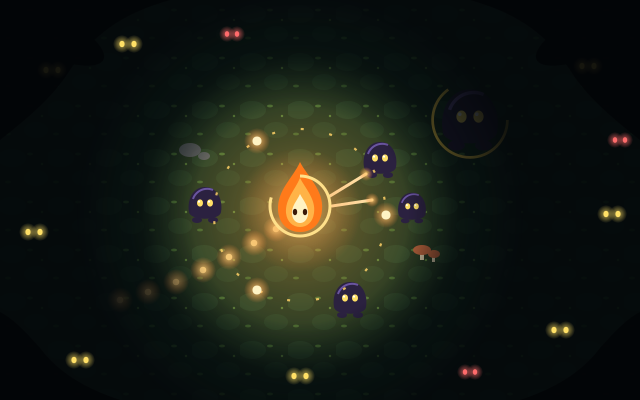
Golf video games have spent three decades pretending to be golf. Power meters, wind gauges, licensed pros, the reverent hush of a Georgia fairway rendered at 4K. Cursed to Golf wants nothing to do with any of that. It opens by killing you — lightning strike, tournament-winning putt, curtain — and drops you into a side-scrolling underworld where the hole is 400 yards away, behind a wall of TNT, and the only way through is a bank shot off a rotating fan.
Released August 18, 2022 by Kyoto-based Chuhai Labs and published by Thunderful Publishing at $19.99, the game arrived in a crowded moment for the “unexpected genre + roguelike” formula. That pitch has curdled into a marketing reflex by now; most of these games are a decent core mechanic wearing a run-based structure like a costume. Cursed to Golf is genuinely not that. The golf here is load-bearing. Strip out the Ace Cards, the shrines, the ghostly Legendary Caddies, and you would still have a first-rate physics puzzler about arcing a ball through hostile geometry.
Critical response has been warm — Metacritic sits at 80 — and that reception captures the craft on display. The friction is structural rather than mechanical: the same hole design that reads as brilliant on first contact reads as a toll on the nineteenth pass, and how much that matters depends on how a given player wants to engage. That split is the whole story.
Positioning-wise, it lands between Golf Story‘s warmth and Slay the Spire‘s attrition, priced and scoped as a mid-tier indie with four biomes, 70+ hand-crafted holes, and online leaderboards. It is not a casual putting game despite the pixel art suggesting otherwise. It is a difficulty-forward puzzle game that happens to use a 7-iron.
Key features
- The Three-Club Arsenal: Driver, iron, wedge — that’s it. No club selection paralysis, no 14-bag inventory management. Every shot is a decision about trajectory shape, not equipment. It’s a deliberate constraint and the smartest design call in the game.
- Strict PAR as a Health Bar: Each hole assigns a stroke count. Exceed it and the curse yanks you back to the start of the entire course. Strokes aren’t score; they’re hit points, which quietly converts golf’s most passive number into the game’s central tension.
- Shot Idols and Birdie-Eye: Gold and silver idols scattered through each hole refund strokes when smashed, turning stray shots into resource gathering. Birdie-Eye lets you scout the full layout before committing — a reconnaissance tool that makes the puzzle solvable rather than memorization-gated.
- 20+ Ace Cards: Scattershot, U-Turn, Rocketball, Mulligan and friends, bought between holes or pulled from chests. These are the roguelike’s build layer, and they range from situational to run-defining.
- Randomized Hand-Crafted Holes: Over 70 authored holes dealt in random order across four biomes. Crucially, the holes aren’t procedurally generated — only the sequence is. The design quality never dips into algorithmic mush.
Analysis
The Gameplay Loop
The core interaction is well-tuned. Aim, set power, watch a ball obey physics that feel tuned by someone who cared. Bounce, roll and spin all read correctly by design — the ball behaves the way intuition predicts, which is the entire foundation a physics puzzler stands on. Get that wrong and nothing else matters. Chuhai Labs got it right.
The reason it works is that every hole is a legibility test before it’s an execution test. Birdie-Eye is the key. You scroll the camera across the whole layout, see the fans and the teleporters and the water hazard and the switch that lowers a wall, and you build a plan: driver over the gap, wedge to kill momentum on the ledge, iron through the fan updraft. Then you execute, and the plan will not always survive contact. That failure margin is where the game lives: constantly improvising a Plan B with two strokes left and a bad lie.
Ace Cards are the pressure valve. Rocketball punches through obstacles. U-Turn recalls a shot heading for disaster. Mulligan is exactly what it sounds like. Used well, they turn a doomed hole into a par save; used as a crutch, they run dry and leave a run exposed on hole 15 with nothing in hand. The economy between holes — deciding whether to buy a card or bank a shrine checkpoint — is a decision that actually matters, and it’s the most successful marriage of golf and roguelike in the whole design.
Where the Structure Fights the Game
Here’s the problem: the roguelike layer taxes the thing that’s already excellent.
Losing a run sends you back to the start of the course. Not the biome — the course. Shrines mitigate this, but they’re a resource you have to spend on, competing with Ace Cards for the same currency, which means the game charges for the privilege of not losing an hour. For a puzzle game, that’s a rough trade. When you fail a puzzle, the useful feedback is retry the puzzle. Being sent back through eleven holes already solved isn’t a lesson; it’s a toll.
The randomization compounds it. Because holes arrive in random order, run difficulty swings hard. Draw a merciful sequence and you cruise. Draw three of the nastiest layouts back to back in the third biome and the run is functionally over before anything wrong was done. Shop RNG stacks on top — a run with no useful cards on offer is a run playing with a hand tied. Roguelikes are supposed to make variance interesting. Here, because each individual hole is a fixed puzzle with a fixed solution, variance mostly just decides whether a run got a fair test or an unfair one.
And the onboarding drags. The early tutorials are slow, over-explained, and front-load exposition on a mechanic set that’s largely self-evident. A game this confident about its physics should trust players faster.
The Repetition Question
The 70+ hand-crafted holes are the game’s greatest asset and, structurally, its liability. Hand-authored holes have solutions. Once one is solved, replaying it is execution, not thought. The roguelike loop forces you back through solved content on your way to unsolved content, and the ratio of thinking to re-executing degrades the deeper an attempt count goes. This is the specific tension underlying the gap between the game’s craft and its structure, and it’s legitimate — a short engagement sees mostly novelty; a long grind toward the ending sees mostly commute.
None of this makes the game bad. It makes it a strong 2D golf game housed in a structure that a meaningful minority of players will resent. The counterargument — and it’s real — is that the run structure is what gives each stroke weight. A stroke-limited hole with no run consequence is a nice puzzle. A stroke-limited hole with eleven holes of progress riding on it is tense. Chuhai Labs made a choice. It’s defensible. It’s also the reason some people bounce off hard.
Visuals & performance
The pixel art is gorgeous and — more importantly — functional. In a game where terrain must be read at a glance to plan a three-bounce trick shot, visual clarity is a gameplay system, not a decoration. Hazards read instantly. TNT looks like TNT. Fan updrafts are legible without a HUD overlay screaming at you. The four biomes are distinct enough to signal difficulty escalation on sight, and the underworld art direction has personality — comic, slightly macabre, never grim.
The soundtrack deserves specific credit. It’s a moody, groove-forward score that gives Golf Purgatory an actual atmosphere rather than generic chiptune filler, and it suits the long sessions the structure demands.
The UI is clean and mostly stays out of the way. Birdie-Eye’s scouting camera in particular is well-implemented — fast, readable, and non-punitive to use. Performance should be a non-issue by design: this is a 2D game with modest technical ambitions and light hardware demands, Switch included.
Platform nuances
Steam is the precision option. Mouse-and-keyboard aiming gives fine control over angle and power, and on a long shot where two degrees decide whether a spike pit gets cleared, that granularity matters. The leaderboards also feel more alive on PC, and quick alt-tab restarts suit a game built around retrying. Controller support is solid for those who prefer it.
Nintendo Switch is the better fit, structurally, with one caveat. Golf holes are natural bite-sized units, and Birdie-Eye planning is a fine thing to do on a couch. Handheld play is where this game feels most at home. The caveat is the run structure: a game that punishes a lost run with a full course restart is fighting the pick-up-and-put-down rhythm the Switch encourages. Stick lean is also slightly less precise than a mouse for tight-angle shots — a real but minor tax. Visually, the pixel art is dense and sharp on the handheld screen and scales fine docked.
If leaderboard placement is the goal, buy it on Steam. If the goal is finishing it over three weeks of evenings, buy it on Switch.
Final verdict
Cursed to Golf is a good game with a structural argument at its center, and where a player lands on that argument decides whether it earns an 8 or a 6. The moment-to-moment design is consistently strong — the physics, the hole authoring, the three-club constraint, the scouting camera all cohere into something that plays better than most of the 2D physics-puzzle space. Chuhai Labs clearly understood exactly what they were building at the mechanical level.
The roguelike shell is where the confidence wavers. It adds real tension and an interesting card economy, but it also imposes a repetition cost on a game whose content is hand-authored and therefore finite in its surprises. The warm critical reception and the cooler player response are both correct, describing different halves of the same object.
We recommend it to players who want a hard, well-made puzzle game and are at peace with losing progress. Skip it if the phrase “back to the start of the course” makes your jaw tighten. There is no version of this where you’re bored — only versions where you’re engaged or annoyed, and often both within the same run.
Reviewed by the Rankeno Action Desk. Scores are out of 10; the overall score is the desk’s editorial judgement, informed by the four sub-scores above. How we review