
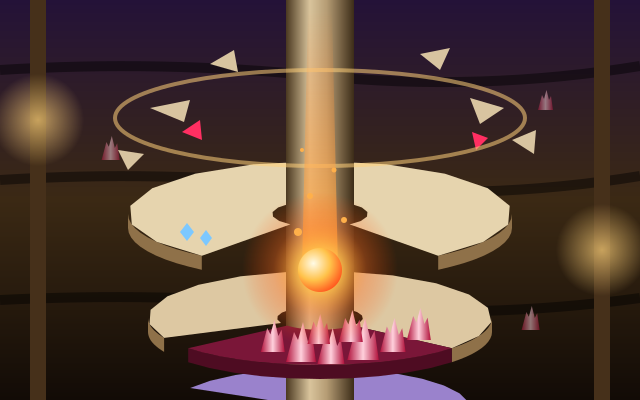
Overview
Most roguelikes ask you to think. Wizard of Legend asks you to move. Developed by two-person studio Contingent99, this pixel-art dungeon crawler made a simple bet back in 2018: that a magic system built like a fighting game — all cancels, juggles, and frame-tight dashes — could carry an entire roguelike on its shoulders.
The premise is thin by design. You’re an aspiring wizard entering the Chaos Trials, a procedurally generated gauntlet of elemental dungeons. Survive every floor, beat every council member, and you earn the title of Wizard of Legend. That’s it. There’s no branching narrative, no lore dumps, no metaphysical framing device à la Hades. Contingent99 spent its entire budget of ambition on the combat, and it shows — in both directions.
Where the game positions itself is interesting. It predates Hades, undercuts it on price, and outpaces it on raw speed. It’s closer in spirit to a character-action game wearing roguelike clothes: the procedural generation and permadeath are delivery mechanisms for the real product, which is a combo system built from over a hundred unlockable arcana across six elements. Between runs, dungeon currency buys new spells, relics, and outfits, slowly expanding your toolkit until the loadout screen becomes its own metagame.
The catch — and there is one — is that Wizard of Legend demands a level of execution that will delight action purists and punish everyone else. This is not a game that meets you halfway. Now available on Steam, Switch, iOS, and Android for $7.99, it’s cheap, fast, and unapologetically hard.
Key features
- Combo-driven arcana system: More than 100 spells across fire, ice, lightning, earth, wind, and water, designed to chain into one another. Launch an enemy with an earth pillar, juggle with lightning, finish with a fire dash. The system rewards lab time like a fighting game.
- Loadout-based build crafting: You pick your kit before the run — a dash arcana, a basic attack, two standard spells, and a signature — then modify it with relics and shop purchases mid-run. It’s a deliberate inversion of the “take what the RNG gives you” roguelike formula.
- Local co-op and PvP: Two-player couch co-op through the full Chaos Trials, plus head-to-head duels. The mobile version supports local wireless co-op over Wi-Fi — a genuine rarity in the ports space.
Analysis
The Combat Is the Game
Let’s be precise about what makes Wizard of Legend work, because it’s not the roguelike structure — it’s the dash. The dash is fast, spammable, and cancels into attacks. Enemies telegraph, you weave, you punish. Every fight becomes a rhythm exercise, and the design is clearly built to produce a flow state that few of its peers can touch. The synth soundtrack driving underneath doesn’t hurt.
The arcana system is where the depth lives. Spells have distinct roles rather than being damage numbers with different particle effects. Some launch. Some pull. Some create standing hazards. Some are movement tools disguised as attacks. Discovering that a wind vortex groups enemies perfectly for a chained lightning signature is the game’s real progression system — the currency unlocks are just the paperwork.
This is also where the first complaint lands: the game explains almost none of this. Onboarding friction is real here. New players will button-mash their way to a wall somewhere around the second boss, and the game offers little guidance on why their damage output feels anemic. The answer — that combos and knockup juggles multiply your effectiveness enormously — is left for wikis and YouTube to teach. In 2018 that was forgivable. Post-Hades, it reads as a design gap.
The Loop, and Where It Frays
A run spans three elemental zones, each capped by a council boss, then a final gauntlet. Levels are procedurally stitched from hand-made rooms, with shops, chests, and challenge chambers scattered throughout. It’s competent generation, but the room variety is the weakest part of the package. By the fifteenth run, most of what the generator can assemble has been seen, and zones start blurring together. The randomization keeps builds fresh far more effectively than it keeps spaces fresh.
Then there’s the difficulty curve, which is less a curve than a cliff face. Wizard of Legend front-loads its punishment. Early runs end fast and often, and the between-run progression — buying new arcana with slowly accumulated gems — moves at a pace that borders on stingy. There’s a meaningful stretch where a player is good enough to see the problem but not equipped enough to solve it. Those who push through find a rewarding skill ceiling. Those who don’t will bounce, and it’s hard to blame them.
The co-op deserves specific praise. Difficulty scales, revives are possible, and the design intent — two spell-slingers filling a screen with elemental effects — is exactly as fun as it sounds on paper. Couch co-op roguelikes are an underserved niche, and this is a strong entry in it.
Visuals & performance
The pixel art is confident and functional — chunky sprites, readable silhouettes, and spell effects that manage to be flashy without (usually) obscuring the danger underneath. “Usually” is doing some work in that sentence: in late-game rooms and especially in co-op, screen clutter can swallow enemy telegraphs, and deaths to unseen projectiles are a genuine irritation.
This is a lightweight engine by modern standards — a 2D game of this scope is light on hardware, which suits its mobile and Switch ports well. The UI is serviceable rather than elegant — the loadout and relic screens are built for small collections and get cramped as they grow — but nothing about it actively obstructs play.
Platform nuances
- Steam: The definitive version. Controller or keyboard both work, but this is a twin-stick-style precision game, and a controller with analog aim is the way to play. Cheap on sale.
- Nintendo Switch: A natural fit. Detachable Joy-Cons mean instant couch co-op — arguably the platform where the game’s social side shines brightest. Single Joy-Con play looks cramped for a game this demanding.
- iOS / Android: The touch layout includes aim assist that meaningfully compensates for the loss of precision, and full controller support means touch can be sidestepped entirely. Local wireless co-op over Wi-Fi is a standout inclusion. That said, be honest with yourself: this is a game about frame-tight dodges, and glass-on-thumbs will always cost you something. Touch play is viable for standard runs; mastery-level play wants physical inputs.
Final verdict
Wizard of Legend is a specialist’s game that found a generalist’s audience. Contingent99 built one thing — fast, expressive, combo-driven spell combat — and built it well enough that the surrounding roguelike scaffolding, with its repetitive rooms and grindy economy, mostly gets a pass. Eight years and one high-profile Hades later, it still occupies a niche nothing else quite fills: the roguelike where your hands, not your build, are the real progression system. We rate it a Good — solid but flawed in ways that matter — and recommend it to the right audience only. If frame-tight spell combos sound like your idea of a good time, it’s worth the $7.99 on whatever platform is closest.
Reviewed by the Rankeno Action Desk. Scores are out of 10; the overall score is the desk’s editorial judgement, informed by the four sub-scores above. How we review