

Overview
Most games ask for your time; Dome Keeper demands your schedule. Developed by Bippinbits and published by Raw Fury, this title occupies a fascinating intersection of genres that shouldn’t work together—part meditative mining expedition, part frantic tower defense, and entirely a roguelike. It places the player in a solitary glass bubble on a hostile, monochromatic world, with a singular, grueling objective: dig deep enough to find the “great relic” before the local fauna rips the life-support system to shreds.
The game’s market positioning is clever. It avoids the sprawling complexity of Terraria or the narrative weight of Deep Rock Galactic, opting instead for a “micro-roguelike” experience that prioritizes mechanical purity. Players descend into the dirt to harvest iron, cobalt, and water—the three pillars of survival. Iron fuels upgrades, cobalt repairs the fragile dome, and water powers the exotic gadgets that tip the scales.
What makes Dome Keeper stand out in a crowded indie landscape is its deliberate pacing. It captures the “one more run” pull not through chaotic randomness, but through the player’s own hubris. Every block mined is a calculation: Carry the iron back now and prepare for the swarm, or dig one layer deeper and risk the dome’s integrity? It is a game of marginal gains and catastrophic losses, packaged in an aesthetic that feels both hauntingly isolated and surprisingly cozy. By focusing on a tight, 20-to-40-minute session length, Bippinbits has crafted a title that fits neatly into the modern “coffee break” gaming habit while offering enough strategic depth to satisfy the hardcore optimization crowd.
Key features
- Phase-Shift Gameplay: A clean transition between the “Mining Phase”—a physics-based resource haul—and the “Combat Phase,” where the dome’s weaponry is manned against shadowy monsters.
- Branching Upgrade Trees: A deep customization system that forces choices between drill strength, jetpack speed, and specialized dome defenses like the Reflector or Tesla Shield.
- Procedural Undergrounds: Every run generates a unique subterranean map, hiding randomized gadgets—like the resource-hauling Lift or the automated Drillbert—that fundamentally alter strategy.
Analysis
The Anxiety of the Metronome
The core of Dome Keeper isn’t the mining or the shooting; it’s the timer. Every second spent underground is a second the dome is undefended. That design creates a psychological weight many larger survival games fail to achieve. The gameplay loop is a metronome of anxiety. The run starts with a basic drill and a slow jetpack, and the literal weight of every ore chunk dragged back to the surface is felt in the controls.
The onboarding friction is intentional. Initially, the keeper is weak—movement is sluggish and the drill chugs through standard rock—which makes every upgrade feel monumental. When enough iron is finally invested to double flight speed, the shift in efficiency is a release of tension as much as a stat increase. However, the design is careful to never allow true safety. As the keeper grows stronger, the shadowy “shifters” and flying “stalkers” attacking the dome grow more numerous and resilient.
Resource Management as Risk Mitigation
Strategy in Dome Keeper is less about “winning” and more about delaying the inevitable. The decision to prioritize Cobalt—the rarest resource—is the game’s ultimate test of nerves. Repair a cracked dome now, or save it for a permanent health upgrade later?
The gadget system adds a layer of mechanical variety that prevents the mining from becoming a chore. Finding the Teleporter gadget mid-run is a revelation; it removes the “commute time” from the mine to the surface, allowing more time hunting for the relic. Conversely, the Stun Laser shifts combat strategy from aggressive eradication to crowd control. These variables ensure that while the goal remains the same, the path to it is never repetitive.
The Combat Dichotomy
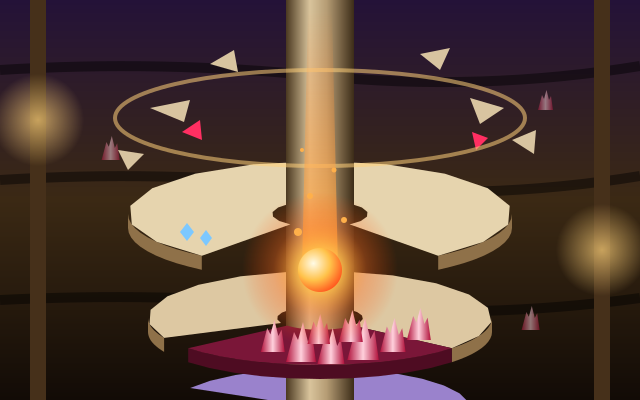
When the timer hits zero, the game shifts from a physics-based miner to a focused arcade defender. The Laser requires precise tracking, the Sword demands timing and positioning, and both feel appropriately heavy. The design gives a tangible sense of impact when a giant shadowy monster slams into the glass roof. The “combat” isn’t an afterthought; it’s the audit of mining efficiency. Dig poorly and fail to afford that shield upgrade, and the cracks forming overhead will say so.
The UI design here is smart in its minimalism. Health is the dome itself, and the feedback—from dimming lights to the screeching of the hull—provides all the telemetry needed without cluttering the screen.
Visuals & performance
The pixel art direction is a standout of high-contrast utility. The subterranean layers use a restricted palette of purples, oranges, and teals that make resources pop against the grime. The animation of the dome’s weaponry—the way the laser glows and the sword heaves—communicates power and fragility simultaneously. A 2D game of this scope is also light on hardware, which suits its pick-up-and-play ambitions.
The atmospheric soundtrack deserves special mention: a synth-heavy, melancholic score that underscores the loneliness of the planet, shifting subtly into high-tempo industrial beats when combat starts.
Platform nuances
On Steam, the game is a natural fit for both mouse/keyboard and controller. Mouse aiming offers a slight edge for the Laser weapon, providing pixel-perfect tracking, while the movement in the mines seems better suited to an analog stick.
The game also looks like a strong fit for the Steam Deck. Its UI is built to scale for a smaller screen, and the short mining bursts pair naturally with a handheld’s pick-up-and-play rhythm.
Final verdict
Dome Keeper is an exercise in restraint. By narrowing its focus to a singular, high-tension loop, Bippinbits has built one of the more compelling indie releases in recent memory. It eschews the “more is better” philosophy of modern gaming, making the case that a well-tuned 20-minute cycle can be worth more than 100 hours of filler. It is punishing, beautiful, and hard to put down. For anyone with an affinity for resource management or the thrill of a last-second defense, this is an easy recommendation—provided the punishing early hours and deliberately narrow scope sound appealing rather than off-putting.
Reviewed by the Rankeno Strategy & Sim Desk. Scores are out of 10; the overall score is the desk’s editorial judgement, informed by the four sub-scores above. How we review