
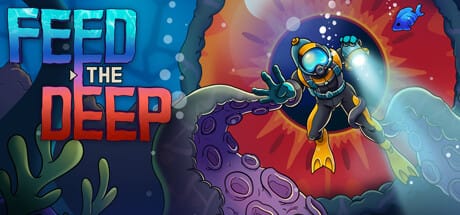

Bottom Line: Luke Muscat traded the candy-colored dopamine of Fruit Ninja for cold black water and made something far better — a taut, near-solo roguelike where every second of air you spend is a bet you might not cover. It's short, occasionally punishing, and one of the most disciplined small games on either storefront.
The Gameplay Loop
The loop is almost aggressively simple to describe and surprisingly hard to master. You drop from a boat, swim down, break rock, collect valuables, and swim back. What elevates it is that the game refuses to give you a safe read on your own situation. Your lamp defines a small cone of legibility in a screen full of black. Your oxygen meter is the only honest number on the interface, and it doesn't care that you just spotted something shiny two rooms further down.
The genius sits in the asymmetry of the return trip. Descending is cheap — gravity and momentum are on your side, the caves open in front of you, the meter feels generous. Ascending is expensive. You're heavier, you're often bleeding oxygen faster, and the route you carved on the way down was optimized for going that direction, not this one. Roguelikes usually escalate danger by adding enemies. Muscat escalates it by making your own earlier decisions the trap. That's a more sophisticated pressure model than the genre typically bothers with.
Panic as a Mechanic
The screen-rotation-on-damage system deserves specific credit, because it's the one idea here that isn't derivative. When a creature connects, your orientation is scrambled. Up is no longer up. The recovery tools are diegetic: bubbles rise, so follow them; heavy objects sink, so drop one and read the fall. It's elegant, it's taught without a tutorial pop-up, and it converts a routine hit-point deduction into genuine cognitive load. Getting mauled in most games costs you resources. Getting mauled here costs you your understanding of the space, at the exact moment your air is running out and you're carrying an inventory you can't afford to lose. Very few designers are confident enough to make the player briefly stupid on purpose.
Progression and the Grind Question
This is where the design's discipline shows a seam. Upgrades are the connective tissue between runs, and the early hours ask you to fund them one modest haul at a time. A meaningful share of critical player feedback lands on exactly this point: the opening stretch can feel like saving up rather than playing forward. It's a real complaint, and it's structural rather than incidental — the upgrade curve is deliberately slow so that the first genuinely deep dive feels earned.
Whether that lands depends entirely on what you want from the meta-layer. If the moment-to-moment tension is enough to carry you, the grind reads as pacing. If you're playing primarily to unlock things, the first two hours will feel like a toll booth. I'd argue Muscat chose correctly for the game he was making, but a slightly steeper early payout curve would have cost nothing thematically and converted some of the players who bounce.
Difficulty and Fairness
The other recurring criticism concerns difficulty spikes and instant-death hazards. Here I'm less sympathetic to the complaint. The overwhelming consensus — and my read — is that the risk/reward math is fair: you almost always know you're overextending at the moment you choose to overextend. The sting of losing a full inventory is the entire product. A version of this game with a forgiving death penalty would be a pleasant, forgettable diving sim. What makes a successful surfacing feel like anything is the credible possibility of losing everything twenty feet from the boat.
That said, the deeper strata do introduce failure states that arrive faster than a new player can parse them, and the game's commitment to darkness means the information you'd need to avoid them is sometimes literally outside your light radius. There's a defensible argument that a handful of these hazards read as unfair on first contact and only become fair on the second run — which is a roguelike tradition, not an excuse.
Session Design
Runs are short. The game is offline-friendly, single-player, and structured so that a complete dive fits into the gap between two other things in your day. That's the Jetpack Joyride designer's fingerprint showing through the Lovecraftian paint — the underlying session architecture is mobile-native, even on desktop. It's also the honest answer to "is it short?" Yes. It's a concentrated experience with a defined end to its content curve, and the multiple modes extend rather than disguise that.