

Overview
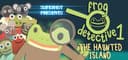
Most mystery games fear one thing: the player solving the case too easily. Frog Detective 1: The Haunted Island simply doesn’t care. The mystery is there to carry the jokes, and the game is open about it.
Grace Bruxner and Thomas Bowker made it, and worm club published it. The game came out on November 22, 2018, on Steam, for Windows and macOS, priced at $2.99. It’s now the first entry in a trilogy, and all three games are sold together in Frog Detective: The Entire Mystery.
The setup is simple. You play a frog who calls himself the second-best detective in the world. That one self-deprecating line sets the tone for everything after it. He’s sent to a small island where a sloth has been haunted for weeks by a mysterious ghost. A team of ghost scientists has already investigated and got nowhere. The job is to walk around, talk to the locals, write things in a notebook and work out what’s actually going on.
There’s no combat, no fail state and no time pressure. It can’t be lost, and it’s hard to get stuck. A run takes about an hour. That makes the game easy to slot into the “wholesome games” category, but the label undersells it. The game is less cosy than it is comedically precise. Its closest relatives are a short film or a good sketch show, not Animal Crossing.
The game has won awards and built a small cult following, enough to fund two sequels, and its Metacritic score sits at 73. The common complaint is length, and that complaint is fair. Whether the length counts as a flaw depends on what you think you’re buying.
Key features
- First-Person Investigation: A small, self-contained island explored in first person, talking to residents and following leads at your own pace.
- Detective Notebook: Clues and conversation threads go into an in-game notebook. It’s a simple tool, and it doubles as a running list of jokes.
- Magnifying Glass: Objects can be inspected closely. It works more as a comedy device than a forensic one, which is the point.
- Item Trading: Progress mostly comes from trading items between islanders, a light adventure-game loop with very little friction.
- No Fail State: No death, no timers, no wrong moves. The game removes every source of stress on purpose.
- Absurdist Writing: Most of the game is dialogue, and most of the dialogue is a joke. It’s built for laughs first and logic second.
Analysis
The Gameplay Loop: A Fetch Quest Wearing a Trench Coat
Taken apart, Frog Detective‘s mechanics are thin. Walk up to a character and talk to them. They want something. Someone else on the island has it. Get it, hand it over, and receive either a clue or another item. Repeat until the mystery is solved.
That’s the classic point-and-click item-trade chain from the LucasArts era, with one difference. Those games often dragged out their runtime with obscure combinations and bizarre leaps in logic. Frog Detective drops all of that. Each solution is obvious as soon as you hear the request. The puzzles aren’t really puzzles. They’re prompts that move the player to the next conversation.
Strict genre fans will find this frustrating, and the “puzzles are very easy” complaint in Steam reviews is accurate. But it misses what the design is for. Bruxner and Bowker aren’t testing deduction. They’re pacing a comedy routine. Each trade gets to the next character, and each character is a new bit. A real puzzle would be a two-minute pause in the middle of a joke, and the game knows that.
Writing and Comedic Timing
This is the game’s strongest feature by a wide margin. The humour is dry, absurd and very well controlled. The frog’s earnest, slightly inept confidence plays off a cast of odd islanders who are each strange in their own way. Even the ghost scientists, who sound like a one-line premise, become a running gag.
The comedy works because it isn’t desperate. There’s no constant pop-culture referencing and no attempt to be “random” for its own sake. Jokes come from character and understatement, and from the distance between how competent the frog thinks he is and how competent he actually is. Being “second-best” is the core of the character, not just a throwaway line. He’s lovable because he’s a bit hopeless and doesn’t realise it.
It’s also suitable for all ages without being childish. A kid will laugh at a frog in a hat. An adult will laugh at the deadpan delivery. Plenty of family-friendly media tries to hit both audiences at once, and this one manages it.
Onboarding and Flow
There’s almost no learning curve. Walk, talk, look, use items — that’s the whole control set. Within a minute everything the game will ask is understood. Because there’s no fail state, nothing ever pushes anyone out of the experience: no game-over screen, no reloading, no wiki tab.
That gives the game an unusually steady flow for an adventure title. Nothing stalls. The flip side is that the payoff of finally cracking a hard problem never arrives, either. The game trades that peak for a consistent level of amusement, and it’s a deliberate choice. It’s arguably the right one, but something is lost too.
The Length Question
About an hour. The complaint keeps coming up, so it deserves a head-on answer.
Pricing games by the hour is crude, but people care about it. Judged against a 40-hour RPG, Frog Detective 1 looks thin. Judged against a movie ticket — and at $2.99, it costs less than one — it looks reasonable. Judged by how much of its runtime is wasted, it does well, because almost none of it is.
The more useful criticism is that the hour doesn’t really build. There’s no climax that changes how what came before is seen. The game is consistently pleasant rather than memorable in its structure. The sequels give the format more room. This first entry plays like a pilot episode: funny, confident, and a bit short on ambition.
Visuals & performance
The colourful low-poly 3D style was clearly chosen as an aesthetic, not forced by budget. Characters are blobby and expressive, the island is bright and readable, and the whole thing looks like a toy diorama. It matches the comedy well. A realistic frog detective wouldn’t be funny, and this one is funny just to look at.
The UI is minimal, and the notebook is the only interface element worth mentioning. It’s functional and fits the tone. It’s not a deep case-management system, but the game doesn’t need one.
Sound adds a lot. The soundtrack does a great deal of the comedic and emotional work, keeping the mood light and setting up punchlines.
On the technical side there’s little to discuss, and that’s by design. A small low-poly island isn’t demanding, and a 2D-scale game of this scope is light on hardware, comfortable even on older laptops. At this scale there’s not much that can go wrong.
Platform nuances
On Steam, the game is built for mouse and keyboard on Windows and macOS. The first-person controls are standard: WASD to move, mouse to look and interact. The control scheme is so light that anyone who’s used a computer will pick it up straight away. People less comfortable with first-person movement, such as younger children or those new to 3D games, will still need a minute or two to adjust to mouse-look. That’s the only real barrier to entry.
The macOS version deserves a mention, because Mac players are often left out of indie releases. It’s also worth checking the price of The Entire Mystery bundle. Buying the trilogy together largely answers the “too short for the price” complaint, and the first game works better as an opening act than as a stand-alone purchase.
Final verdict
Frog Detective 1: The Haunted Island knows exactly what it is and does it with confidence. It isn’t a mystery game. It’s a comedy short where the player is the protagonist, and on those terms it works. The writing is the selling point. The art and music support it well, and the near-total lack of friction keeps the jokes flowing.
Its limits are real. It’s short, the puzzles are barely puzzles, and the hour never builds to a peak that changes the experience. As a stand-alone purchase it’s a pleasant novelty rather than an essential one. As the opening chapter of The Entire Mystery, it’s an easy recommendation and a promising start to one of indie gaming’s most likeable small series.
The frog may be the second-best detective in the world. The game is good at exactly what it’s trying to do — and only that.
Reviewed by the Rankeno RPG & Adventure Desk. Scores are out of 10; the overall score is the desk’s editorial judgement, informed by the four sub-scores above. How we review