Bottom Line: Grace Bruxner and Thomas Bowker end their trilogy with its funniest, biggest and most confident entry, a cozy comedy that uses a detective story as the setup for its jokes. It won't challenge your deductive skills and you can finish it in an evening, but very few games of any length are this consistently funny.
The Gameplay Loop: Talk, Trade, Repeat
The mechanical loop fits on an index card. You enter an area, talk to whoever's there, pick up an item or a clue, and bring that item or information to someone who needs it. Repeat until the case resolves. There's no accusation screen where a wrong guess costs you, no clue-matching minigame, and no inventory combination logic where you rub a rubber chicken on a pulley.
If you judge the game as a detective game, this is thin. The internal logic of the "investigation" is deliberately trivial, and the game never pretends otherwise. The Detective isn't clever and the game doesn't ask you to be either. What it asks is that you be curious. Every resident is a joke delivery system, and the reward for talking to someone isn't a clue. It's a line of dialogue that makes you snort.
This is a design choice, not a shortcut, and it works because the writing can carry the weight. The item-trading chain gives you a reason to cross the map and revisit characters, and each revisit tends to pay off an earlier joke. You don't get tension from the loop. You get comic rhythm. Running gags build across conversations and come back at just the right moment, and the game trusts you to remember them.
Writing: Deadpan, Warm, and Relentlessly Consistent
The series' comic voice is its most valuable asset, and this third game is its most polished version of it. The humor is deadpan and warm at the same time, which is harder than it sounds. A lot of "wholesome" comedy games slide into cloying or self-congratulatory, winking at the player about how quirky everything is. Frog Detective avoids that. Its characters are odd, often ridiculous, but never cruel, and the jokes come from how people talk, not from the game winking at you.
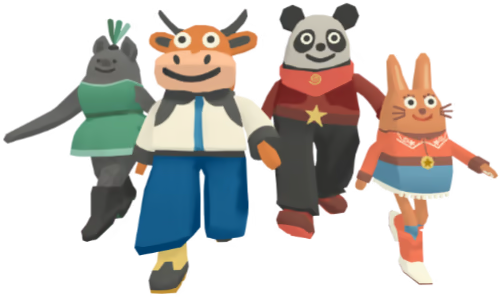
The cast is larger this time, and residents like Bonnie the bunny fill the frontier town with memorable, slightly unhinged personalities. The return of Lobster Cop is the emotional center of the series' final act. Their partnership gives a mostly episodic stream of gags a real throughline, and it's what makes the finale feel like an ending rather than just another case.
Crucially, the jokes work for different ages at once. The game is family-friendly without being childish. A kid gets a funny frog in a cowboy town, and an adult catches the dry absurdity layered underneath. That's why the group-play pitch isn't a gimmick.
Group Play: An Unexpectedly Strong Use Case
The suggestion that friends pass the controller and take turns reading the dialogue aloud sounds like a quaint marketing hook. In practice it's one of the best ways to play. Deadpan comedy works when it's spoken, and a room full of people doing voices for a clueless frog and his lobster partner is exactly the kind of shared experience most games can't create. With no fail states and only simple inputs, nobody needs "gaming skill" to join. It works as a board-game replacement for a weeknight.
Pacing and Length: The Real Point of Contention
The main criticism is fair. A playthrough takes roughly two to three hours, and the puzzles offer essentially no resistance. Players who come in expecting Return of the Obra Dinn or even a light Ace Attorney-style deduction chain will feel shortchanged.
My view: the length suits the content, and I'd rather have a tight three-hour comedy than a padded eight-hour one. The pacing rarely sags, and the game ends before its central joke gets old. But there's also no replay value to speak of. Once you've heard the jokes, the mystery has nothing left to hide. You're paying for one excellent evening, maybe two, and you should go in knowing that.