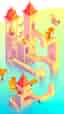

Bottom Line: ustwo games finally lets Monument Valley leave the room it was built in. Sailing and reshaping architecture make this the most ambitious game in the trilogy, but the puzzles are still too easy to challenge anyone who has solved an Escher staircase before.
The Gameplay Loop
The basic loop is the same as in 2014. You look at a structure and spot a connection your brain says is impossible. Then you turn a crank or slide a block until the impossible thing is true. Monument Valley's genius was always turning perceptual tricks into rules you can play with, and that still works. The first time a staircase that clearly goes nowhere lands on a walkway because you rotated the camera 90 degrees, you get a small, real jolt.
The new mechanics do move things forward. Structures that grow, bend and reshape matter more than they sound. In earlier games, the architecture was a fixed object that you looked at from different angles. Here it can be a moving system, and some of the best puzzles ask you to think about both how a structure looks and what it becomes. The light-and-shadow theme could have been decoration. Instead it gives the level design a clear direction: you're usually pushing toward something, not just toward the exit.
Sailing as Pacing, Not Content
Sailing is the headline feature, and it's also the easiest one to misread. As a mechanic, it's not deep. You aren't fighting currents or managing resources. It works as pacing. It gives you a breather between puzzles, a sense of place, and the feeling that you're traveling rather than picking the next level from a menu. Players describe it as opening up the series' usually closed levels, and that's accurate.
Sailing doesn't make the game less linear in any way that matters, and that's the catch. The islands are points on a guided route, not a real open world. The world feels bigger, but your freedom to take it apart hasn't grown much. That's a reasonable trade for a game this focused on authored moments. It's also why some players call the new ideas "safe." ustwo added space around the puzzles without giving that space many new rules.
Difficulty: The Old Argument
The most common criticism of Monument Valley 3 is the same one leveled at both earlier games: the puzzles are too easy. The difficulty curve is gentle by design, suited to newcomers and returning players, and most solutions show up after a minute of poking at the level. You'll rarely get stuck. You'll almost never feel the satisfaction of breaking through a hard wall.
I'm split on this. ustwo is clearly aiming for calm, not challenge, and a game that promises no pressure shouldn't frustrate you on purpose. But there's a gap between "never frustrating" and "never demanding," and Monument Valley 3 stays on the wrong side of it for too long. The best puzzle games, from The Witness to Baba Is You, show that the reward matches the confusion that came before it. Monument Valley 3 rarely lets you get confused, so the payoff tends to be pleasant rather than memorable.
Length and Narrative
The campaign lasts a few hours. Some players will call that tight, and others will call it thin. Noor's story is sincere, and the lightkeeper framing gives the trilogy its most coherent setup yet. It also plays out almost exactly as you'd guess. The emotional moments land because the art and music carry them, not because the writing surprises you. "The Garden of Life" adds more time and a softer, more meditative mode, but it adds very little challenge.


