
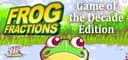

Overview
There is a genuine critical problem at the center of Frog Fractions, and it deserves naming in the first paragraph: this is a game whose primary mechanic is your ignorance of it. Jim Crawford’s 2012 Flash oddity — released under the studio name Twinbeard — was built as a trap. It opens on a lily pad rendered in the visual language of a mid-2000s educational Flash title, sticks a “fractions” progress counter in the corner, and asks you to flick your tongue at bugs approaching your fruit. It looks like homework. It is styled to look like homework. And then, roughly ninety seconds in, it stops being that, and keeps not being that for the next hour in increasingly committed ways.
The Game of the Decade Edition on Steam is Crawford’s answer to the Flash apocalypse: a native rebuild for Windows and Mac, freed from a browser plugin that no longer exists. That distinction matters more than a typical remaster note. Flash’s death in 2020 threatened to quietly delete an entire generation of experimental, free, weird-for-its-own-sake game design, most of which nobody bothered to port. Frog Fractions got ported. It is now a permanent, installable, achievement-tracked artifact sitting in the same storefront as Baldur’s Gate 3, costing zero dollars.
Market positioning is where this gets funny. Frog Fractions doesn’t compete with anything. It has no monetization strategy beyond a paid cosmetic hat that is itself a joke about DLC. It has a single screenshot on its store page — a deliberate act of anti-marketing, since screenshots would spoil the whole product. The Steam consensus is strongly positive, and the reviews themselves are notable for what they refuse to say. Players have independently arrived at the same conclusion: describe nothing, just tell people to install it. That’s a rare kind of cultural discipline, and it’s the strongest endorsement in the file.
Key features
- The Bait-and-Switch Structure: The game presents as shabby edutainment and systematically dismantles that premise. Every upgrade bought between waves doesn’t just increase a stat — it bends the rules of what game you are playing. The lock-on targeting, the cybernetic brain, the turtle mount, the dragon: each one is a lever that quietly moves the walls.
- Genre Roulette: Underwater exploration, text adventure, resource trading, rhythm sections, courtroom drama, and more, each played completely straight. Nothing winks. The comedy comes from total commitment to bits that should not sustain themselves — and then sustaining them anyway.
- Joke Density: This is the underrated technical achievement. Frog Fractions doesn’t ration its material. It burns through more ideas in sixty minutes than most comedy games manage in twelve hours, and it never repeats a punchline for safety.
- The Remaster Package: Native rendering on Windows and Mac, achievements, Remote Play Together, and Family Sharing. Free.
- The Hat DLC: A paid cosmetic add-on for a free game. It’s satire. It also, per Steam reviews, genuinely confuses some buyers — which is arguably the joke completing itself.
Analysis
The Gameplay Loop (Or: The Loop That Eats Itself)
Start with the mechanical skeleton, because critics tend to skip it in favor of gushing about the twist, and that does the design a disservice. The opening is a slow Missile Command riff. Bugs descend, you aim a tongue, you protect fruit. It is deliberately underwhelming — the input is tuned to feel sluggish, the targeting floaty, the scoring readout insists you’re learning math. Handed to a stranger with no context, it would lose them in three minutes. That’s the point, and it’s also a real risk the design takes on knowingly.
What makes it work is the upgrade shop. This is the load-bearing wall of the entire game. Between waves you spend bug currency, and the upgrades are not balance tweaks — they are narrative escalations disguised as balance tweaks. Lock-on targeting removes the aiming friction that defined the opening minute. The turtle mount removes the lily pad. The dragon removes the pond. Each purchase is a player-authored consent form: yes, break this further. By the time the game has fully transformed, you can trace the exact chain of choices that got you there, and every one of them was yours. That’s not a gag. That’s a designer who understands that comedy and player agency run on the same fuel — expectation, then violation.
The escalation curve is disciplined in a way that gets undersold. Crawford never lets a new mode overstay. Just as the brain finishes recalibrating to whatever absurd system it’s been dropped into — and starts to get comfortable, starts to get good — the floor moves again. The pacing is aggressive to the point of ruthlessness. Sixty minutes with maybe a dozen distinct mechanical contexts means most segments get four or five minutes to make their case and get out. A lesser designer would have expanded the best bit into a full game. Crawford cuts.
Onboarding Friction as a Design Weapon
Most games treat onboarding friction as a defect to be minimized. Frog Fractions treats it as a resource to be spent. The clunky opening isn’t incompetence — it’s a deliberate investment in a low baseline, and every subsequent surprise draws interest against it. That’s a clever inversion of standard UX doctrine, and few games pull it off without the seams showing.
The cost is real, though, and it deserves honesty. This design only works once, on a player who doesn’t know. If you’ve read the Steam page carefully, absorbed the memes, or gotten the explanation from a friend who couldn’t help themselves, you’re playing a fundamentally diminished product. The first four minutes go from setup to tedium you’re waiting out. There is no second-playthrough value here beyond achievement hunting and a few hidden systems worth poking at. Frog Fractions is a single-use object, and it’s worth saying plainly rather than pretending replayability exists where it doesn’t.
Where the Writing Actually Lands
The humor is absurdist, dense, and largely deadpan. It works because the game refuses to signal that it’s joking — no laugh track, no self-aware narrator explaining that things are getting silly. Systems arrive fully built and internally consistent, and you’re left to notice on your own that the rules you’re now following are insane. That restraint is the difference between this and the decade of “random = funny” indie games that followed it.
It won’t land universally. If absurdism reads as noise, an hour of it will read as an hour of noise. The Steam reviews reflect this: the criticism isn’t that the jokes are bad, it’s that some players simply don’t have the receptor for this comedic register. Fair. Comedy is the least universal thing in software.
Legacy Check
Frog Fractions matters beyond its own runtime because it proved something about the medium: games can execute structural comedy that no other form can, because only games can make the audience complicit in their own misdirection. A film can cut. A novel can turn the page. Only a game can make you buy the upgrade that ruins everything. Nearly fifteen years on, that argument has not been improved upon.
Visuals & performance
Let’s be precise about what the remaster means here: it means the crude art is now crisply crude. This is Flash-era vector work — flat colors, stiff animation, UI elements that look assembled in an afternoon. Native rendering removes the muddy upscaling artifacts of the browser original and delivers clean lines at modern resolutions, which is exactly the right restraint. Redrawing this art would have been vandalism. The cheapness is the costume, and the costume has to fit.
Performance should be a non-issue by design. It’s a 2012 Flash game rebuilt natively — a 2D game of this scope is light on hardware, and the native build eliminates the browser plugin layer that was a known source of input lag in the original.
The store presence deserves a note. One screenshot. That’s the entire visual marketing. It’s an act of faith by a developer who understands that his product’s value is inversely proportional to how much you know about it, and it’s the most honest storefront on Steam.
Platform nuances
Steam is the correct and now essentially only home for this. Mouse and keyboard is the native input language — the tongue-flick aiming, the text adventure segments, the menu-driven interludes all assume a cursor, and a controller would fight the design at several points. Play it at a desk.
The platform additions are thoughtful rather than perfunctory. Remote Play Together is the sleeper feature: passing the controls to a friend who’s never seen it, over the internet, and watching their reaction in real time is arguably the ideal way to experience Frog Fractions today. Family Sharing does similar work locally. The achievements are the one genuine addition to the game’s content — they function as a treasure map to the hidden systems the original never advertised, giving lapsed players a legitimate reason to return.
The paid hat DLC is the only sour note in the Steam packaging, and only in one specific way. As satire of cosmetic monetization, it’s sharp. As a store listing, it’s ambiguous enough that some buyers pay real money for a joke they didn’t know they were purchasing. When the punchline requires the audience to spend money to learn they’re the punchline, it’s fair to ask whether the bit is worth it.
Final verdict
Frog Fractions is not a great game by conventional metrics. The shooting is mushy, the art is ugly on purpose, it’s over in an hour, and half its mechanics are functional for about four minutes each. Judged as a product spec sheet, it’s a mess.
Judged as what it actually is — a sixty-minute magic trick built out of interactive systems — it’s excellent, and nothing in the fourteen years since has replicated it. The Game of the Decade Edition does the one job a remaster of this thing needed to do: it makes it permanent, playable, and free, without touching what made it work. Crawford resisted every temptation to explain, expand, or modernize the joke.
The overwhelmingly positive Steam reception reflects more than fan enthusiasm. It’s a consensus among people who all discovered they’d been had, and enjoyed it enough to protect the trick for the next person. We rate it accordingly: a clear recommendation with real reservations about its single-use nature. Join the audience. Then don’t tell anyone.
Reviewed by the Rankeno Strategy & Sim Desk. Scores are out of 10; the overall score is the desk’s editorial judgement, informed by the four sub-scores above. How we review