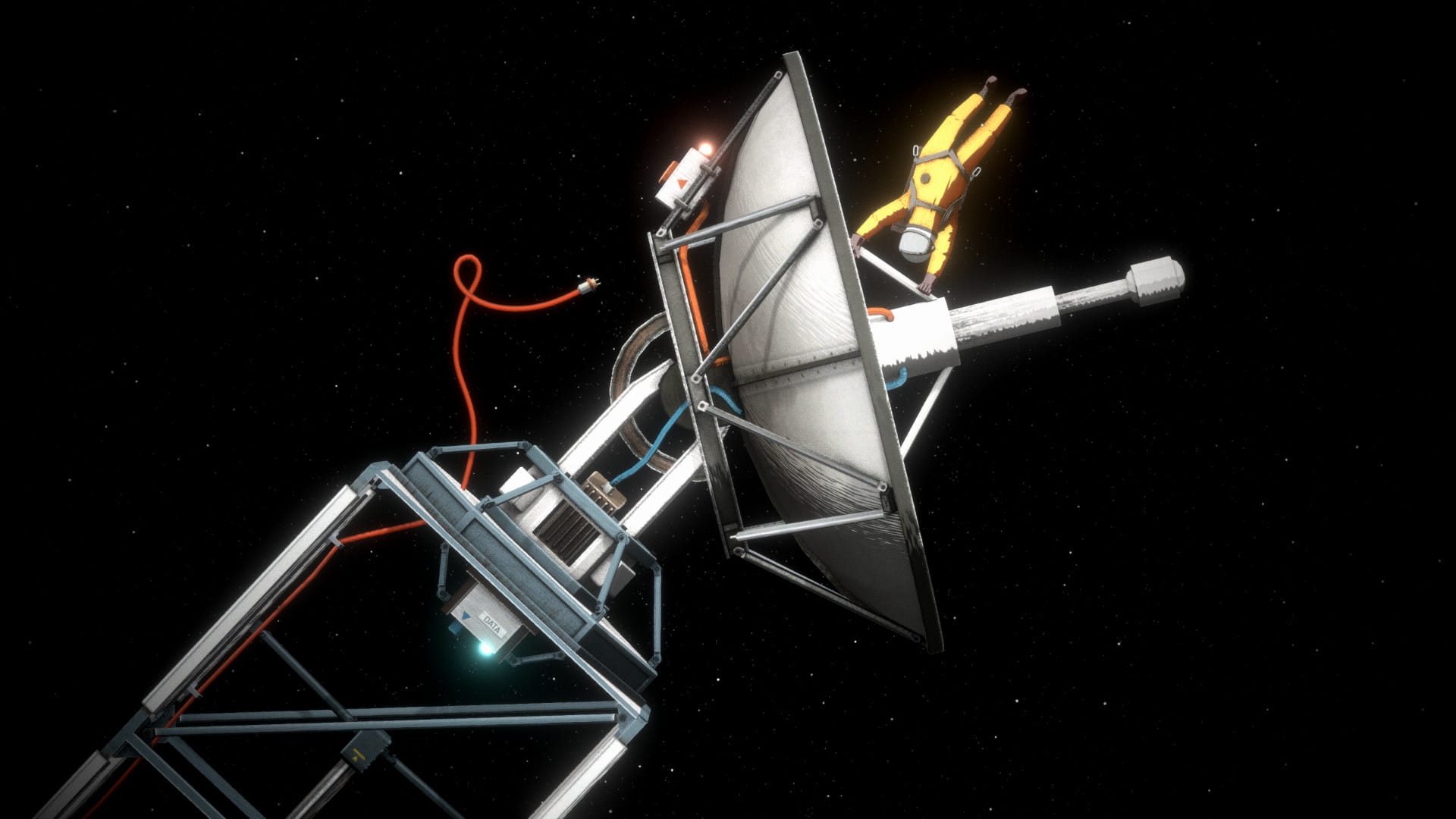




Bottom Line: 2pt Interactive built an entire game around the radical idea that arms are hard to use, and somehow made it one of the most tactile, funny, and quietly beautiful things you can play with a controller. It's short, it's occasionally janky, and it's absolutely worth your evening.
The Gameplay Loop
Here's what a minute of Heavenly Bodies actually looks like. You need to plug a cable into a port four meters away. You reach out with your right hand, grab a rail, pull. Your body swings. Your legs, which you do not control, hit a cabinet. You're now rotating. You flail your left arm out, catch nothing, catch nothing again, then hook something — and now you're stopped, but upside down and facing the wrong way. You reorient. You grab the cable with one hand while anchoring with the other, which means you have exactly zero hands left for stability. You inch the connector toward the port. You miss. You miss again. It seats. There's a soft, satisfying click.
That loop is the game. It sounds tedious written down and it is genuinely thrilling in practice, because the game has correctly identified that the fun was never in the task — it's in the negotiation with your own body. Ordinary games flatten that negotiation into a button press. This one refuses, and in refusing, restores a sense of physical stakes to actions no game has bothered to make interesting since the invention of the interact prompt.
The oxygen tether is the design's sharpest touch. It converts what would otherwise be a relaxed sandbox into a low-grade pressure cooker. You could take your time. You have a finite amount of it. That tension between "be careful" and "be quick" is where the game generates its best moments — and, honestly, its worst frustrations.
Onboarding Friction Is the Point (Until It Isn't)
Let's be clear about the learning curve: it is steep, it is intentional, and it will lose people. The first hour is a comedy of errors where you are not solving puzzles so much as auditioning for basic motor control. Players say this constantly in reviews, and they're right. The controls are unwieldy by design.
Where I'll push back on the game is the difference between difficulty that teaches and difficulty that stalls. Heavenly Bodies mostly delivers the former — there's a real, measurable competence curve, and the moment around hour two when you start moving with intent instead of panic is one of the great quiet payoffs in recent indie games. But the physics simulation that makes that curve possible also produces genuine failures. Objects clip. Items wedge into geometry. A bolt you needed slips through a wall and now you're restarting a checkpoint you'd already earned. That's not the game teaching you anything. That's the game breaking, and the difference between "I was clumsy" and "the sim glitched" is the difference between laughing and quitting.
It doesn't happen constantly. It happens often enough that I'd call it the single legitimate technical knock against an otherwise remarkably polished production.
Co-op, and Why It's the Real Version
Play this alone and it's a thoughtful, meditative puzzler about persistence. Play it with a second person on the couch and it becomes something else entirely — a slapstick physical comedy where two people who both can't operate their arms attempt coordinated engineering. Most reviewers call local co-op the definitive experience, and I agree without reservation. Puzzles that took ten minutes solo take twenty-five in co-op, and every one of those extra fifteen minutes is funnier.
The reason it works is structural, not incidental. Because neither player can reliably stabilize themselves, cooperation requires actual physical trust: one person anchors, the other reaches. That's a genuinely novel co-op verb, and it's the sort of thing you only discover by committing hard to a weird control scheme instead of hedging.
Length and the Value Question
Four to six hours. That's the campaign, and it's the most common complaint after the controls. I'm less bothered than most. This is a game with one extraordinary idea executed with precision, and it exits before that idea calcifies into routine. The mastery layer — challenge objectives, time trials, collectibles — extends things meaningfully for players who want to convert struggle into fluency, and speedrunning a game where movement is this hard-won is a legitimately compelling proposition.
Still: judge it on price. At full retail it's a tight, brilliant, brief experience. On discount it's a straightforward buy.