

Bottom Line: The 1999 game underneath is one of the finest turn-based strategy designs ever shipped, and a quarter-century hasn't dulled it. The HD Edition is a lazier custodian than it deserves — no expansions, no random map generator, and a fan-made alternative that does more for less.
The Gameplay Loop
The reason HoMM3 outlived its contemporaries is that it built two games that constantly interrupt each other, and made the interruptions the point.
On the adventure map, you're running a logistics problem. Movement points are finite and terrain-dependent. Mines produce ore, gold, gems, crystal, sulfur, mercury and wood on a weekly cadence, so seizing a sawmill on day three compounds for the rest of the scenario. Dwellings accumulate creatures whether you're there to collect them or not. Subterranean passages fold the map in on itself, turning a two-week march into a three-day flank if you know the geography and your opponent doesn't. Every turn is a small allocation argument: scout or consolidate, grab the artifact or contest the mine, push the hero forward or send them home to reload troops.
Then you touch an enemy stack and the game becomes something else entirely.
Combat
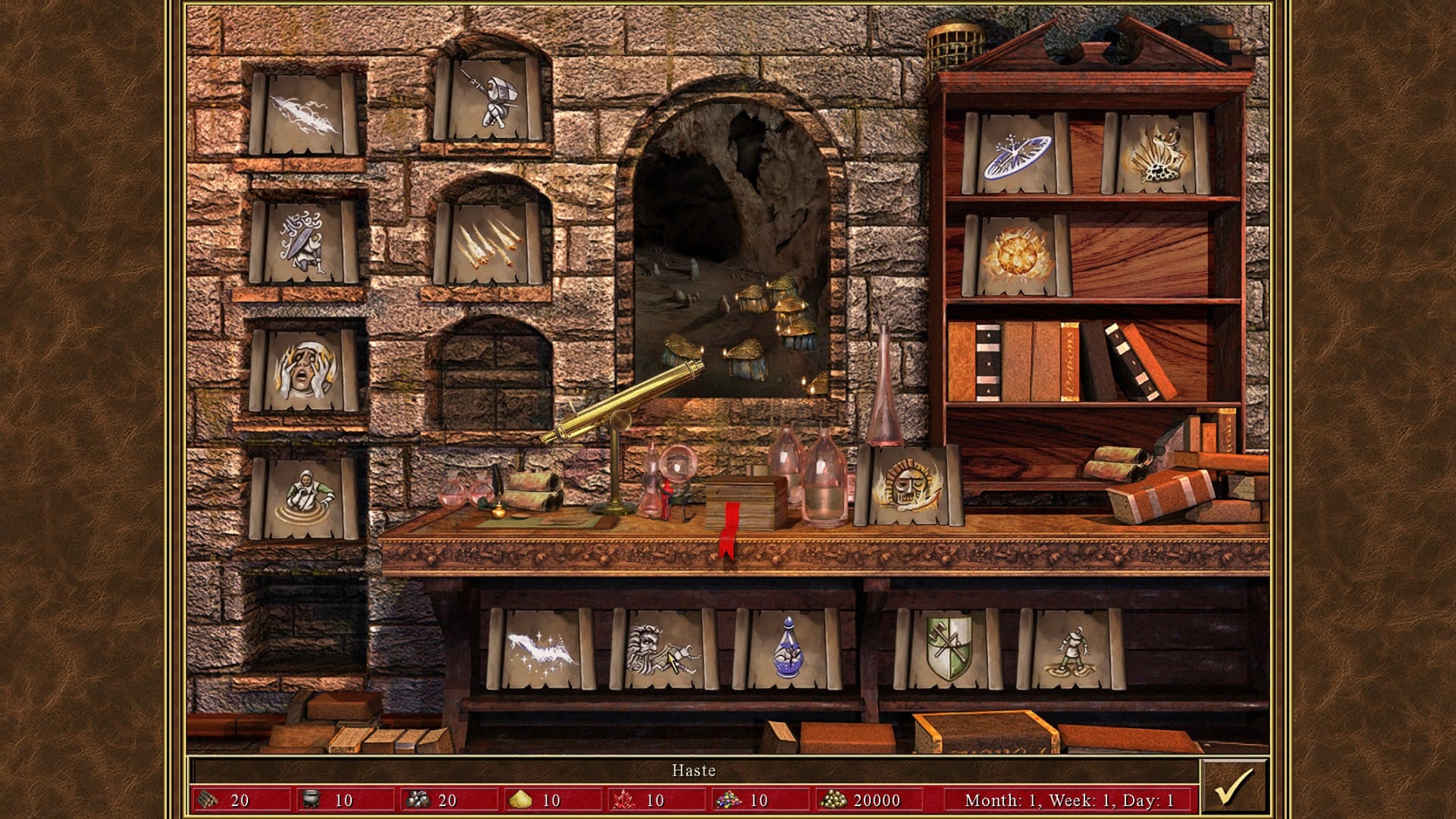
Tactical battles run on a hex grid where the variables are legible and the interactions are not. Stack size, initiative order, terrain obstacles, the ranged penalty for shooting past half the map, morale and luck rolls, and — decisively — whatever your hero can cast. Spellcasting is where the game's skill ceiling actually lives. A well-timed Blind on an archangel stack, Slow on a fast melee wave, or Resurrection on your own losses rewrites a battle that raw army value said you'd lose.
This is also where the design shows its teeth. Combat is not balanced around fairness; it's balanced around information. Knowing that a Behemoth ignores a chunk of defense, that ranged stacks are helpless in melee, that certain spell schools counter entire faction archetypes — that knowledge is the progression system. The game teaches almost none of it explicitly. Onboarding friction is real and unrepentant. New players will lose scenarios for reasons they cannot reconstruct.
Skill Roulette and the Long Campaign
Hero progression is the most divisive system here, and I'd defend it. Level-ups offer a constrained random pick from the secondary skill pool, which means you don't build the hero you planned — you build the hero the game offered you. Draw Logistics and Earth Magic early and your campaign takes a completely different shape than a Necromancy-and-Offense run. Draw Eagle Eye and Scouting in the same session and you've been mugged.
Purists call this bad design. It isn't. It's variance placed at the exact layer where variance produces stories, and it's the main reason 300 hours of HoMM3 doesn't collapse into a single optimal script.
The AI, however, has not aged with the same grace. It plays the economy competently enough on higher difficulties — mostly by getting resource handicaps rather than getting smarter — and plays tactical combat like it's reading the manual for the first time. Against a human, this game is a knife fight. Against the AI, it's a checklist you complete faster each time.
What's Actually Missing
I have to keep coming back to this, because it's the review.
Cutting Armageddon's Blade and Shadow of Death removes two factions, dozens of maps, the campaign editor and the combination-artifact layer. Cutting the random map generator removes the thing that made HoMM3 functionally endless. Fifty hand-made skirmish maps sounds generous until you've played them, at which point the well is dry and the official product has no more to give you.
Meanwhile, the version you're being steered away from — Complete, on GOG — pairs with the free HD Mod for widescreen and quality-of-life fixes, or with VCMI, an open-source engine reimplementation, or with Horn of the Abyss, a fan expansion of genuinely professional quality. All free. All requiring the older, cheaper, larger package. The community consensus in those Steam reviews isn't nostalgia or contrarianism. It's arithmetic.