

Bottom Line: Thunder Lotus's hand-drawn Norse epic is one of the most beautiful indie games ever animated, and one of the thinnest to actually play. Buy it for the five colossal boss fights and the Icelandic voice work; forgive it the forty minutes of walking between them.
The Gameplay Loop
Jotun alternates between two modes, and they are not equal partners. One is a triumph. The other is filler with a gorgeous coat of paint.
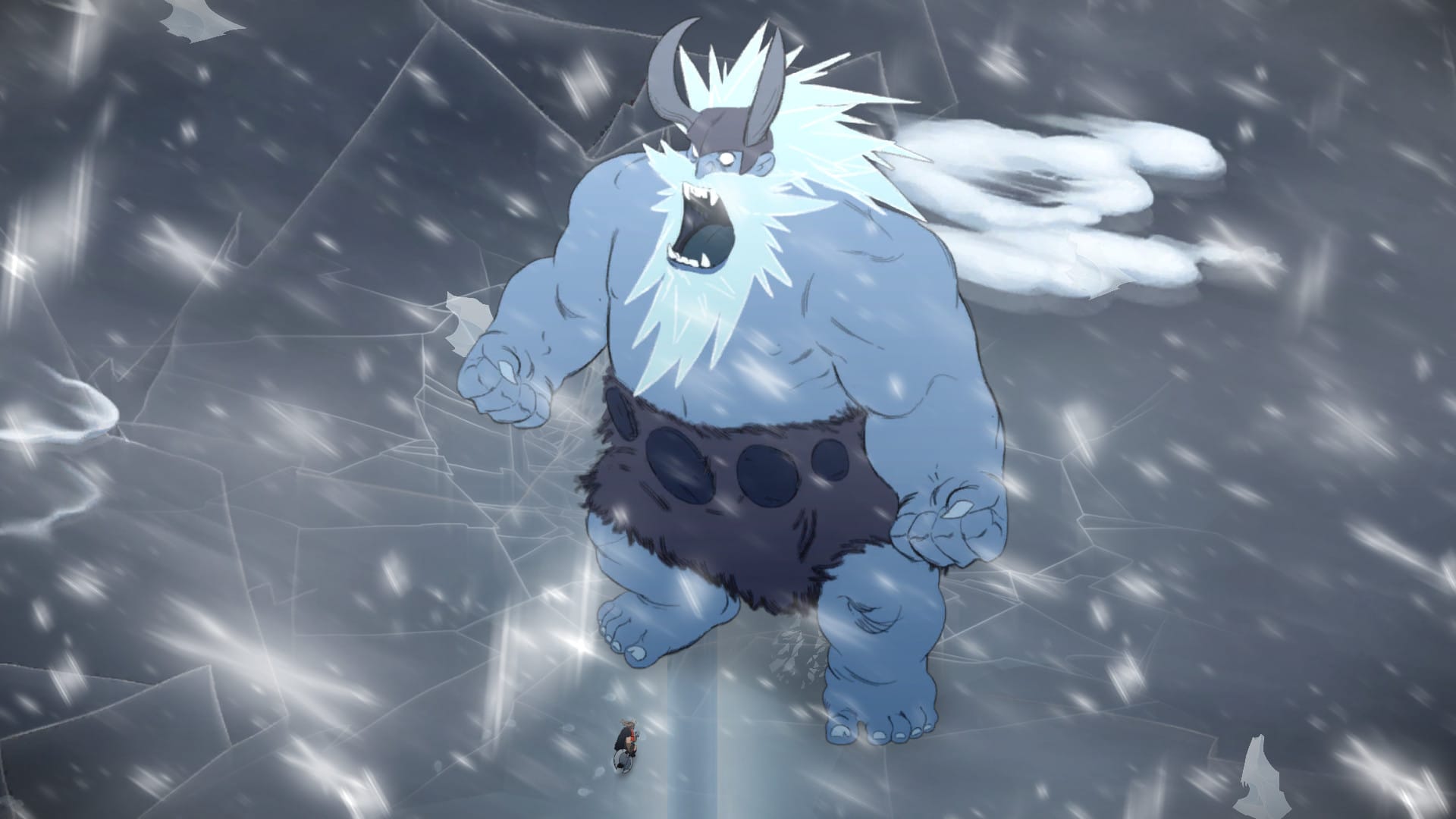
Combat is built around a single weapon: a two-handed axe that Thora swings like it weighs what it looks like it weighs. You get a light swing and a heavy swing, plus a dodge. That's the kit. The heavy attack has a wind-up long enough to read a paragraph in, and committing to it is a genuine decision — if the jotun's arm comes down while you're mid-animation, you eat it, and you deserved to. This is a game about spacing and patience, not execution. In its best moments it plays like a very slow Shadow of the Colossus boss fight rendered in two dimensions, where the entire challenge is learning a giant's tells and finding the two-second window where its wrist is on the ground and vulnerable.
The problem is that a two-button moveset with no combo depth, no parry, no positional damage, and no meaningful progression can only stay interesting for so long. And "so long" turns out to be about five hours. There is no growth curve here — the Thora who kills the final jotun is mechanically identical to the Thora who killed the first one, just with a slightly bigger health bar and a couple more god powers stocked. Compare that to a Hollow Knight or a Dead Cells, where mastery compounds. In Jotun, mastery plateaus in the first hour and then you simply apply it, over and over, more carefully.
Exploration, and the Backtracking Problem
Between bosses, you walk. A lot.
The nine exploration levels are large, largely empty, and structured around rune collection — find two runes per region, the gate opens, fight the giant. On paper this is fine pacing: tension, release, tension, release. In practice, these levels are where the game's design ambitions run out ahead of its budget. There are no enemies worth the name in most of them. There are environmental hazards, some light puzzling, and an enormous amount of holding the stick in a direction. When you miss a rune, the game asks you to retrace ground you have already cleared, with no fast travel worth the name and a movement speed calibrated for atmosphere rather than convenience.
This is the single most consistent complaint in user reviews, and it is entirely legitimate. The exploration is a delivery mechanism for the art, not a system in its own right. I want to be fair here: some of those walks are genuinely affecting. Crossing the roots of Yggdrasil in near-silence, or wandering a burning forest as the narrator describes Thora's father's death, produces something close to awe. But awe is not renewable at the rate this game demands it. By level six, the frame you're admiring is one you've already admired, and you are pressing forward because the boss is the reward, not because the road is.
The Narrative Layer
The story is delivered entirely through narration in authentic Icelandic, subtitled. This was a bold call for a game with no marketing budget, and it pays off enormously. There is no localized-English safety net, no attempt to make the mythology palatable. The result is that Jotun sounds ancient in a way almost no game about Vikings manages. Thora's backstory arrives in fragments — her family, her voyage, her stupid, undignified drowning — and the emotional arc lands because it is understated. Nobody explains the themes to you.
Valhalla Mode
The boss-rush addition is the best value in this package and the clearest signal of what the game should have been. Stripped of the walking, Jotun becomes a tight, brutal, ninety-minute gauntlet where the combat's deliberateness reads as design rather than limitation. Harder jotun, no filler, no rune hunting. If you finish the campaign and feel the game never quite got going, this is where it does.